Homeโ€บArticlesโ€บSMK-37+VA: Baud Girl’s firmware adds a virtual anโ€ฆ
Articles

SMK-37+VA: Baud Girl’s firmware adds a virtual analog engine and a deeper sequencer to the SMK-37

Baud Girl’s SMK-37+VA keeps the keyboard’s FM engine and adds a virtual analog engine, an 8-bit engine and a sequencer with ratchets, chance and song chaining.

Bernardo de Azevedo
Bernardo de Azevedo
ยท Updated
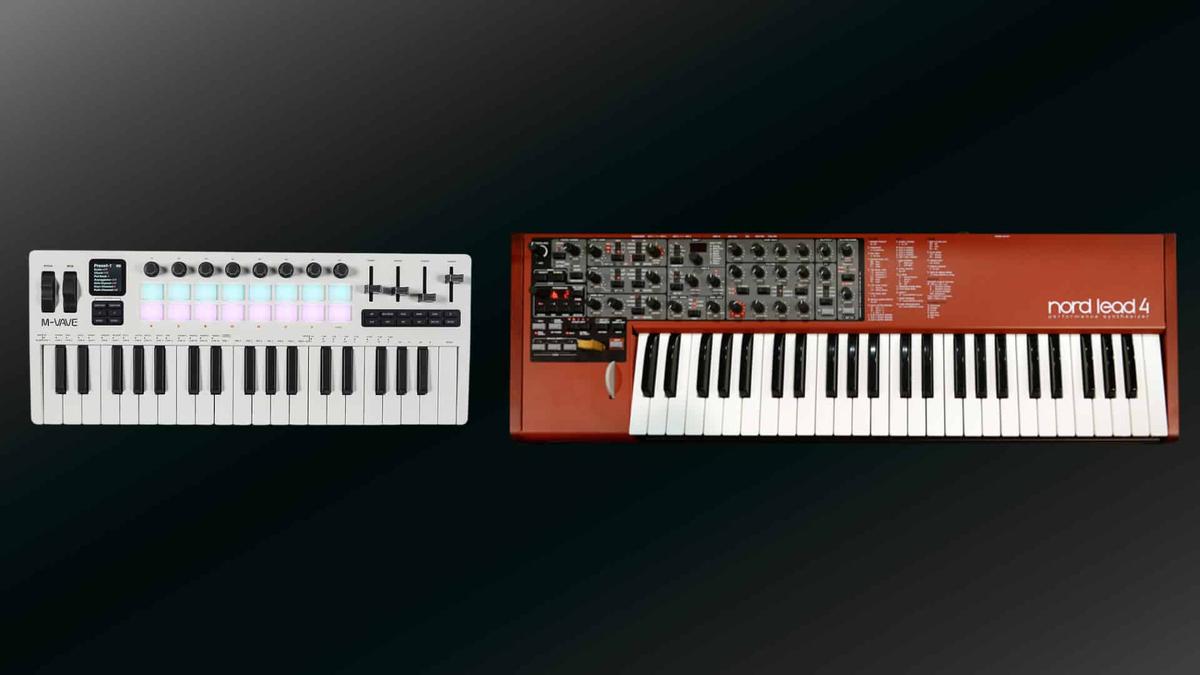
SMK-37+VA firmware: the M-VAVE SMK-37 Pro next to a Nord Lead 4 virtual analog synthesizer

SMK-37+VA is a custom firmware by the developer Baud Girl for the M-VAVE SMK-37 Pro, the SMK-37 Elite and two rebadged versions of the same keyboard. Synth Anatomy covered it on 11 October 2026, making it one of the first alternative firmwares for the keyboard. It is the sibling of FM-1+VA, which Piano & Synth Magazine describes as probably the first custom firmware released for the M-VAVE FM-1.

Unlike most of the SMK-37 scene, SMK-37+VA is not a groovebox or an experiment. It keeps the instrument recognizable as a synth with a keyboard and works on two of its weak points: the interface and the sound engine. Here is what it adds and how to install it.

Why SMK-37+VA matters

https://www.youtube.com/watch?v=22JMcExYwQ0

In stock form, the SMK-37 Pro has a DX7-style FM engine that reviewers found thin and an interface that heise called awkward, especially for choosing patches. The video above shows the keyboard with its factory firmware, the starting point that SMK-37+VA builds on.

Baud Girl’s approach, already tested on the FM-1, is to rethink how the instrument feels to play and to add new sound engines alongside FM. Version 102, dated 19 October 2026, is available for both the FM-1 and the SMK-37.

Supported keyboards

SMK-37+VA supports four versions of the same hardware:

  • M-VAVE SMK-37 Pro
  • M-VAVE SMK-37 Elite
  • Donner Starrykey-37 Play
  • EROK MKE-P37

That makes it one of the few SMK-37 firmwares that names the Donner version as supported. For the relationship between these models, see our article on SMK-37 Elite, Starrykey-37 Play and MKE-P37.

The SMK-37+VA interface

The firmware reorganizes the controls around a few consistent rules:

  • Encoders K5 to K8 work on every screen. Several banks control all four at once, and in the Preset bank you choose what each knob controls.
  • Holding the < button and turning a knob reassigns that knob’s parameter, even during a performance.
  • The > button opens the selected item, and < goes back.
  • K1 selects a parameter and K2 changes it.

The screens are HOME, Oscillator, Algorithm, Sequencer, Arpeggio and GLOBE, which holds global settings and color themes, including a pink SMK-37 theme and an orange one.

The virtual analog engine

The VA engine is the headline of SMK-37+VA. Its oscillators use BLEP anti-aliasing, a common technique to keep classic waveforms clean at high pitches. A Super mode stacks seven detuned oscillators per note for supersaw sounds, and a Drift setting adds per-note tuning instability for a less static, more analog feel.

The filter section offers low-pass at 12 or 24 dB per octave, band-pass and high-pass. The low-pass uses a zero-delay-feedback design. Each note has its own filter envelope, and velocity, key tracking and an LFO can modulate the cutoff of individual notes.

The 8-bit engine

The second new engine is aimed at chiptune. Each 8-bit preset contains drums, sound effects, bass and lead parts, placed on different octaves of the keyboard and reached with the OCTAVE buttons. Twelve drum sounds have adjustable wave, pitch, sweep, decay and snap. There are a dozen built-in effects, such as coin, jump, laser and explosion sounds.

Bass and lead parts can run arpeggios with 31 shapes or a custom one, follow a key and scale, and the lead can be set to follow the bass.

The SMK-37+VA sequencer

The sequencer goes well beyond the stock one. Patterns reach 64 steps, with 16 shown at a time and notes drawn in lanes. You can record step by step or in real time, with up to nine notes per step, and new recordings layer over existing notes.

Each step has ratchet, chance, gate, length and transpose settings and can be tied to the next. Steps can be moved or copied while the pattern plays, patterns can be copied or stretched and squeezed in time, and patterns can be chained into songs with a repeat count for each, with changes landing on the beat.

Installing SMK-37+VA

Baud Girl’s installer runs in Chrome or Edge on macOS, Windows or Linux, or in Chrome on an Android phone or tablet. The process is:

  1. Connect the keyboard by USB and open the Install page.
  2. The installer backs up your presets and patterns, installs the firmware and restores them. Settings reset to SMK-37+VA defaults. The first install takes several minutes.
  3. Optionally, download the free 8-Bit and Virtual Analog preset packs from the Device Manager page.
  4. Read the Quick Start guide.

The preset packs overwrite existing presets: the 8-Bit pack replaces slots 97 to 112 and the VA pack replaces slots 113 to 128. Back up everything before installing them. For general precautions on the keyboard’s flash, read our guide on how to install SMK-37 firmware safely.

Quick answers about SMK-37+VA

Is SMK-37+VA free?

The firmware page offers the two preset packs for free and invites optional tips on Ko-fi to support development.

Does SMK-37+VA remove the FM engine?

No. It keeps FM and adds the virtual analog and 8-bit engines alongside it.

Does it work on the Donner Starrykey-37 Play?

Yes. Baud Girl lists the Starrykey-37 Play and the EROK MKE-P37 as supported, together with the SMK-37 Pro and Elite.

How is SMK-37+VA different from SMK37 OPEN?

SMK-37+VA focuses on playing the keyboard as a synth, with new engines and a deeper sequencer. SMK37 OPEN, M-VAVE’s official firmware, is an eight-track groovebox with six engines and a sampler.

Final perspective

SMK-37+VA is the option for owners who bought the SMK-37 for its keyboard and want it to sound and behave like a better synth rather than become something else. It addresses the stock firmware’s two main criticisms, a thin engine and a clumsy interface, and it adds a sequencer that rivals dedicated grooveboxes. It is also unusually broad in the hardware it supports, which matters for owners of the Donner and EROK versions.

Sources

Bernardo de Azevedo
Written by
Bernardo de AzevedoFounder & Editor

His connection with music began at age 6, in the 1980s, when his father introduced him to Jean-Michel Jarre's Rendez-Vous on vinyl. He works professionally in the legal field, while synthesizers became his space for abstraction and creative exploration. Founder of The Synth Source.