Home›Articles›M-VAVE SMK-37 vs FM-1: same chip, different instruments
Articles

M-VAVE SMK-37 vs FM-1: same chip, different instruments

The M-VAVE SMK-37 and FM-1 share a chip, a DX7-style engine and a community of firmware developers. One is a keyboard, the other a pocket desktop synth. Here is how they compare.

Bernardo de Azevedo
Bernardo de Azevedo
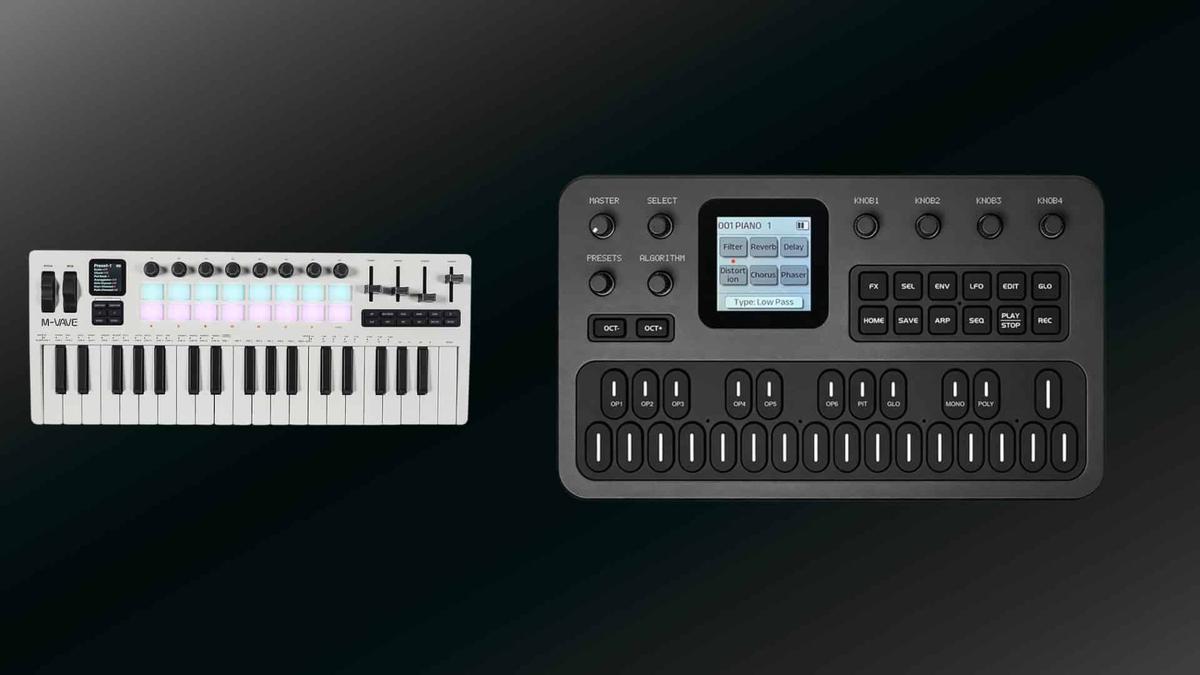
SMK-37 vs FM-1: the M-VAVE SMK-37 Pro next to the M-VAVE FM-1

The SMK-37 vs FM-1 question has become common since October 2026, when the community firmware written for M-VAVE’s pocket synth began to run on its keyboard. The two products come from the same company and use the same JieLi AC791N chip, the same DX7-style sound engine architecture and, increasingly, the same alternative firmware. Yet they are built for different ways of playing.

The M-VAVE FM-1 is a small battery-powered desktop synth with a speaker, released in mid-June 2026. The M-VAVE SMK-37 Pro is a 37-key MIDI controller with pads, faders and a built-in synth, released a year earlier. This comparison looks at hardware, sound, firmware and price to help you choose.

SMK-37 vs FM-1 at a glance

The video above shows FM-1 firmware running on the SMK-37, the moment the two platforms began to overlap. The main SMK-37 vs FM-1 differences are clearer side by side:

M-VAVE SMK-37 ProM-VAVE FM-1
Format37-key MIDI keyboard with built-in synthDesktop pocket synth
ReleasedJune 2025June 2026
Playing surface37 velocity-sensitive mini keys, pitch and mod wheels27 silicone keys with menu shortcuts
Other controls16 RGB pads, 8 encoders, 4 faders8 knobs, 14 menu buttons
Screen1.54-inch displayColor TFT showing the algorithm
FM engine (stock)12 voices, 6 operators, 32 algorithms12 voices at launch; 20 voices and 8 parts with firmware V16
Stock effectsFilter, distortion, delay, reverbFilter, reverb, delay, distortion, chorus, phaser
Stock sequencerUp to 64 steps, 8 patterns16 steps at launch; 64 steps with an 8×8 arrangement grid in V16
MIDI inUSB and Bluetooth onlyUSB, Bluetooth and 3.5 mm TRS, all at once
MIDI outUSB, Bluetooth and 3.5 mm TRSNot specified by Synth Anatomy
SpeakerNoYes, mutes with headphones
Battery2000 mAh2000 mAh, about 12 hours
Typical priceAbout 70 to 135 US dollarsAbout 60 to 100 US dollars

For the full FM-1 spec sheet, see our article on M-VAVE FM-1 specs and key features.

One platform, two bodies

When the FM-1 launched, Synth Anatomy noted that M-VAVE had taken the SMK-37 Pro’s sound engine and put it into a desktop unit. The developer genkigenki later confirmed the deeper link: both devices use the same chip, second-stage bootloader, update loader and chip key, and only the panel wiring differs. We explored the FM-1 side of that story in Inside the M-VAVE FM-1.

That shared base is why firmware moves between them. Porting means replacing the board layer that reads the controls and drives the screen and LEDs, a job documented in genkigenki’s fm1-to-smk37 port kit.

Sound engine: SMK-37 vs FM-1

In stock form, the two engines start from the same design: six operators, 32 algorithms and DX7 patch compatibility. The FM-1 adds two effects the keyboard lacks, chorus and phaser.

The bigger difference is firmware support. M-VAVE’s official V16 update for the FM-1 turned it into an eight-part multitimbral synth with 20 voices shared across parts, a 64-step sequencer with ratcheting and an 8×8 arrangement grid, stereo effects and DX7 bank export. The SMK-37’s stock firmware, V016, has not received a comparable update. Synth Anatomy was unimpressed by the SMK-37 engine, finding it lacking in volume and quality compared with other DX7-style hardware, and in our comparison of FM-1 alternatives we noted its reports that the keyboard’s engine is noisier and harder to edit than the FM-1’s.

Controls and playing

In the SMK-37 vs FM-1 comparison, this is where the SMK-37 wins clearly. Real velocity-sensitive keys, pitch and mod wheels and a sustain input make it playable as a keyboard instrument, and 16 RGB pads with aftertouch and four faders give grooveboxes a natural layout. Firmware such as the sampled piano Erik37, which uses half-pedaling and velocity layers, only makes sense on the keyboard.

The FM-1 is designed for portability and menu diving. Its 27 silicone keys double as shortcuts, and its color screen shows the algorithm structure. It is easier to carry and better suited to editing FM patches on the device, but it is less comfortable to play melodies on than a keyboard.

Connectivity and portability

On connectivity, the SMK-37 vs FM-1 split is clear. The FM-1 has a wired MIDI input on a 3.5 mm TRS jack, so it can be played from a hardware sequencer or a controller, and it can use USB, Bluetooth and TRS MIDI at the same time. The SMK-37 has the opposite arrangement: its TRS jack is MIDI out only, so it can drive other gear but cannot receive wired MIDI.

Both run on 2000 mAh batteries. The FM-1 adds a speaker and is rated at about 12 hours of play, which makes it a true pocket instrument. The SMK-37 needs headphones or an amplifier, but it doubles as a USB audio interface and a MIDI controller for a computer.

Custom firmware: SMK-37 vs FM-1

The FM-1 has the larger ecosystem. By 17 October 2026, FW Radar was tracking 63 FM-1 projects, and the scene has continued to grow, with grooveboxes, emulators, samplers and, in November, Xfer Records’ wavetable firmware Shrub. M-VAVE released FM1 Open, its official open-source firmware, on 20 October 2026.

The SMK-37 is catching up through ports and its own official release, SMK37 OPEN. genkigenki’s installer lists more than 20 SMK-37 builds, including ports of SLOOP, X0X, Melodee and ORBIT, plus originals written for the keyboard. The full list is in our guide to SMK-37 custom firmware.

Two practical notes apply. Projects do not transfer between the devices: Skiff’s author says projects saved on an SMK-37 do not load on an FM-1 and vice versa. And on the FM-1, Piano & Synth Magazine reported in November 2026 that newer units use a slightly different chip that can break some custom firmware, so FM-1 owners should check each firmware’s compatibility notes.

Price and value

Price rarely decides SMK-37 vs FM-1 on its own. Both are cheap by synthesizer standards, and prices move with coupons. The FM-1 sold for around 74 euros on AliExpress after launch, and Synth Anatomy has described it as a 60-euro synth. The SMK-37 Pro has ranged from about 70 euros, according to heise, to about 135 US dollars, according to Synthtopia. Donner’s version of the keyboard, the Starrykey-37 Play, costs more but includes software.

SMK-37 vs FM-1: which one should you buy?

  • Choose the FM-1 if you want a pocket synth with a speaker, the largest firmware scene, official multitimbral firmware and wired MIDI input.
  • Choose the SMK-37 if you want to play keys, use pads and faders for grooveboxes, control a DAW and still have a synth with you.
  • Choose both if you want a keyboard and a desktop module on the same platform; the SMK-37’s TRS MIDI output and the FM-1’s TRS MIDI input make a direct cable connection possible, as long as both use the same TRS wiring standard.

Quick answers about SMK-37 vs FM-1

Do the SMK-37 and the FM-1 sound the same?

They share an engine design, but their firmware differs. The FM-1’s official V16 update adds multitimbrality and more voices, while the SMK-37’s stock engine has been criticized as thin.

Can I install FM-1 firmware on the SMK-37?

Only builds ported to the keyboard. genkigenki warns against using FM-1 factory files on an SMK-37.

Which is better for beginners?

The SMK-37, because it also works as a MIDI controller for a computer and has a familiar keyboard. The FM-1 is better as a portable instrument for players who already know FM or want to explore firmware.

Which has more custom firmware?

The FM-1, by a wide margin, although most popular FM-1 grooveboxes now have SMK-37 ports.

Final perspective

The SMK-37 vs FM-1 choice is less about sound than about form. Both run the same chip and increasingly the same software, and both have official open firmware from M-VAVE. The FM-1 is the pocket synth with the bigger community; the SMK-37 is the keyboard that turns that community’s work into something you can play with two hands. For many owners, the most interesting answer may be to treat them as two bodies for the same growing library of firmware.

Sources

Bernardo de Azevedo
Written by
Bernardo de AzevedoFounder & Editor

His connection with music began at age 6, in the 1980s, when his father introduced him to Jean-Michel Jarre's Rendez-Vous on vinyl. He works professionally in the legal field, while synthesizers became his space for abstraction and creative exploration. Founder of The Synth Source.