

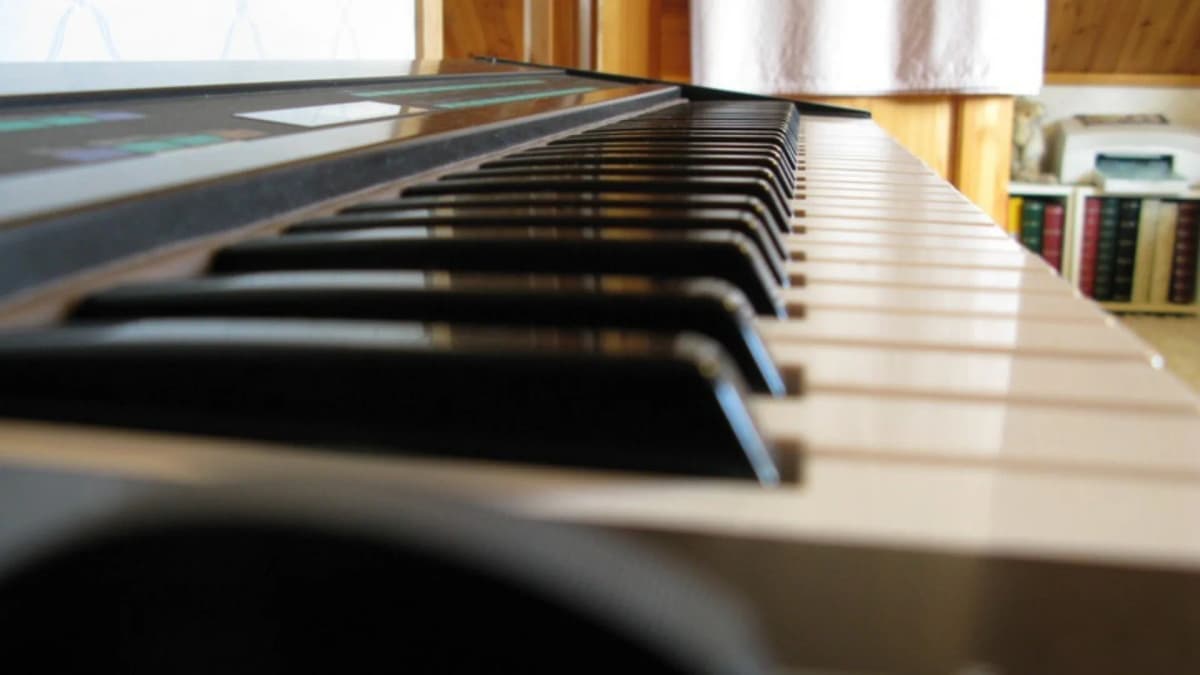
The M-VAVE FM-1 specs describe a pocket desktop FM synthesizer with a six-operator, 32-algorithm engine compatible with Yamaha DX7 patches, 128 patch slots, 27 silicone keys, a colour screen, six built-in effects, an arpeggiator and step sequencer, a 2,000 mAh battery, a built-in speaker, and MIDI over USB-C, Bluetooth and 3.5 mm TRS. Launched in June 2026 with 12-voice polyphony, it became an eight-part multitimbral synth with 20 shared voices through official firmware v16 in October 2026.
Table of Contents
FM-1 specs and key features
- DX7-style FM engine: six sine-wave operators, 32 classic algorithms, operator feedback, four-rate/four-level envelopes, keyboard scaling and an LFO.
- DX7 patch compatibility: imports single voices and 32-voice SysEx banks; v16 can export banks back as DX7 .syx files.
- Visual editing: the screen draws the current algorithm, and EDIT lights up labelled keys for direct access to each operator.
- Multitimbral (v16): eight parts with their own preset, MIDI channel, level, pan, bend range, glide and fine tune.
- Effects: filter, chorus, phaser, distortion, delay and reverb in a reorderable chain; v16 stores them in a 128-entry FX library.
- Arpeggiator and sequencer: seven arpeggio modes; a sequencer of 16 steps at launch and 64 steps with an eight-track arrangement grid and ratchets in v16.
- Portable: built-in battery and speaker that mutes when headphones are connected.
- Computer- and phone-friendly: class-compliant USB MIDI and USB audio, plus Bluetooth MIDI.
- Open platform: an official open-source branch (FM1 Open) with an SDK, and dozens of community firmwares.
M-VAVE FM-1 specs: technical specifications
| Specification | M-VAVE FM-1 |
|---|---|
| Manufacturer | M-VAVE (also known as Cuvave), Zhuhai, China |
| Announced / released | June 2026 |
| Type | Portable desktop FM synthesizer with keys |
| Synthesis | FM, 6 operators, 32 algorithms |
| Polyphony | Up to 12 voices (launch firmware); 20 voices shared across 8 parts (firmware v16) |
| Multitimbrality | None at launch; 8 parts with v16 |
| Voice modes | Poly, mono; glide (V15 and later) |
| Presets | 128 slots, four banks of 32 (A–D) |
| Patch format | Yamaha DX7 SysEx (single voice and 32-voice bank) |
| Effects | Filter (LP/HP/BP), chorus, phaser, distortion, delay, reverb (room/hall/plate) |
| Arpeggiator | 7 modes: up, down, inclusive, exclusive, bidirectional, random, order |
| Sequencer | 16 steps, 16 patterns (launch); up to 64 steps, 8 × 8 arrangement, ratchets (v16) |
| Keyboard | 27 silicone keys, standard piano layout |
| Controls | Encoders for presets, algorithm, select and four parameters, plus master volume; 14 function buttons |
| Display | Colour TFT, 240 × 240 pixels |
| Audio output | 3.5 mm stereo (headphones/line); built-in speaker |
| USB | USB-C: power, charging, MIDI and audio (class compliant) |
| MIDI | USB MIDI, Bluetooth LE MIDI, 3.5 mm TRS MIDI in (Type A); usable simultaneously |
| Battery | 2,000 mAh rechargeable, about 12 hours |
| Processor | JieLi AC791N (dual-core pi32v2), per community reverse engineering |
| In the box | FM-1, USB-C cable, user manual |
| Not included | Power adapter, TRS-to-DIN MIDI adapter |
| Typical price | About $60–80 on AliExpress; around $80 on Amazon US and €100 on Amazon Germany (2026) |
How the FM-1 specs changed with firmware
| Area | Launch (V09–V14) | V15 (July 2026) | V16 (October 2026) |
|---|---|---|---|
| Polyphony | 12 voices | 12 voices | 20 voices, shared by 8 parts |
| Sequencer | 16 steps | Longer notes, step length, voice binding | 64 steps, arrangement grid, ratchets |
| MIDI | Notes, bend, mod wheel, FX CCs | Velocity, CC guide | CC 7, CC 11, FX on CC 70–93, external arp input |
| Editing | Basic | Init voice, rename, copy, 1–100 ranges, glide | Preset import/export, bank export, colour themes |
| Effects | Stored per sound, mono | Finer ranges | 128-group FX library, shared stereo chain |
What the FM-1 specs don’t tell you
Numbers aside, reviewers point out that the knobs feel cheap, the effects are basic in quality, and the sound, while solid, is not as refined as an original DX7. The 3.5 mm output carried a mono signal at launch. These points matter more than any spec at this price; we weigh them in Is the M-VAVE FM-1 any good?
Under the hood, the FM-1 runs an engine derived from msfa, the code behind the Dexed plugin, on an inexpensive Bluetooth-audio microcontroller. That design explains both its low price and why so many developers could write new firmware for it. Read Inside the M-VAVE FM-1 for the hardware story.
FAQ
How many voices does the FM-1 have?
Twelve on the launch and V15 firmware; 20 voices shared across eight parts on firmware v16.
Can the FM-1 load DX7 sounds?
Yes. It imports standard DX7 SysEx banks over USB. See how to load DX7 banks.
Does it have MIDI out?
Yes, over USB and Bluetooth. The 3.5 mm TRS port is an input.