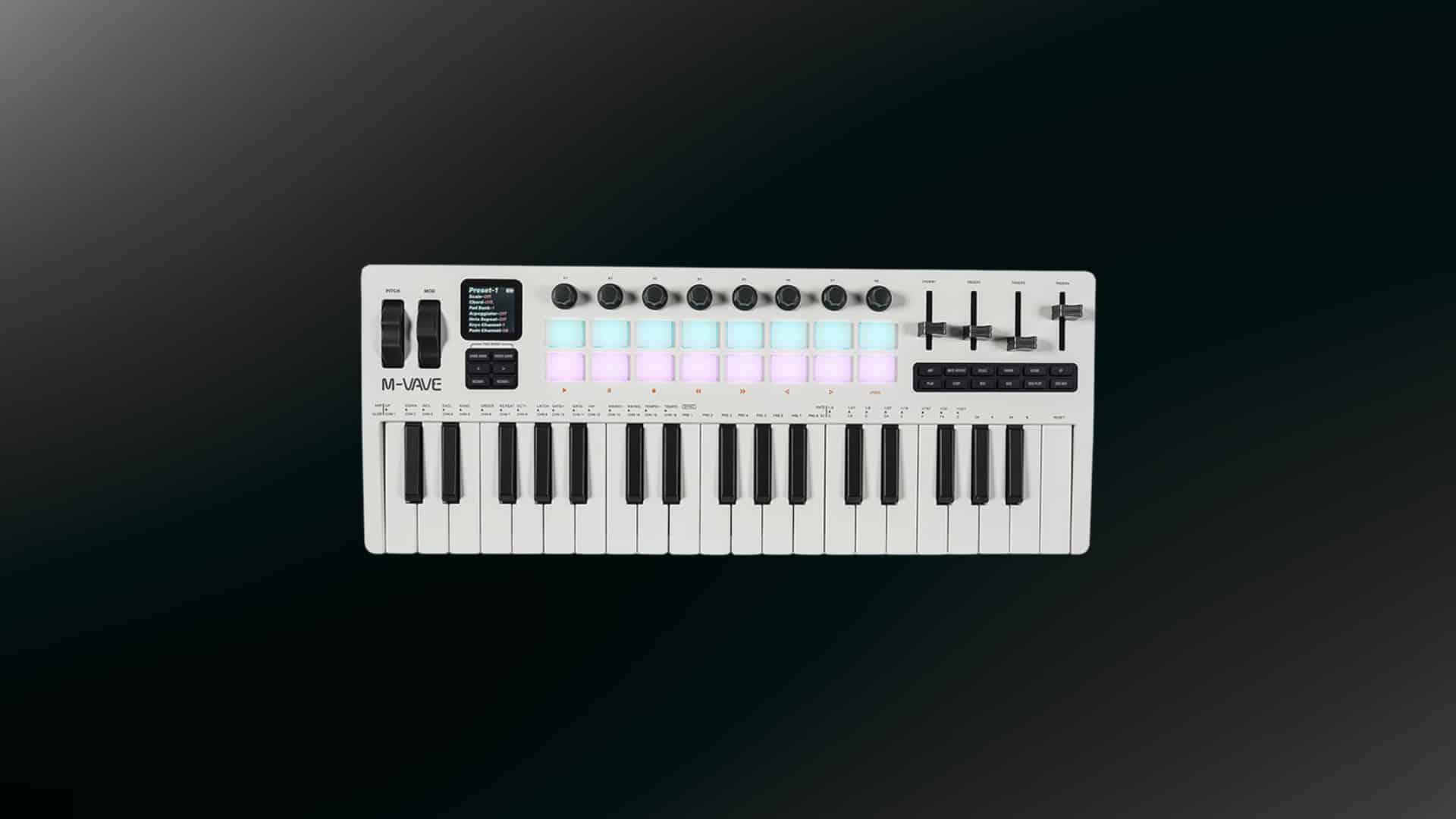
M-VAVE SMK-37 Pro: the cheap MIDI keyboard with a DX7-style synth that became a firmware platform
A 37-key controller with a 12-voice FM engine, pads, a sequencer and a battery, the M-VAVE SMK-37 Pro was a curiosity in 2025 and a hacking platform by late 2026.
The M-VAVE SMK-37 Pro is a compact 37-key MIDI keyboard with something most controllers at its price do not have: a built-in DX7-style FM synthesizer. M-VAVE released it in June 2025, first in China and later through Amazon, and Synth Anatomy found it on AliExpress for around 100 euros, depending on coupons. For a year it was mostly a curiosity, a controller that could also make sound on its own.
That changed in October 2026. The same chip that powers the M-VAVE FM-1 sits inside the M-VAVE SMK-37 Pro, so the community firmware written for the desktop synth started moving to the keyboard. This article covers what the instrument is, how it sounds, where it falls short and why it became the second hackable M-VAVE platform.
The M-VAVE SMK-37 Pro combines a controller, a synth and a sequencer in one battery-powered unit. The main specifications, as reported by Synth Anatomy, heise and M-VAVE’s own open-source repository, are:
Feature
M-VAVE SMK-37 Pro
Keys
37 velocity-sensitive mini keys, pitch and mod wheels
Pads
16 RGB pads with velocity and aftertouch
Controls
8 endless encoders, 4 faders, with banks that double them
Synth engine
DX7-style FM, six operators, 32 algorithms, 12 voices
Presets
128 patches in four banks of 32, DX7 SysEx import
Sequencer
Up to 64 steps, 8 patterns, key, live and drum modes
Arpeggiator
Up, down, inclusive, exclusive, random and order, plus note repeat
Effects
Low-pass filter, distortion, delay and reverb
Connectivity
USB-C (MIDI and audio), Bluetooth MIDI, 3.5 mm TRS MIDI out, sustain jack, headphone out
Power
Built-in 2000 mAh battery
Chip
JieLi AC791N with 1 MiB of flash
The screen is a small 1.54-inch display that shows parameters, the note being played and the chord when several keys are held. heise also notes that the keyboard works as a 24-bit, 44.1 kHz mono audio interface over USB-C, although Windows sees it as a microphone and a DAW needs the free ASIO4ALL driver to use it.
The FM engine inside the M-VAVE SMK-37 Pro
The sound engine follows the Yamaha DX7 model: six operators, 32 algorithms and compatibility with standard DX7 patch files. You can send voices to it as MIDI SysEx, including from websites that host FM patch libraries. On the panel, you can change the algorithm, feedback, mono or poly mode, volume, cutoff and the three effects, either directly or over USB-MIDI.
The engine is the instrument’s weak point in stock form. Synth Anatomy tested it in 2025 and later wrote that, next to other DX7-style hardware and even cheap iPad FM apps, it lacks volume and quality. heise called the effects very basic and pointed out that the encoders would be ideal for editing six-operator patches, but the stock firmware does not give full or intuitive control over them.
Patch selection is another complaint. In the heise test, choosing a sound meant holding a button while turning a knob, and the reviewer measured a noticeable delay in synth mode that, in his view, made it unsuitable for professional use until a firmware fix arrived.
Controller first, synth second
Out of the box, the M-VAVE SMK-37 Pro is best understood as a feature-rich controller. The sequencer stores eight patterns of up to 64 steps, with swing, gate and tempo controls, and the arpeggiator includes a latch function, according to a reader reply in the Synth Anatomy review. Built-in scales and chords help players who do not want to think about theory.
M-VAVE supports the keyboard with three utilities: Sinco Connector for Windows, a MIDI Suite for macOS and Windows to adjust default settings, and M-UPGRADE for firmware updates. Two early updates fixed pops and clicks after patch changes, heise reported. The final stock version, V016, is dated 12 August 2026 in M-VAVE’s repository.
The wired connections have one gap: there is no MIDI input on the TRS jack, which is output only. External gear can reach the synth over USB or Bluetooth, but not through a cable from a hardware sequencer.
How the M-VAVE SMK-37 Pro became a firmware platform
The reason the M-VAVE SMK-37 Pro matters in 2026 is not its stock firmware. In September 2026, independent developers began writing alternative operating systems for the FM-1, and by mid-October dozens of projects existed. The developer genkigenki then showed that the SMK-37 uses the same JieLi AC791N chip, second-stage bootloader and update loader as the FM-1. Only the panel wiring differs.
That discovery opened the keyboard to the same ecosystem. In October 2026, the following arrived in quick succession:
11 October: Baud Girl released SMK-37+VA, a firmware with a virtual analog engine and a new sequencer.
12 October: genkigenki published ports of SLOOP, X0X and FoMni, plus Makkuro37, a drone synth written for the keyboard.
20 October: Skiff 1.4 added SMK-37 Pro support to its six-track groovebox firmware.
26 October: M-VAVE published SMK37 OPEN V01, its own open-source firmware and browser workbench for the Pro and the Elite.
Today, genkigenki’s catalogue lists more than 20 firmwares for the keyboard, from grooveboxes and trackers to a sampled grand piano. You can read the full list in our guide to SMK-37 custom firmware.
Who the M-VAVE SMK-37 Pro is for
The keyboard suits three kinds of players. Beginners get a controller, a synth, a sequencer and a battery for less than many controllers without sound. Travelling producers get a single unit that runs over Bluetooth for hours; Synth Anatomy reported more than four hours of Bluetooth use without extra power. Tinkerers get a cheap, recoverable platform to try community firmware, with keys and pads the FM-1 does not have.
It suits professionals less. The mini keys are springy, the faders feel plasticky to some owners, and the stock synth is modest. Anyone who wants a serious FM instrument with real-time editing will be better served by a dedicated synth.
Quick answers about the M-VAVE SMK-37 Pro
How much does the M-VAVE SMK-37 Pro cost?
Prices vary with sellers and coupons. Synth Anatomy saw it for around 100 euros at launch and paid under 80 euros; heise quoted a street price of about 70 euros; and Synthtopia listed it at about 135 US dollars in October 2026.
Can the M-VAVE SMK-37 Pro load DX7 patches?
Yes. It accepts standard DX7 voices as MIDI SysEx, and M-VAVE’s SMK37 OPEN firmware adds a library that imports and exports single voices and 32-voice banks.
Does it have a MIDI input?
Not on a cable. The 3.5 mm TRS jack is MIDI out only. MIDI input comes over USB or Bluetooth.
Is the Elite version different?
The SMK-37 Elite shares the same controls and is supported by the same open-source firmware, but its firmware files are model-specific. We cover the differences in our article on SMK-37 Elite, Starrykey-37 Play and MKE-P37.
Final perspective
The M-VAVE SMK-37 Pro launched as a value proposition: a controller that did more than its price suggested, held back by a thin FM engine and awkward menus. Its second life began when developers realized it shares a chip with the FM-1. With M-VAVE now publishing its own open firmware for the keyboard, the instrument has become what the FM-1 already was, a cheap piece of hardware whose character depends on the software you choose to install.
His connection with music began at age 6, in the 1980s, when his father introduced him to Jean-Michel Jarre's Rendez-Vous on vinyl. He works professionally in the legal field, while synthesizers became his space for abstraction and creative exploration. Founder of The Synth Source.