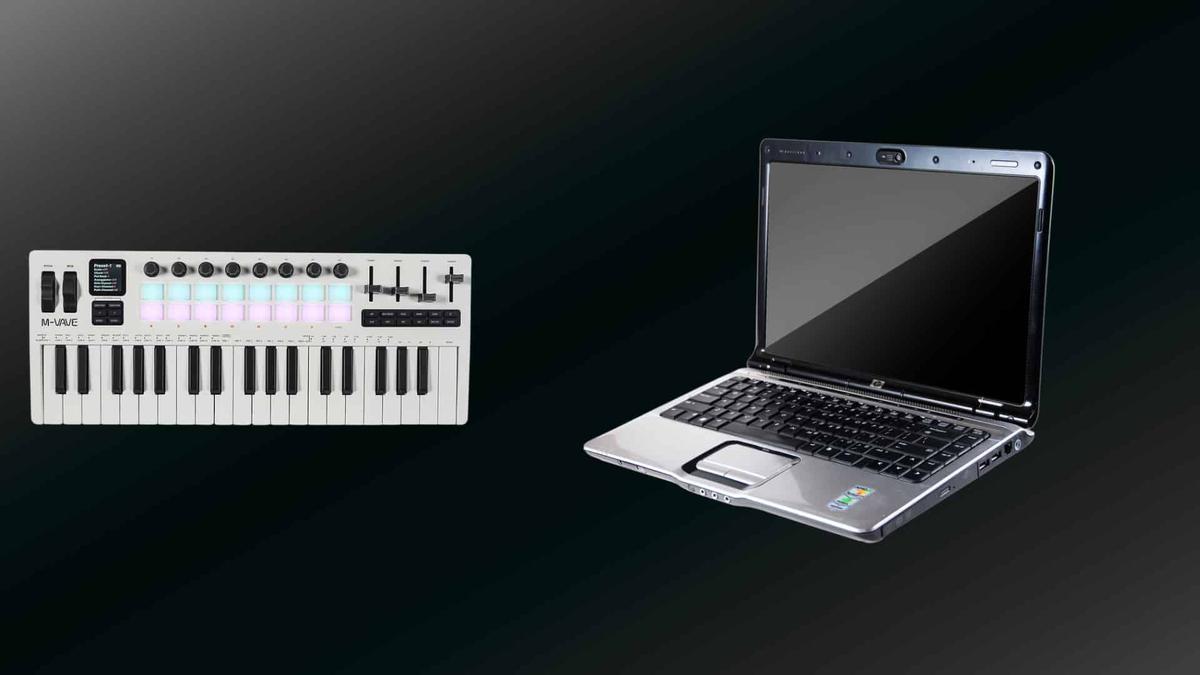
fm1-to-smk37: the port kit that moves M-VAVE FM-1 firmware to the SMK-37 keyboard
The FM-1 and the SMK-37 share a chip, so porting firmware means swapping the board layer. genkigenki’s fm1-to-smk37 kit turns that job into a guided session with a coding agent.
fm1-to-smk37 is the port kit behind most of the M-VAVE SMK-37 firmware scene. Written by the developer genkigenki, it explains how to move an open firmware from the M-VAVE FM-1 desktop synth to the SMK-37 keyboard, and it is designed to be followed with a coding agent such as Claude Code. It also lets developers maintain one source that builds for both devices.
The kit matters beyond its own repository. It explains why the SMK-37 could inherit dozens of FM-1 firmwares in weeks, and it shows how AI-assisted development is changing hardware hacking in 2026. Here is how fm1-to-smk37 works.
The FM-1 and the SMK-37 use the same JieLi AC791N chip, also known as WL82, with the same second-stage bootloader, update loader and chip key. According to the fm1-to-smk37 README, only the panel wiring differs. As we explained in Inside the M-VAVE FM-1, the FM-1 is built around a chip designed for Bluetooth audio products, and M-VAVE used the same platform in its keyboard.
Porting therefore does not touch the sound engine. It replaces the board layer, the code that deals with the physical instrument: the keyboard matrix, the analog inputs for faders and wheels, the display pins, the pad LEDs and the flash map. The SMK-37 side has 37 keys, 16 RGB pads, eight encoders, four faders, pitch and mod wheels, a color screen and 1 MiB of flash.
How a port with fm1-to-smk37 works
The README describes a five-step session:
Start Claude Code in an empty folder and paste the kit’s prompt. The agent clones the firmware and the kit, and you approve each command.
Answer setup questions about how the pads, faders, outer keys, wheels and knobs should behave. The answers go into a file called smk37-port.yaml.
The agent works through a checklist in AGENTS.md: a baseline build, the board layer, storage, controls, both builds and tests, pausing after each area.
You do the hardware part: back up the keyboard, install the build, test it and report results or serial output back to the agent.
Release your build, submit a pull request to the original firmware, or both.
The README names Claude Code as the main tool but says any coding agent that can read AGENTS.md and run a shell will work. The human stays responsible for the steps that can damage hardware.
The board layer and the reference port
The reference implementation is Snoop37, genkigenki’s port of SLOOP. Its smk37-board branch holds only the board port, as a series of patches on top of SLOOP covering the board switch, flash map, update path, input layer, display, pad LEDs, wheels and interface mapping.
Firmware based on Felucca, the multi-engine FM-1 firmware by Leo Kuroshita, uses a single commit instead: the smk37 branch of genkigenki’s Felucca fork, also submitted upstream as pull request 237 to hugelton/Felucca. Because the FM-1 build stays byte-identical, the SMK-37 target can live in the original project rather than in a separate fork.
How much work a port takes
fm1-to-smk37 gives rough estimates:
SLOOP forks: low effort, about one evening with a working build setup.
Felucca forks: medium effort, about a day if the fork has its own storage layout.
Other firmware without the Felucca hardware layer: high effort.
genkigenki added a caveat in reply to Synthtopia readers: AI can help produce a synth firmware quickly, but testing it and making it feel right is the hard part.
Protected areas of the flash
The kit lists flash ranges that a port must never write:
Range
Content
0x00000–0x03FFF
Flash header, bootloader and boot configuration
0xC0000–0xC0FFF
Bluetooth pairing data
0xC1000–0xC1FFF
Factory key, pad and wheel calibration
0xF4000–0xFDFFF
Stock resources
0xFF000–0xFFFFF
Chip key and MAC data
Before installing anything, the README asks for a full flash backup: read all 1 MiB twice and compare the two dumps. The calibration and pairing data are unique to each keyboard. Our guide on how to install SMK-37 firmware safely explains why.
What fm1-to-smk37 has produced
The kit lists these ports: Makkuro37 (a new firmware), Snoop37 (the reference port of SLOOP), X0X37 (from Charles Vestal’s fm1-x0x), FoMni37 (from fm1-fomni), RAINBOW37 (from felucca-rainbow) and Felucca itself as a build target. genkigenki’s installer page has since grown to more than 20 SMK-37 firmwares, many built with the same method. See our list of SMK-37 custom firmware.
License and disclaimer
The text and tables of fm1-to-smk37 are published under CC BY-NC 4.0. The firmware code and patches are not in the repository; they live in their own projects under GPL-3.0. The kit is not affiliated with M-VAVE or JieLi, and it asks users to proceed at their own risk.
Quick answers about fm1-to-smk37
Do I need to know C to use fm1-to-smk37?
The kit is designed to be followed with a coding agent, which writes most of the code. You still need a working build setup, the ability to approve commands and the patience to test on real hardware.
Can I port Groove OS or other closed firmware?
The kit works with open firmware whose source you can build. Closed projects cannot be ported this way.
Does a port change the FM-1 version of the firmware?
No. The README says the FM-1 build stays byte-identical, which is why ports can be merged upstream.
Does fm1-to-smk37 support the SMK-37 Elite?
The installer page lets you pick the Pro, the Elite or the MKE-P37 when flashing, but many ports have been tested only on a Pro.
Final perspective
fm1-to-smk37 is a small repository with a large effect. By documenting that the two M-VAVE devices differ only in their panels, and by turning a port into a guided session with a coding agent, it let one developer bring most of the FM-1 ecosystem to a keyboard in a few weeks. It is also a clear example of how firmware hacking has changed: the code is easier to write than ever, while hardware testing and musical judgment still belong to people.
His connection with music began at age 6, in the 1980s, when his father introduced him to Jean-Michel Jarre's Rendez-Vous on vinyl. He works professionally in the legal field, while synthesizers became his space for abstraction and creative exploration. Founder of The Synth Source.