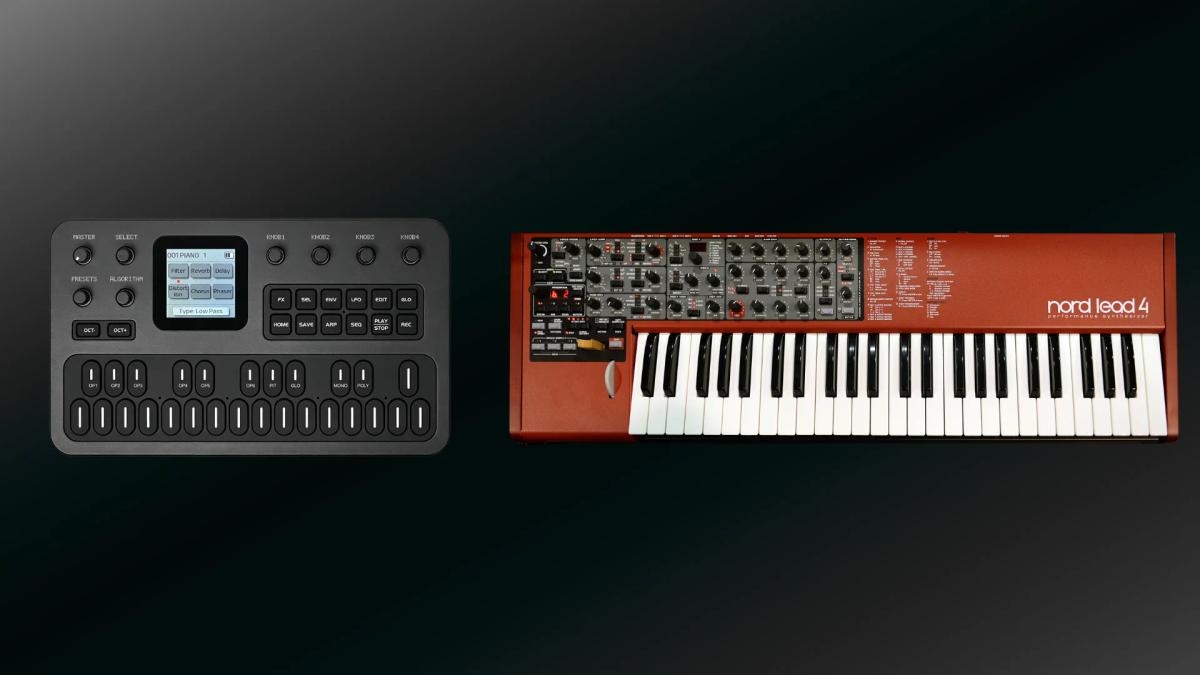
BAUDGIRL FM-1+VA: the free firmware that opened up the M-VAVE FM-1
BAUDGIRL’s free FM-1+VA was the first widely covered custom firmware for the M-VAVE FM-1. It patches M-VAVE’s V15 instead of replacing it, adding virtual analog and 8-bit engines and a 64-step sequencer.
When Sonicstate published a short news item on 29 September 2026 about a free custom firmware for the M-VAVE FM-1, the pocket six-operator synth was still mostly known as a very cheap DX7-style box. The firmware in question, BAUDGIRL’s FM-1+VA, was then at version FM-1_089. It added a virtual analog engine, a reworked sequencer and new screens, and it installed from a web browser over USB. Within three weeks the FM-1 had dozens of alternative firmwares, a software twin, an official open-source project from M-VAVE and a reputation as one of the most hackable instruments of the year.
FM-1+VA was not the most ambitious of those projects, and by mid-October it was far from the only one. It matters because it came first, and because of how it was built. Rather than throwing away M-VAVE’s code and starting over, it modified the stock V15 firmware in place. That choice shaped what the firmware can do, how safe it is to install, and why its source code has remained closed while most of the scene that followed it went open.
The most useful way to understand FM-1+VA is as an extension of M-VAVE’s own firmware. A technical note in the ip2k/lunar-modulator repository on GitHub, which compared M-VAVE’s V15 package with BAUDGIRL’s FM-1_092 build byte by byte, describes it as “a binary patch of V15” and sums it up as “V15 plus hooks, not a new application.” According to that analysis, about 1,820 bytes of the original application differ from V15, spread across 90 small regions, and roughly 110 KB of new code and data are appended at the end. The six-operator engine’s algorithm table, which comes from the msfa library at the heart of Dexed, is left intact.
That is why the community resource lists describe FM-1+VA as keeping the stock FM engine. Everything the original FM-1 does is still there, including DX7 SysEx compatibility and the 32 algorithms, and the new features are hooked into it. The same note explains a small quirk users noticed on first boot: the patch moves the area of flash used for settings, which is why the global settings screen can reset to factory values the first time the new firmware starts. Sonicstate’s write-up mentions that reset too, and says saved presets and sequencer patterns live in a separate memory area that the installer does not touch.
The patch approach also explains the installer’s safety logic. Sonicstate reports that the web page reads the synth’s current firmware version before writing, refuses to resend a version the unit already has, and rejects any file whose first 16 KB differ from M-VAVE’s. Those first 16 KB hold the boot configuration, and the GitHub analysis confirms they are identical in V15 and in BAUDGIRL’s build. In other words, the installer is designed never to alter the part of the flash the FM-1 needs to start. That matters on a device that, according to a separate reverse-engineering project, uses a single flash bank and has no established ROM recovery path.
None of this makes installation risk-free. Sonicstate’s article says plainly that you install it at your own risk, notes that an install that fails before writing anything leaves the existing firmware in place, and adds that an install interrupted partway through, by a pulled cable or a sleeping computer, had not been tested.
What FM-1+VA adds
The current version, Version 101, dated 12 October 2026 on BAUDGIRL’s site, is considerably larger than the build Sonicstate covered. Its two headline additions are new sound engines that sit alongside the FM engine.
The virtual analog engine uses BLEP anti-aliased oscillators, a Super mode that stacks seven detuned oscillators per note, and a Drift control that adds per-note tuning variation. Its zero-delay-feedback filter offers low-pass at 12 or 24 dB per octave, band-pass and high-pass, with a per-note filter envelope and modulation of the cutoff from velocity, key tracking and the LFO. On a device built around six sine-wave operators, that gives the FM-1 a set of sounds it simply could not make before: fat detuned leads, resonant basses and the kind of acid line demonstrated in NatLife Sounds’ tutorial on the firmware, published on 29 September.
The 8-Bit engine is more of a self-contained toy. Each preset has four parts, Drums, SFX, Bass and Lead. Twelve drum sounds each have Wave, Pitch, Sweep, Decay and Snap settings, and the built-in sound effects include coin, jump, laser and explosion sounds in the style of old game consoles. Bass and lead each get an arpeggiator with 31 shapes or a custom shape, and a Key and Scale section lets the lead follow the bass.
The interface changes are less dramatic but probably matter more in daily use. Four knobs work on every screen, organized in banks, and the preset bank lets you choose what each knob controls. Holding HOME and turning a knob reassigns it. The firmware also adds color themes and reorganizes the screens for Oscillator, Algorithm, Sequencer, Arpeggio and global settings.
The sequencer
For many users the sequencer is the real reason to install FM-1+VA. The stock FM-1 offers 16 steps per pattern. BAUDGIRL’s version extends patterns to 64 steps, shown 16 at a time with notes in lanes, and records either step by step or in real time. Steps can hold chords of up to nine notes, and new recordings add to existing notes instead of replacing them.
Each step can have its own ratchet, chance, gate, length and transpose values, and notes can be tied across steps. Holding SEL and turning a knob locks a setting to a single step, a simple form of the parameter locks found on more expensive grooveboxes. Steps and whole patterns can be moved or copied, patterns can be stretched or compressed in time, and up to 16 patterns can be chained into songs with set repeat counts, with changes landing on the beat. The developer’s own description of the firmware emphasizes live performance and quality-of-life features, and the sequencer is where that focus shows most clearly.
A fast release cycle
FM-1+VA moved quickly. Sonicstate covered FM-1_089 on 29 September. The Virtual-FM-1 project and the GitHub analysis both refer to FM-1_092. Zalmanim’s overview of the scene noted on 10 October that the firmware was “on version 97 already,” and the developer’s site lists Version 101 two days later, available for both the FM-1 and M-VAVE’s SMK-37 keyboard, which gets its own SMK-37+VA build.
Some of those updates fixed problems that affected more than the custom firmware itself. BAUDGIRL’s install page notes that on Version 93 or earlier, M-VAVE’s own M-UPGRADE tool showed a checksum error and could not find the FM-1, which meant it could not install any firmware, including V15. Version 94 fixed that. It is a reminder that patching a manufacturer’s firmware creates dependencies in both directions: the patch relies on V15, and the official tools have to keep recognizing a unit that runs the patch.
Installation, according to the developer, takes less than a minute from Chrome or Edge on macOS, Windows or Linux, or Chrome on Android. Firefox and Safari cannot install it because they lack the Web MIDI support the installer uses.
Preset packs and Virtual-FM-1
BAUDGIRL also offers two free preset packs, one for each new engine. They are not added to empty memory: the 8-Bit pack overwrites presets 97 to 112, and the Virtual Analog pack overwrites presets 113 to 128. The developer’s site warns users to back up all presets first, and FW Radar repeats the warning. Without the pack, slots 113 to 128 simply play as FM sounds.
The firmware’s other notable side effect is Virtual-FM-1, an open-source software version of the FM-1 published on GitHub by the user jbschooley, which installs as “Virtual FM-1” by Bockage. It runs as a standalone app and as a VST3, Audio Unit or Linux LV2 plugin, uses the msfa FM engine with 12 voices tuned against hardware measurements, and can push and pull single presets, all 128 presets and sequencer patterns. Its two-way sync depends on FM-1+VA, because BAUDGIRL’s firmware provides the read-back functions that stock V15 lacks. With M-VAVE’s firmware, the plugin can play and edit sounds but cannot read anything back.
There is one telling limitation. The plugin does not emulate the virtual analog engine. VA presets sync, but they play through the FM engine “until baud girl publishes the VA source,” in the words of the project’s README. The project is not affiliated with M-VAVE or with BAUDGIRL.
Free, funded and closed
FM-1+VA is free. The developer accepts tips through Ko-fi, and Nacho Dramis, writing in his Focus newsletter on 5 October, counted more than 350 donations there at the time. That model has been cited approvingly in later debates about paid firmware: when Groove OS arrived as a $29 product, several commenters on Synth Anatomy pointed to BAUDGIRL’s donation-based release as the fairer approach.
The code, however, is not public. The awesome-fm-1 resource list on GitHub files FM-1+VA under closed source and notes that the author has said the source will be released. Dramis wrote that BAUDGIRL had not yet released the source code, “but it’s supposed to happen soon.” As of mid-October, the developer’s site carries a copyright notice and links to no repository, and the GitHub analysis advises others to treat the code as all rights reserved.
That puts FM-1+VA in an unusual position. Much of the scene it helped start is licensed under GPL-3.0, from Hügelton Instruments’ Felucca to 3dSam’s SLOOP and the many forks built on them. Felucca, which Dramis dates to 1 October, became the open base most later projects build on. BAUDGIRL’s firmware, by contrast, could not be forked, and the tools that grew around it, such as Virtual-FM-1, have to work from the outside. The patch approach may also make publication more complicated than usual, since the firmware is a modification of M-VAVE’s own closed V15 image. That last point is an inference rather than anything the developer has stated.
Final perspective
FM-1+VA is a careful piece of work in a scene that has not always been careful. By patching V15 instead of replacing it, it kept everything that made the FM-1 attractive in the first place, including the DX7-compatible engine, and added the two things owners most obviously wanted: a second kind of synthesis and a sequencer worth performing with. Its installer was designed around the hardware’s weakest point, the absence of a reliable recovery path, by refusing to touch the boot region.
Its limits are just as clear. The firmware depends on M-VAVE’s V15, its source is closed for now, its preset packs overwrite user slots, and its fast release cycle means owners need to keep an eye on version notes. With M-VAVE now offering FM1 Open and dozens of GPL projects available, FM-1+VA is no longer the default choice it was at the end of September. It remains the firmware that showed the M-VAVE FM-1 could be more than it shipped as. For owners who mainly want a better version of the original instrument, with the DX7-style engine intact, it is still one of the most sensible places to start.
His connection with music began at age 6, in the 1980s, when his father introduced him to Jean-Michel Jarre's Rendez-Vous on vinyl. He works professionally in the legal field, while synthesizers became his space for abstraction and creative exploration. Founder of The Synth Source.