

Home›Articles›LOOM-8: Charles Vestal’s OP-XY-inspired eight-tra…
Articles

LOOM-8: Charles Vestal’s OP-XY-inspired eight-track groovebox firmware for the M-VAVE FM-1

The LOOM-8 groovebox by Charles Vestal turns the M-VAVE FM-1 into an eight-track sequencer with p-locks and weave. Features, limits and open questions.

Bernardo de Azevedo
Bernardo de Azevedo
· Updated
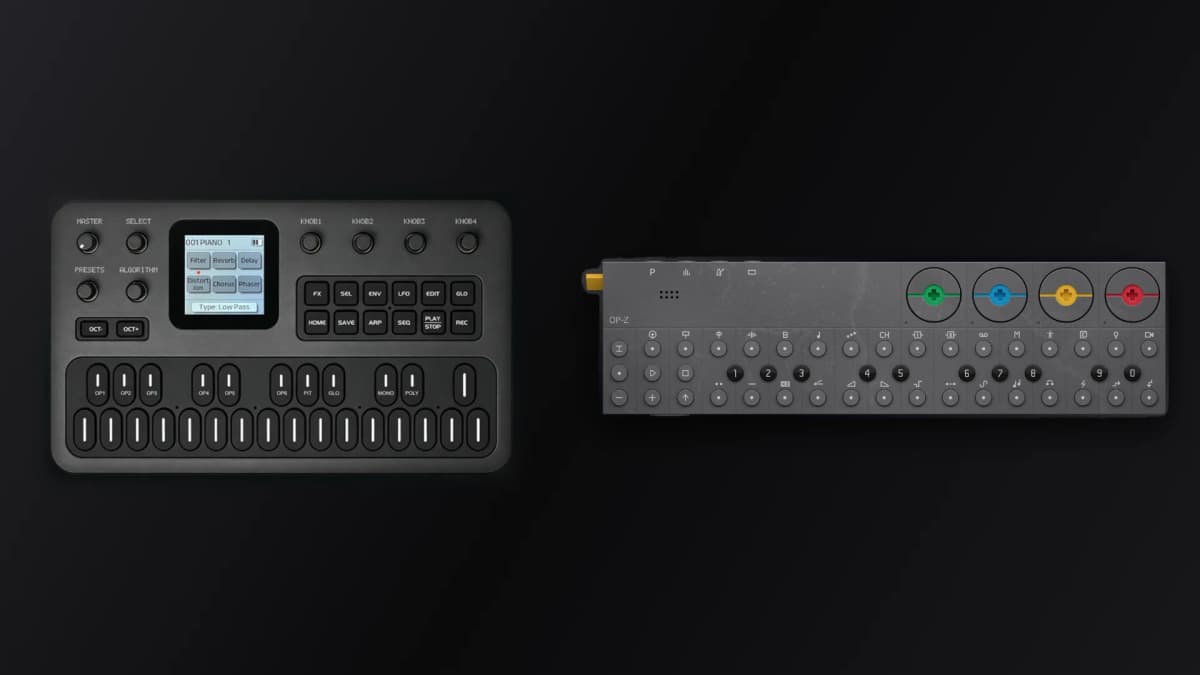
LOOM-8 groovebox: M-VAVE FM-1 pocket synthesizer beside the Teenage Engineering OP-Z

The LOOM-8 groovebox is a firmware for the M-VAVE FM-1 written by Charles Vestal, a developer already known on the site for his earlier X0X and FoMni releases. It converts the pocket FM synth into an eight-track sequencer with its own sound engines, samples and effects, and its workflow openly follows teenage engineering’s OP-XY. The central question is how much of that approach survives on a roughly $70 device with limited memory, and where the project is still settling.

Table of Contents

What the LOOM-8 groovebox is

LOOM-8 appeared in public on 19 October 2026 as a first beta, according to the project’s GitHub release notes, and MatrixSynth announced it the following day. The release notes show a rapid series of updates over the next few days. The project page describes it as a pocket groovebox, and states that it is not affiliated with M-VAVE or teenage engineering, whose trademarks it acknowledges.

The video above was uploaded by Vestal on his own channel and is titled as a sequencing groovebox for the FM-1. MatrixSynth’s post, which credits the video upload to Vestal, says the workflow is heavily inspired by the OP-XY. The video’s contents could not be checked, so this article does not describe what it shows.

Vestal’s earlier firmwares are covered in a separate article on his FM-1 work, and they are not retold here. The LOOM-8 groovebox is a different kind of project, closer to a full workstation.

Tracks, engines and sound sources

The project page lists eight tracks, each with up to eight patterns of up to 64 steps. Six synth engines are offered: knit, a subtractive voice with up to seven unison voices; rayon, a two-operator FM voice; jacquard, a wavetable voice; bellows, an organ; and cane and voile, which the README says are based on Mutable Instruments Braids by Emilie Gillet, released under the MIT licence.

Beyond the synths, a track can play samples, slice breaks, run an eleven-voice drum kit, or send MIDI to an external instrument over USB or Bluetooth. The manual counts nine engines in all and 85 factory presets, with 16 user preset slots. The manual also states practical limits: the knit engine can play up to six voices, cane up to four, and the drum kit’s sample model sounds four sample keys at once, with a fifth taking the place of the oldest.

In the LOOM-8 groovebox, samples are held in a bank of 214 KB, according to the manual, with 16 factory samples and up to 32 user samples. Lower sample rates fit more material, and a user sample can run to about 16 seconds at 22,050 Hz. Custom samples are loaded from a browser page or a command-line tool. These numbers show the scale of the hardware: the LOOM-8 groovebox is a sampler in the sense of a small lo-fi sample bank, not a full-length audio player.

The sequencer: tricks, locks and weave

The sequencer is where the OP-XY influence on the LOOM-8 groovebox is most visible. Each step can hold up to four notes, a chance percentage, up to two “tricks” and parameter locks, per the manual. The 14 tricks include pulse, hold, multiply, ramps, glide, bend, jump and skip functions. Parameter locks let a knob value be tied to a single step, and knob movements can be recorded as locks while a pattern plays. A release note from 19 October describes the punch-in recording of knob motion.

Three players, arp, strum and hold, handle chords. A conductor track holds a key, scale and link and sets which tracks follow it, so that melodic tracks can be moved together through a progression while drum tracks stay out of it.

The most unusual feature is weave. It combines a track’s pattern with a second pattern, following one of four rules in the manual: bars, which alternates bars from the two patterns; steps, which alternates steps; rhythm, which keeps the track’s rhythm but plays the other pattern’s notes in order; and notes, which does the reverse, using the other pattern’s rhythm with the track’s own notes.

The result plays live, can be recorded onto a dedicated weave track, and can be kept as a new pattern. This is a compositional tool rather than an effect, since it generates new pattern material from two existing ones.

Effects, mixing and arrangement

Twelve momentary effects, called throws, are played from the keys and can be recorded. There are two send effects. The first offers chorus, delay, lo-fi, phaser or reverb, and the second is a reverb with eleven modes, including some derived from the PlayStation, using the PSXVerb code credited in the README. The master section has a three-band EQ, a compressor and a pump control that ducks the output, driven by a kick, a track or the metronome.

Arrangement in the LOOM-8 groovebox relies on scenes and a song mode. Scenes choose a pattern for each track along with mutes and the conductor key, and a song assigns scenes to slots of between one and 64 bars. The scene count is a point where the documents disagree. MatrixSynth’s October 20 report and the manual both say 16, while the project page and the 0.6-beta notes of 21 October say 32. The manual may simply not have caught up with the later release, in which case 32 is the current figure.

Installing and staying safe

The project page offers a web installer for Chrome or Edge over USB, a command-line option, and a route back to M-VAVE’s stock firmware, either through the installer or through the manufacturer’s updater. The README states that an FM-1 that keeps crashing starts in a safe mode. That is the author’s claim and has not been tested on hardware for this article.

As with any custom firmware, installing is at the user’s own risk, as the page itself says. Read the project’s warnings first, and use the site’s safe install and recovery guide for the general procedure. No flashing steps are given here.

Saving works differently from a typical groovebox. The manual says projects autosave three seconds after the last change, but only while stopped and silent, because writing to flash would interrupt the sound. There are three project slots, and projects are not named. Backups cover projects and presets but not user samples, so the sample bank needs a separate copy.

Credits, licence and lineage

The LOOM-8 groovebox is built on fm1-base and felucca-bsp, taken from Felucca by Leo Kuroshita of Hügelton Instruments with his permission, according to the README. The site’s article on Felucca describes that shared foundation. The credits also list factory breaks by u/FCTRYBEATS, 909 drum renders from 9W9, recorded instruments from the CC0 Versilian Studios Chamber Orchestra, and two fonts under the SIL Open Font Licence.

The README names several influences: X0X for its sequencer approach, Polly for its menu design, Melodee by keremimo and Jangada by zednaked for lessons learned on the second core, and Groove OS for the idea of a browser emulator. The project page says the emulator runs the same code as the FM-1, with sound, so the interface can be tried without the hardware. The site covers Groove OS separately.

The licence is another point of inconsistency. The repository sidebar shows GPL-3.0 and the 0.5-beta release notes say GPL-3.0-only, with a LICENSING.md file listing the origin of each part, while the project page gives MPL-2.0 for the source, which is also the licence the README lists for the platform code underneath. The inconsistency is unresolved at the time of writing, and anyone planning to reuse the code should check the repository directly.

Reception and positioning

Press coverage of the LOOM-8 groovebox is brief. MatrixSynth’s post reads as an announcement built on the developer’s own description and names no limitations, and no independent hands-on review or user report had been published at the time of writing. Any judgement of how the firmware feels in use therefore has to wait for such accounts.

Among the alternatives, a Synthtopia overview from early October describes SLOOP as a free four-track groovebox and X0X as a standalone groovebox, while Groove OS is described as a groovebox firmware too. The LOOM-8 groovebox differs by modelling its workflow explicitly on one commercial instrument, and by combining synthesis, sampling and arrangement in a single unit. The cost is complexity: the manual’s page-by-page structure suggests that learning the instrument will take time, though no user reports on this had been published.

The project page also says the FM-1 can speak its screen through a separate project called FM-1 Screen Reader. The README does not mention it, so the claim rests on the project page and the MatrixSynth post, and the separate project has not been checked.

Final perspective

The LOOM-8 groovebox is among the more ambitious applications built for the FM-1 so far. Its documentation is detailed, its limits are stated openly, and its credits are thorough. The weave function and the conductor track suggest ideas of Vestal’s own, rather than simple imitation of the OP-XY.

The caution is about stability and consistency. The project went from first beta to several revisions in about a week, the version shown on the project page at the time of writing (0.11) differs from the latest entry on the GitHub releases page (0.6.1, dated 22 October), and the manual, scene count and licence statements do not fully agree. None of this is unusual in a fast-moving beta, but it argues for checking the repository before relying on any detail given here.

Sources

  1. LOOM-8 for the M-VAVE FM-1, Charles Vestal (GitHub Pages)
  2. charlesvestal/fm1-loom, GitHub
  3. fm1-loom releases, GitHub
  4. LOOM-8 manual, GitHub
  5. LOOM-8 Sequencing Groovebox for the M-VAVE FM-1, MatrixSynth
  6. LOOM-8 Sequencing Groovebox for the M-VAVE FM-1, YouTube (Charles Vestal)
  7. Alt Firmware Options For The M-Wave FM-1 Pocket Synthesizer, Synthtopia
Bernardo de Azevedo
Written by
Bernardo de AzevedoFounder & Editor

His connection with music began at age 6, in the 1980s, when his father introduced him to Jean-Michel Jarre's Rendez-Vous on vinyl. He works professionally in the legal field, while synthesizers became his space for abstraction and creative exploration. Founder of The Synth Source.