FoMni, covered by Synth Anatomy on 6 October and by Synthtopia on 12 October, turns the FM-1 into a chord harp inspired by the Suzuki Omnichord. The 16 white keys act as the strum plate and the 11 black keys as chord buttons, with ENV and LFO held for minor and seventh chords, as on the Omnichord’s three rows.
Behind the strings sit an organ-like chord, a bass and the OM-84’s ten rhythms, which can play the bass and chord in time. It is deliberately simple: one screen, four knobs a page and no patterns to program. Synth Anatomy reported that its rhythms, waves, drum sounds and envelope shapes come from Chordian.
CTL-1 makes the FM-1 a MIDI controller. Its README says it reads velocity and aftertouch from the FM-1’s own keys, offers scales with chords on the black keys, sends controllers from the knobs in four banks, and runs an arpeggiator and a four-track Euclidean drum sequencer on its clock. Output goes over USB and Bluetooth, and the FM-1’s built-in General MIDI sounds can play everything so it works with nothing connected.
AMB-1 is a generative ambient machine inspired by Brian Eno’s Music for Airports. It plays itself from power-on, with breathing voices, bells on tape loops of unequal length, a gliding bass and quiet Euclidean percussion through a tape echo and a plate reverb. MONK-1 ports MonkSynth, Jonathan Taylor’s formant vocal synth and homage to the Delay Lama plug-in, with twelve singing characters from Vestal’s iOS port. Polly is a pocket arranger inspired by the Yamaha QY70, with General MIDI sounds from Sonivox EAS and the ability to play the QY70’s preset styles if the owner supplies a dump of their own unit’s ROM. Nothing of Yamaha’s ships with it.
As of FW Radar’s 17 October listing, these were all early: FoMni at version 0.4, CTL-1 at 0.9.2, AMB-1 at 1.2, MONK-1 at 0.9.1 and Polly at 0.4.3. The site noted that for CTL-1, AMB-1, MONK-1 and Polly the developer had not yet said they had run on a real FM-1, although each has a browser emulator. CTL-1, AMB-1 and MONK-1 also report what their screens show to Vestal’s FM-1 Screen Reader web page over USB, an accessibility feature that follows his screen reader work on the Move.
All of these firmwares install the same way: open the project’s web installer in Chrome or Edge with the FM-1 connected by USB. The READMEs for X0X, FoMni, CTL-1 and AMB-1 all say installing is at your own risk, and add that the web installer can restore M-VAVE’s firmware and that an FM-1 that keeps crashing, or fails to start twice, comes up in a safe mode. FW Radar adds, for X0X, that restoring V15 can lose patterns.
The GPL complaint and FM1 Open
On 14 October Vestal posted twice in the Elektronauts FM-1 thread. In the first, he said he had contacted M-VAVE and been told the company would launch an “open source community” in the next few days. In the second, he wrote that M-VAVE “were distributing some GPL work (including my own) compiled with closed source binaries, a violation of the GPL,” and that after he raised it the company had taken the work down while it sorted out licensing. He added that M-VAVE was “definitely embracing the space.”
The complaint touches the central legal fact of the scene. 0, which requires anyone distributing them to provide the complete corresponding source under the same licence. Combining that code with a closed binary engine and distributing the result is not something the licence allows without the authors’ permission.
” Such an exception can cover code M-VAVE owns. It cannot be applied to community code without its authors’ agreement, which is why Vestal’s objection was reasonable.
Final perspective
Charles Vestal’s FM-1 work is a compact case study in what AI-assisted instrument development looks like when it is done in the open. He chose clear musical references, from ReBirth and the Omnichord to Music for Airports and the QY70, assembled them from credited open-source components, and released each one with a browser emulator, a manual, a web installer and a documented way back to the stock firmware.
He was also explicit that AI did much of the coding, which makes his projects a useful reference point in the argument over “vibe-coded” firmware: the code may be generated with help, but the design, the sourcing and the responsibility are visibly his.
For owners of the M-VAVE FM-1, the practical takeaway is that X0X is the most mature of his firmwares and the closest thing to a finished instrument, while the others are early betas that are best tried in the browser emulator first. For the wider ecosystem, his insistence on GPL compliance came at a useful moment, just as the manufacturer was deciding how to open its own platform.
Sources
- Charles Vestal X0X: custom firmware turns the M-VAVE FM-1 into a ReBirth-like groovebox, Synth Anatomy
- X0X for the M-VAVE FM-1, Charles Vestal, GitHub
- FoMni for the M-VAVE FM-1, Charles Vestal, GitHub
- CTL-1 for the M-VAVE FM-1, Charles Vestal, GitHub
- AMB-1 for the M-VAVE FM-1, Charles Vestal, GitHub
- MONK-1 for the M-VAVE FM-1, Charles Vestal, GitHub
- Polly for the M-VAVE FM-1, Charles Vestal, GitHub
- New firmware turns FM-1 synthesizer into a pocket Omnichord, Synthtopia
- Charles Vestal OMNI: an Omnichord custom firmware for the M-VAVE FM-1, Synth Anatomy
- M-VAVE FM-1 discussion thread, Elektronauts
- Custom firmware: Elektron pushes back, modders keep flashing, Gearnews
- Move Everything accessibility, CDM
- Move Everything turns Ableton Move into an open platform, Synth Anatomy
- Four custom firmwares turn the M-VAVE FM-1 into a groovebox, Time To House
- ReBirth RB-338, Wikipedia
- Reason Studios, Wikipedia
- M-Vave FM-1 custom and alternative firmware, FW Radar
- M-VAVE FM-1 Open: the green light for custom firmware and community hacks, Synth Anatomy
- m-vave/fm1_open, GitHub
- awesome-fm-1 resource list, GitHub
- m-vave fm-1 x0x firmware higher state of consciousness, Charles Vestal, YouTube
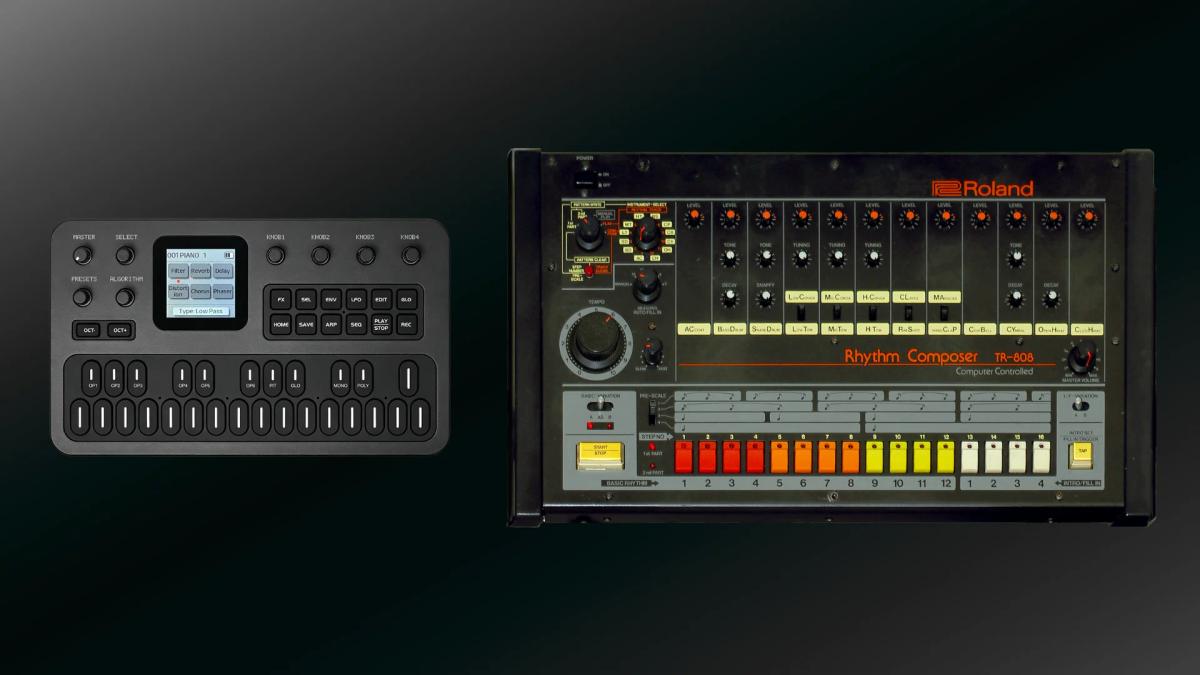
Cover image credit: Roland TR-808 photo by Brandon Daniel (CC BY-SA 2.0), via Wikimedia Commons. M-VAVE FM-1 product image courtesy of M-VAVE.