The risks are stated plainly. “Installing is at your own risk,” the README says. syx file should be kept. The FM-1 has a single flash bank and no recovery button, and an interrupted update can leave the unit with a black screen.
For that case, Kuroshita also wrote FM-1 Transporter, an MIT-licensed tool that reads and writes the FM-1’s flash through a Seeed XIAO RP2040 board. It is the recovery route Felucca points to, and several other projects point to it as well.
Why so many firmwares are built on it
By our count of FW Radar’s 17 October listing, roughly 50 of the 63 FM-1 projects name Felucca, or a firmware derived from it, as their base. Felucca’s GitHub page showed around 80 forks at the time of writing. The reasons are practical. Writing a synth engine is the creative part of a firmware project. Getting audio out of an undocumented JieLi AC791N chip, reading the panel, talking USB MIDI, packaging an update and writing to flash safely is the tedious part, and Felucca solved it early and published the result under the GPL.
Some forks keep Felucca’s foundations and replace the instrument on top. Charles Vestal’s X0X, a ReBirth-style groovebox with 909, 808 and two 303-style parts, describes itself as keeping Felucca’s hardware layer, USB, update loader, web installer and storage. SLOOP, by the developer credited by Synth Anatomy as 3dSam, repackaged Felucca’s engines into a live looping groovebox with three synth tracks and a drum machine.
Others stay closer to the original. Jangada, by zednaked, offers four tracks, ten engines and a modulation matrix. 0 and built a six-operator FM instrument with an 808 kit and pattern banks. GHOULBOX, by jasonpersinger, is a dungeon-synth firmware with hurdy-gurdy and drones, and it has already been forked in turn into SARDAB, which adds maqam tuning, Arabic rhythms, oud and ney.
The code has flowed in both directions. Felucca’s credits list contributions from developers who went on to run their own projects, including keremimo, zednaked and jasonpersinger, as well as ChanceTheMaker, who contributed TRS MIDI, pitch bend, sustain and clock support. More strikingly, Felucca’s optional second-core audio, added as an opt-in beta in 1.6.1, takes its start-up, mailbox and guards from Vestal’s X0X, with dual-core findings from Melodee and audio-split measurements from Jangada. Felucca’s in-browser emulator is also credited as following X0X’s browser build. The base project absorbed improvements from its descendants, which is how a healthy open-source ecosystem is supposed to work.
Two structural decisions make Felucca easier to build on. In 1.6.1, five engines (ANALOG, LOFI, TRIO, WHEEL and NOISE) moved to a separate repository, Felucca-Engines, under the permissive MIT licence, while Felucca as a whole remains GPL-3.0-only. The hardware layer is also published separately as felucca-bsp, and several newer firmwares, including Vestal’s AMB-1 and Polly, say they are built on it rather than forking the full instrument.
The maintainer steps back
On 16 October 2026, two days after 1.6.1, Kuroshita added a maintenance notice to the top of the README. “What began as a personal experiment grew far beyond my expectations,” he wrote, adding that he had “decided to step back from active development to focus on creating new instruments and music.” Felucca will remain available with occasional maintenance, but new features, issue responses and pull request reviews are not guaranteed. The notice says the Felucca-Engines repository is still maintained.
For users, nothing changes overnight. 1 still installs from the browser, and the return to V15 still works. For the ecosystem, the notice is a test. The GPL guarantees that the source stays available and that anyone can continue the work, but it does not guarantee that anyone will. Forks that track Felucca closely will now need to decide whether to merge their improvements into one of the larger descendants, maintain their own copy of the hardware layer, or move to felucca-bsp and treat Felucca as a finished reference.
The timing also overlaps with M-VAVE’s launch of its own FM1 Open project on 17 October, which gives developers an official alternative base with its own SDK.
Final perspective
Felucca’s importance is easy to understate because it is not the most specialized firmware on the M-VAVE FM-1. It is not the best acid machine or the best looper. What it did was turn an inexpensive, closed DX7-style box into a documented, installable platform within days, and publish that work under terms that let others reuse it. Most of what followed depends on that choice.
The project also shows the shape of AI-assisted instrument development in 2026. Kuroshita was open about using coding agents and clear that the design decisions and the responsibility were his. The output was extensive release notes, licensing files that trace every borrowed component, and a recovery tool for when things go wrong, which is more documentation than many commercial firmwares ship with. Its step back after two weeks is a reminder of the other side: one person can build a platform quickly, but keeping it maintained takes a community. Whether the FM-1 scene provides that is the question for the months ahead.
Sources
- Felucca, Hügelton Instruments, GitHub
- Felucca licensing (LICENSING.md), GitHub
- Felucca credits (CREDITS.md), GitHub
- Felucca wiki: Engines, GitHub
- Felucca wiki: Release notes, GitHub
- Felucca releases, GitHub
- Felucca 1.6.1 release notes, GitHub
- On AI-assisted development and responsibility, Felucca discussion #166, GitHub
- Hügelton Instruments Felucca: custom M-VAVE FM-1 firmware turns it into a multi-engine synth, Synth Anatomy
- FM-1 custom firmware Felucca, MATRIXSYNTH
- M-Vave FM-1 custom and alternative firmware, FW Radar
- FM-1 Transporter, GitHub
- X0X for the M-VAVE FM-1, Charles Vestal, GitHub
- SLOOP, isod89, GitHub
- awesome-fm-1 resource list, GitHub
- Hügelton Instruments
- Mvave FM-1 | Felucca Firmware – Multi Sequencer, 9 Engines, Scale Mode – First Look, Stanley Gurvich, YouTube
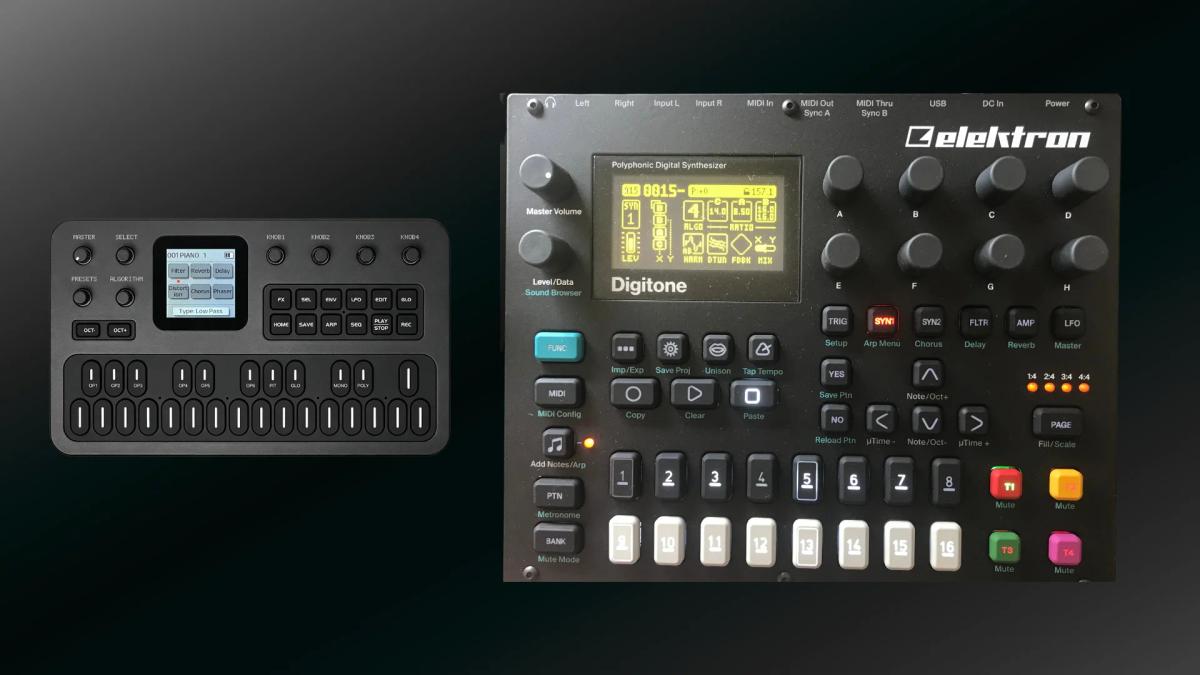
Cover image credit: Elektron Digitone photo by Joan Recordà (CC BY-SA 4.0), via Wikimedia Commons. M-VAVE FM-1 product image courtesy of M-VAVE.