

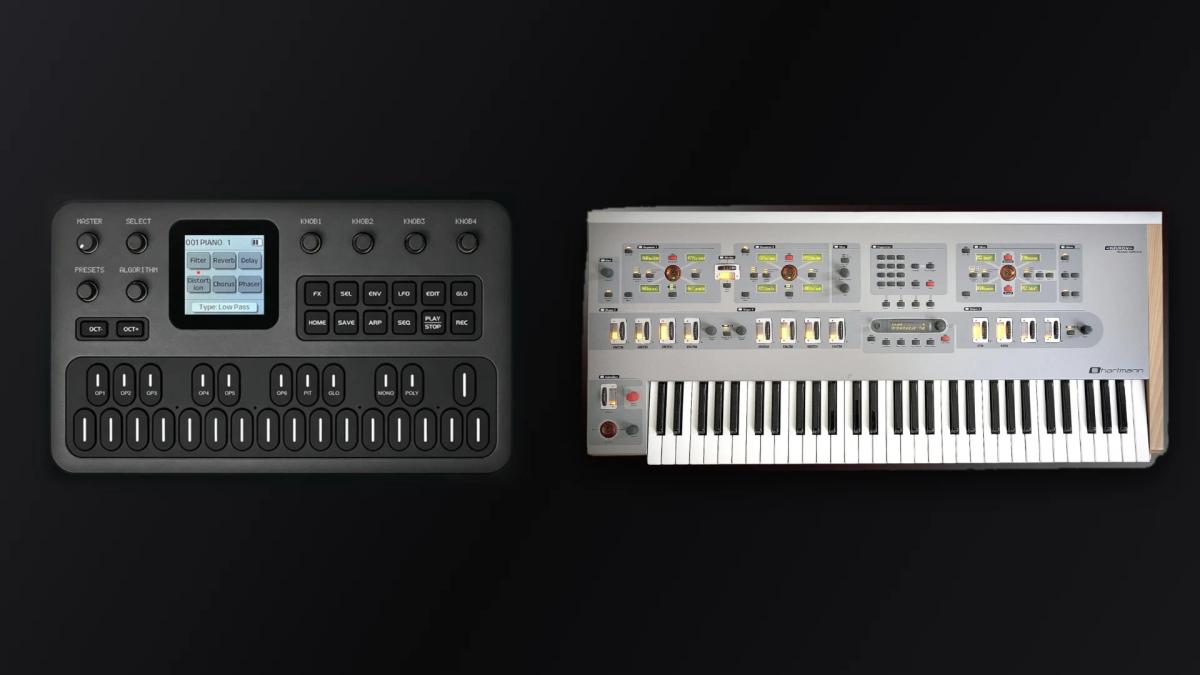
The GR!MM firmware, published on GitHub by the account GRiMMBIENT, turns the M-VAVE FM-1 into a four-track drone and atmosphere machine aimed at dark ambient, dungeon synth and what its author calls deathdream. It is built on Dinghy, Felucca and SLOOP, and, according to a single MATRIXSYNTH post, a later collaboration with the Swiss artist Apetactics produced a MIDI channel filter. This article describes what the firmware offers, what its documentation does and does not confirm, and whether a pocket FM synth with shared voices suits slow, textural work.
Table of Contents
What the GR!MM firmware is
The project’s repository describes GR!MM as unofficial, open-source firmware for the FM-1, and it states plainly that M-VAVE neither made nor endorses it. The page does not name an individual author. It is owned by the GRiMMBIENT account, and MATRIXSYNTH’s coverage credits the firmware’s own video to “GR!MM // Deathdream”.
The first public release of the GR!MM firmware, tagged v1.0, appeared on 17 October according to the release page, with no year shown. The manual and the community cheat sheet both cover version 1.0, so that is the only version this article can describe. The firmware is free and licensed under GPL-3.0, while the four bundled factory samples are released under CC0.
The central design decision is the track structure. Four tracks run side by side, each with its own sound and its own 64-step sequence, and all four draw on a pool of six voices together with shared effects. The community cheat sheet on the Firmware Hub uses the same description of a drone and atmosphere machine as the repository.
Sound sources, samples and effects
According to the repository, the firmware offers seven sound sources: a virtual analog engine with a supersaw, six-operator FM, a sample player, a formant-based choir called VOICE, a tonewheel organ called WHEEL, physical models, and phase distortion. The FM-1’s own six-operator FM is therefore one of seven options rather than the centre of the instrument, which is a notable departure from the hardware’s original purpose.
The sound library of the GR!MM firmware is modest and clearly organised. There are 40 factory sounds in eight categories and 64 user slots. The four factory samples, named URCHIN, LEAVE, NIKOLAI and M-SOFT, last up to 6.6 seconds each and sit in replaceable slots. The manual adds that empty sample slots are filled with these on first start, while any slot already in use is left alone.
Four effects shape the output. TAPE and DELAY handle the worn, repeating textures, GRAIN includes a freeze function, and SPACE is a reverb that the repository says reaches about 32 seconds, with an infinite setting beyond that. MATRIXSYNTH, relaying the maker’s video description, mentions a warm tape warble on user-loaded WAV files.
Each track also has an envelope, an LFO and a filter, and the keys can snap to a chosen scale. Those are standard parts of any synth, but on a 27-key device with a few encoders they matter because they decide how much shaping can be done without a computer.
Sequencing, song mode and the performance layer
The sequencer runs 64 steps per track and offers chance, ratchets, note lengths, step locks and chord steps. The cheat sheet adds copy, paste, randomise and mutate tools. For dark ambient these are useful mainly for probability: a pattern that drops and returns steps behaves less like a loop and more like a slowly shifting texture.
There is also an arpeggiator and a one-key chord mode. A latch mode keeps a note sounding until its key is pressed again, which is what makes a drone practical on a small keyboard, since the hands are free for the knobs.
Song mode has four slots, labelled A to D in the repository. The manual describes chaining up to 16 sections and offers mute and solo controls. The manual lists four project slots, and says the firmware autosaves once the sequencer has been stopped and idle for 2.5 seconds, so a sketch survives a power cycle.
The PERFORM page collects momentary tricks such as freeze, throws, tape stop, reverse and stutter. The manual also covers MIDI learn for up to 32 controller links, assignment of MIDI channels and sending sequencer and arpeggiator notes out over USB. The release notes list MIDI and USB audio support.
Foundations and credits
GR!MM credits its sources carefully. Felucca supplies the platform and several synthesis engines, and our Felucca article covers that foundation in detail. Dinghy, by zvenson, is a deliberately small starting point: its README describes about 300 lines of sine-wave code on top of finished plumbing for updates, USB, panel and screen. GR!MM grows from that template.