- Three synth tracks and one drum track, each with up to 64 steps, its own length and its own division, so polymeters stay in phase
- Twelve engines inherited from Felucca, including analog, four- and six-operator FM with DX7 patches, phase distortion, tonewheel organ, formant voice, granular, lo-fi chip, sampler, physical models and noise
- 153 factory sounds and 32 user preset slots
- A drum machine with 16 sounds on the white keys, ghost and hard hits, ratchets and 37 kits, plus user sample kits and synthesized kits designed in the web editor
- 27 punch-in effects on the whole mix, including loops, stutter, reverse, tape stop, filter sweeps, DJ kills, rewind and freeze
- Song mode with four sections, A to D, launched on the next bar, recorded as you play, or chained by holding SAVE and tapping several sections
- Parameter locks, micro timing and fill conditions per step
- Master DUST, DUCK and DJ filter, a look-ahead limiter and a TEXTURE layer for vinyl, tape or room-tone beds
- USB audio, USB MIDI, TRS MIDI input, MIDI clock in and out, MIDI CCs, MIDI learn and per-track MIDI channels
The FM-1 holds one song at a time, with more songs kept as backup files in the editor. Bluetooth MIDI is not supported; the README says SLOOP, like Felucca, never switches the radio on. The project does not ship factory patterns: “everything you hear, you play,” as the README puts it.
The web editor, which runs in Chrome or Edge, mirrors the device live and adds a piano roll, MIDI file import and export, a drum synthesizer, a sample chopper, DX7 cartridge import and, since 2.7, a LIVE page for performing a set from a computer, tablet or phone. It can be downloaded as a single offline file or installed as an app, including on Android.
Installing, going back and rescue
SLOOP installs from the browser. The README’s steps are to open the installer in Chrome or Edge on a computer, connect the FM-1 by USB with a data cable directly rather than through a hub, press Install, allow MIDI access and wait for the unit to restart on the SLOOP logo. Projects, presets, samples and settings are kept across SLOOP updates. A Python installer and build-from-source instructions are also provided.
The documentation is careful about the way back. To return to an earlier SLOOP, you install that release’s firmware file, but project formats have changed, so a backup should be saved first. To return to M-VAVE’s firmware, the installer page has a “Return to the official firmware (V15)” option that accepts only the exact FM-1.fwsc file from M-VAVE’s website, and M-VAVE’s M-UPGRADE updater works too. The README recommends a backup with the web editor before doing this.
For problems, SLOOP has its own rescue mode: hold OCT minus while switching on to reach a USB rescue screen, then install again. An install that was cut off resumes when Install is pressed again. The installer checks each package’s SHA-256 before writing it and the update loader checks it again before starting it. If an FM-1 no longer starts at all, the README points to FM-1 Transporter, the external recovery tool. “Custom firmware is installed at your own risk. No warranty,” it adds, and SLOOP’s own status line still calls it a beta.
The forks and ports
SLOOP’s design proved popular enough to become a base layer in its own right. FW Radar’s 17 October listing includes several projects built on it:
- sloopDX, by zvenson, strips SLOOP down to a single six-operator DX7 engine. Its README says the Dexed-derived core was checked against Dexed sample by sample, and that the drum track plays FM drums made with the same engine. Version 4.0 is marked as a beta that had not yet run on a device; the developer says 3.5 had been installed and played on a real FM-1.
- SHIFL, by schwartzworld, expands the idea to six synth tracks and a drum machine across six engines, and its 3.0 release adds musical mutation tools that evolve parts every four, eight or sixteen bars. FW Radar lists it as in development.
- FM1 Move, by Nicodesy06, is an eight-track clip-and-scene groovebox built on SLOOP that FW Radar describes as experimental and never run on hardware.
- winampFM Synth, by hericdk, rebuilds SLOOP 2.6 with a Winamp-style interface, and MYCELIUM, by megagott, uses Felucca and SLOOP for a forest and psytrance groovebox.
SLOOP also crossed hardware. In a 12 October report, Synthtopia described Snoop37, a port of SLOOP to M-VAVE’s SMK-37 keyboard that adds velocity-sensitive keys, track-colored pads, a pad sound picker, fader banks for level, filter, reverb and delay, and pitch and mod wheels. It was released alongside ports of Vestal’s X0X and FoMni and a porting kit published by the developer genkigenki. Synthtopia reported that memory on the SMK-37 is tight, so firmwares cannot be combined and only one can be installed at a time.
Final perspective
SLOOP is the clearest example of how the M-VAVE FM-1 firmware scene works. It did not write a new hardware layer or new synth engines. It took Felucca’s open foundations and built a distinct musical idea on top, one centered on recording by feel rather than programming by step. That idea, plus a steady stream of releases that credited their sources and responded to user requests, made it a base for other developers within days.
The caveats are the ones that apply to the whole scene. SLOOP is a beta maintained by one main account, it depends on a parent project whose author stepped back from active development on 16 October, and its rapid release pace means project formats change and backups matter. Synth Anatomy introduced SLOOP as part of a growing wave of vibe-coded alternatives, and a reader’s question there about whether it stays stable once installed had no reply at the time of writing.
Even so, for an owner who wants the FM-1 to behave like a small, immediate groovebox, SLOOP is one of the most complete and best-documented options available, and it costs nothing to try or to undo.
Sources
- SLOOP, isod89, GitHub
- SLOOP manual and version history (SLOOP.md), GitHub
- SLOOP releases, GitHub
- SLOOP web installer
- isod89 (Sodwave), GitHub profile
- 3dSam SLOOP: custom firmware turns M-VAVE FM-1 into a 4-track groovebox, Synth Anatomy
- SLOOP custom firmware turns M-VAVE FM-1 into 4-track groovebox, Noizefield
- Alt firmware options for the M-Wave FM-1 pocket synthesizer, Synthtopia
- Loop with SLOOP: new firmware for the FM-1, MATRIXSYNTH
- Four custom firmwares turn the M-VAVE FM-1 into a groovebox, Time To House
- M-Vave FM-1 custom and alternative firmware, FW Radar
- sloopDX, zvenson, GitHub
- SHIFL, schwartzworld, GitHub
- M-Vave SMK-37 keyboard getting FM-1 firmware options, Synthtopia
- Felucca, Hügelton Instruments, GitHub
- Loop with SLOOP — New Firmware for the FM-1, substatica drones, YouTube
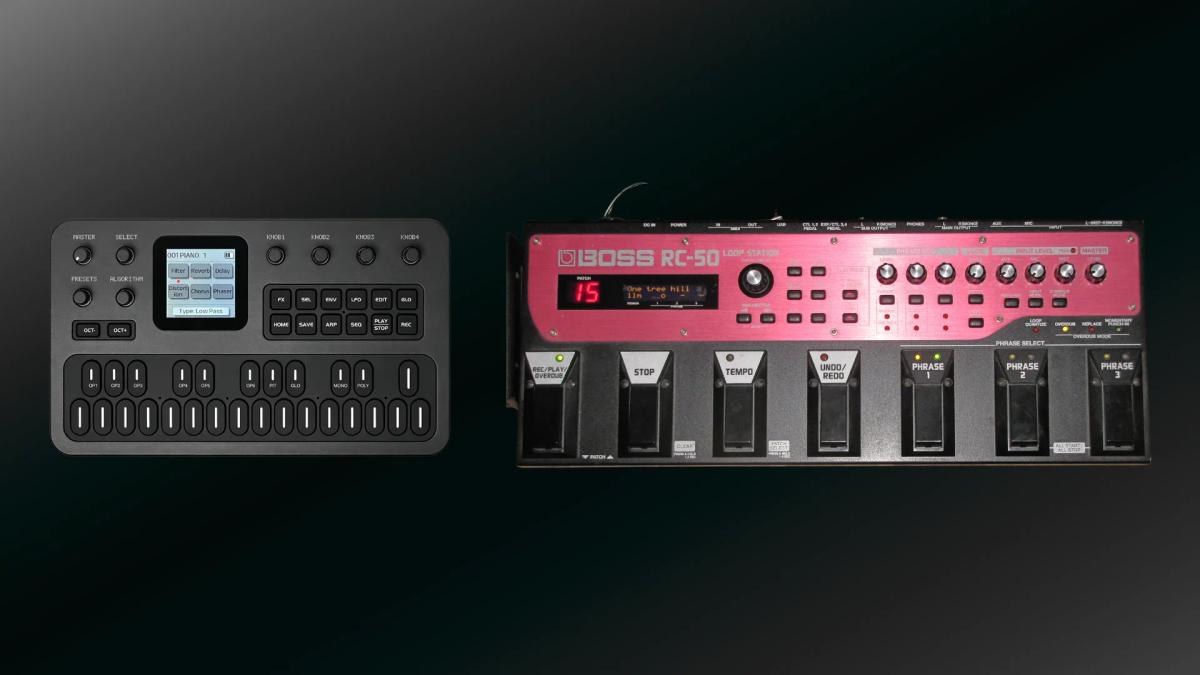
Cover image credit: Boss RC-50 photo by Massygo (CC BY 2.0), via Wikimedia Commons. M-VAVE FM-1 product image courtesy of M-VAVE.