

Home›Articles›Bigorna: a Digitone II-inspired step-sequencing firmwar…
Articles

Bigorna: a Digitone II-inspired step-sequencing firmware for rhythmic noise and IDM on the FM-1

Bigorna firmware brings parameter locks, trig conditions and a BREAK performance mode to the M-VAVE FM-1. Design, limits and install warnings.

Bernardo de Azevedo
Bernardo de Azevedo
· Updated
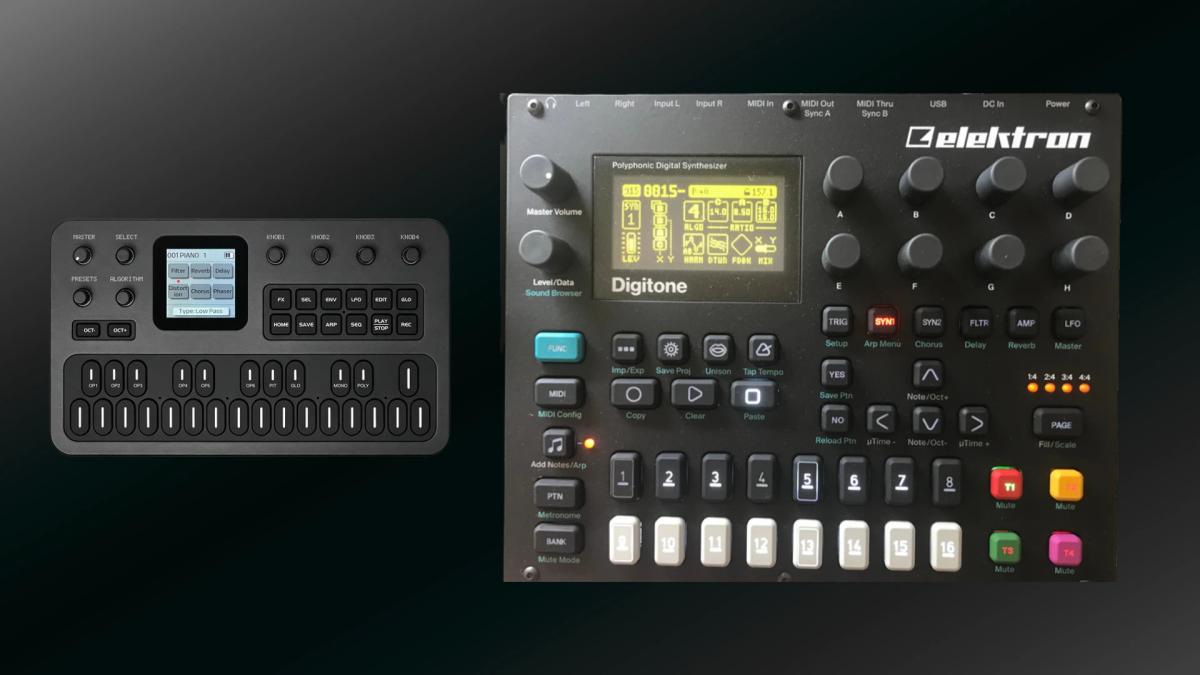
Bigorna firmware: M-VAVE FM-1 pocket synthesizer beside an Elektron Digitone

Bigorna firmware is a community operating system for the M-VAVE FM-1 by Nuno Zimas, who also wrote the ambient-oriented Tonitor. The name is Portuguese for anvil, and the target is rhythmic noise, power electronics and IDM, with the Elektron Digitone II as the stated reference. The question is how much of a Digitone-style workflow, with parameter locks, trig conditions and a sound-page layout, can be fitted onto a roughly $70 pocket synth with 27 keys, and where the compromises show.

Table of Contents

How Bigorna firmware borrows from the Digitone II

The author’s Bigorna page names the Digitone II as the model and says the firmware tries to match its harshness and grit within what the FM-1 hardware allows. The README adds that no Elektron code or data is included. The Elektron product page describes the original as a 16-voice instrument with 16 tracks, FM Tone and FM Drum engines, a 128-step sequencer, parameter locks and trig conditions.

Bigorna firmware adopts the structure rather than the scale. Sound editing is split into pages of eight parameters, in the way the Digitone II presents its synth, filter, amplifier and effect sections. Sequencing keeps per-step parameter locks and trig conditions, but the limits are much smaller: six tracks, 16 steps per track and twelve voices shared across them.

Four machines and a sound generator

In Bigorna firmware every track chooses one of four machines, and each machine stores its own sound. 4-OP is a four-operator FM voice modelled on the Digitone II’s FM Tone, with eight algorithms, ratios, feedback and two modulator envelopes. DRUM is a three-operator percussion voice with a pitch sweep, a wavefolder and a grain-based noise source, following the FM Drum idea. WAVY uses two wavetable oscillators with phase distortion, ring modulation or sync, and HIVE is a swarm of six detuned oscillators suited to pads and basses.

The HOME key is the most distinctive part of the sound design. It draws a new sound from one of 56 sound families, 29 of them for drums, and the manual says values are randomised within each recipe’s ranges with a lean towards industrial, IDM or abstract results. The README states that the recipes were ported from SynthSeeder, which it describes as the same author’s patch generator for the Digitone II. Pressing SHIFT with HOME redraws within the current family.

Sequencing: locks, conditions and BREAK

Each step can carry a note, velocity, length, trig condition, ratchet, a mutation setting and up to eight parameter locks. Ratchets run from two to eight hits, and conditions cover probabilities and A:B patterns. Tracks have independent lengths, clock divisions and directions, so polymetric layering is possible even within the 16-step limit.

A phrase generator writes a pattern suited to the track’s role, such as kick, hat or bass, and DENSITY and COMPLEXITY controls thin or fill the result. Live recording places keys onto the nearest step with the played velocity and length, and a looper adds loops of one to 32 bars, three per track, which are rounded to whole bars so that they stay in step with the patterns. A chord mode plays scale-based triads with several voicings, and the white keys play one of the stored scales from any root.

BREAK is the performance feature that gives the sequencer in Bigorna firmware its character. While the third black key is held, the pattern is rearranged with repeats, half and double time, reversals, chops, rolls, flams and octave leaps, without writing to the steps. The track position keeps running underneath, so the pattern resumes where it would have been on release. The manual adds that a break can be saved into a pattern slot, which turns a happy accident into material.

Panel handling follows a consistent logic. The six top buttons select tracks, PRESETS chooses the machine, EDIT opens the sound pages, STEP opens the step view and SAVE handles sessions, with SHIFT adding a second function to most keys. MUTE mode turns the track buttons into mutes, and holding a track button solos it. The README includes a full panel map, and a forum comment described later suggests it is worth reading before playing.

Each track also has its own arpeggiator and three LFOs, according to the manual, which means the machines can move on their own between pattern changes. Patterns switch in time, when the selected track reaches the end of its steps, and a session stores 16 patterns together with the sounds, effects and loops.

Effects, sidechain and connectivity

Per-track MANGLE offers digital degradation in four forms (wrap, XOR, bit flip and drop-outs) and a tempo-synced slicer gate with 16 patterns. Overdrive types include VALVE, RAT and FOLD, and the manual credits the last two to the LXR firmware. Send effects are chorus, a ping-pong delay and a plate reverb.

The master section has a compressor with sidechain ducking, where any track can be pushed down by another track’s hits, from light pumping to near gating. The changelog shows this part was reworked in builds 24, 29 and 30, and records fixes in builds 26 and 28 for kicks losing their body. It also describes a second processor core that renders half the voices and all effects, which indicates how the engine fits onto the hardware.

MIDI runs over USB and a 3.5 mm TRS input, with clock in and out, start, stop, continue and song position. Notes and controllers are sent and received on each track’s channel, an AUTO channel follows the selected track, and program changes select patterns. MIDI LEARN maps hardware controllers to sound or effect parameters, and the manual puts the limit at 64 learned controllers. When Bigorna firmware follows an external clock, the README says the sequencer locks to the incoming pulses to avoid drift.

The FM-1 also acts as a class-compliant stereo USB audio input at 44.1 kHz, carried on the same cable as MIDI. The project page reports testing with a MacBook Air M5 and a POCO X7 Pro phone, and the manual adds that phones may need OTG enabled. That is useful context, but it describes the author’s own setup, and no independent test results could be confirmed at the time of writing.

Lineage and build history

Bigorna is built on Tonitor, which the README says is in turn built on Felucca by Leo Kuroshita and on SLOOP by isod89. The dual-core start-up, fault handling and stock power setup come from Melodee by Kerem Kilic. The README credits that lineage with the hardware layer, USB stack, update loader and installer. For the SLOOP side of the family, see the site’s page on SLOOP.

The changelog records the first build as based on an early Tonitor version and shows a steady sequence of additions up to build 71 at the time of writing. It carries no dates, and the repository lists no formal releases, so the history can be ordered but not timed. The Bigorna repository is released under the GPL-3.0, with the website and logo under MIT.

Installing, recovering and building from source

Installing Bigorna firmware uses a browser installer in desktop Chrome, Edge or Opera, with a USB data cable. The install page states that Bigorna is unofficial, that it replaces the original firmware, that it may void a warranty and that an interrupted update can leave the FM-1 unable to start. It links two third-party recovery tools. This article does not repeat any flashing steps, so follow the project’s own warnings and the site’s install and recovery guide.

Two practical notes come from the documentation. The manual warns that Bigorna and Tonitor store sessions in ways that can overwrite each other, so the Backup page should be used before switching between them. After installing, the page also asks for one power cycle so a stopped second core is restarted.

The repository also documents a command-line route for macOS and Linux, a build script and a host test suite that needs no hardware. The README notes that the chip vendor’s toolchain runs only on Linux x86-64, so macOS users go through Docker Desktop.

Firmware and installer are covered by the GPL-3.0, with a licensing file recording the origin of each part. A trademark note states that M-VAVE, FM-1, Elektron and Digitone are named only to identify hardware. The existence of host tests is a point in the project’s favour, since they allow the audio code to be checked without risking a device.

Limits and early reception

The manual is candid about constraints. Steps are limited to 16 per track, patterns hold a fixed amount of data, and loops share a store of about 125 KB that can run out and block a save. USB audio is 44.1 kHz only, and outgoing MIDI clock pulses are placed to within one audio block, about 0.73 ms.

Changes must be saved explicitly, and starting a new session discards unsaved ones. Anyone expecting the Digitone II’s depth from Bigorna firmware will find a narrower tool, and anyone wanting long melodic sequences will find the step count short.

Public reaction is thin. On the Elektronauts FM-1 thread, the user krunchr recommended Bigorna to someone looking for an easier-to-read interface. They said it sounds great and the interface is easy to read, but added that the button and knob assignments are a bit strange and that the manual should be read first.

No independent review or video could be confirmed at the time of writing, and this article is based on the project’s documentation rather than hardware testing. Compared with the six-operator approach of Korg’s opsix, Bigorna works with fewer operators per voice and spends its effort on rhythm.

Final perspective

Bigorna firmware is a focused rhythm instrument with a defined taste: gritty, glitch-prone and built around performance gestures rather than polished presets. Its sequencer ideas are well documented and its limits are stated openly. The cost of that depth is a steeper learning curve, a short step count and the risks that come with any unofficial firmware. It is best seen as a companion to Tonitor rather than a replacement, since the two serve different musical jobs.

Sources

  1. Bigorna: firmware for the M-VAVE FM-1, Nuno Zimas
  2. nzimas/bigorna, GitHub
  3. Bigorna manual, Nuno Zimas
  4. Bigorna changelog, Nuno Zimas
  5. Bigorna install page, Nuno Zimas
  6. Elektron Digitone II, Elektron
  7. M-vave fm-1, thread page 26, Elektronauts
Bernardo de Azevedo
Written by
Bernardo de AzevedoFounder & Editor

His connection with music began at age 6, in the 1980s, when his father introduced him to Jean-Michel Jarre's Rendez-Vous on vinyl. He works professionally in the legal field, while synthesizers became his space for abstraction and creative exploration. Founder of The Synth Source.