

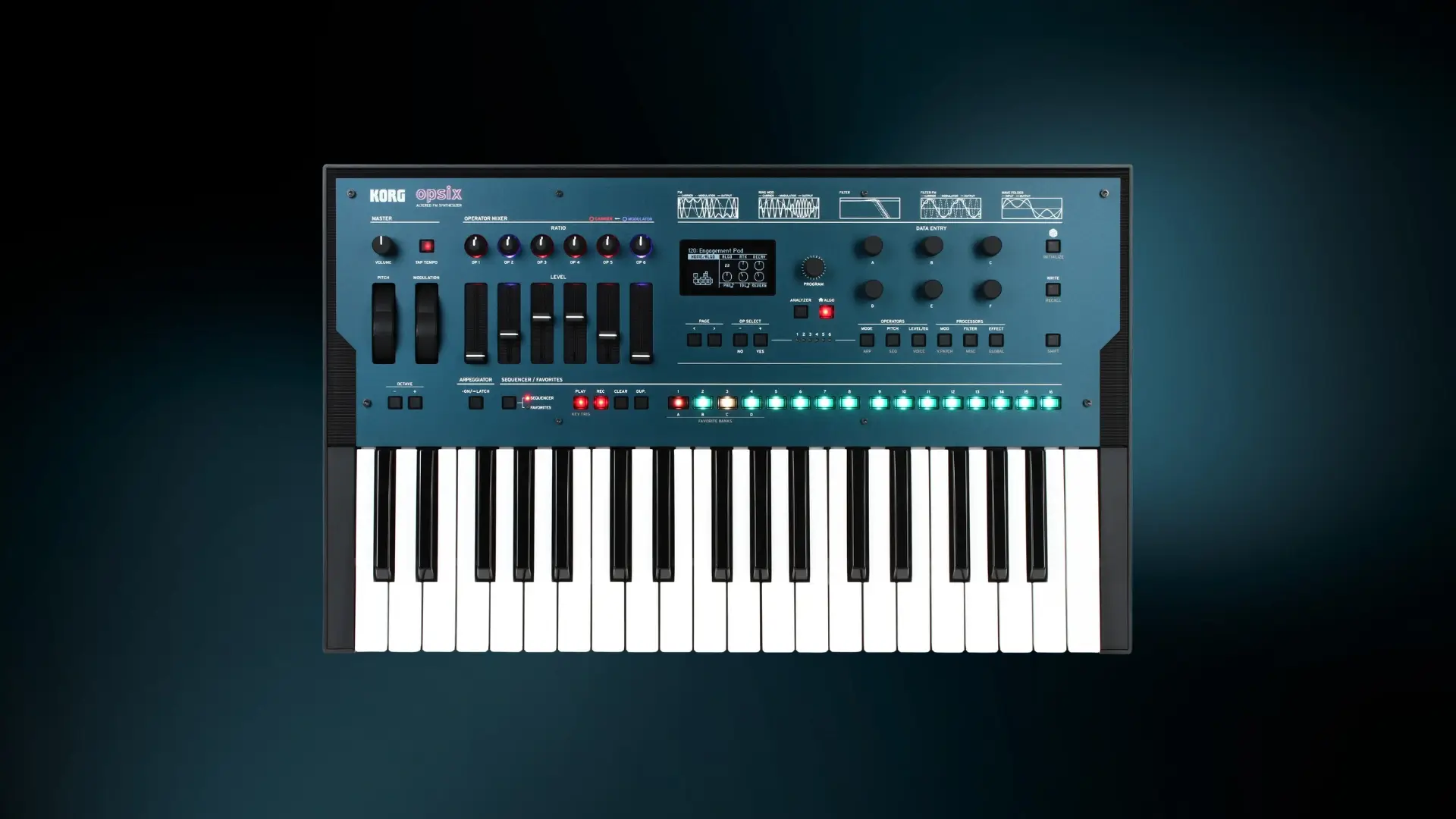
The Korg Opsix is a 37-key digital polysynth announced in November 2020 and released near the end of that year, combining a six-operator FM architecture with 32-voice polyphony, multiple operator-processing modes, subtractive filters, effects, sequencing, and a physical operator mixer. Its importance lies less in reviving the Yamaha DX7 than in confronting the problem that followed the DX7 throughout its history: six-operator FM could produce extraordinarily complex sounds, but its relationships were difficult to understand and tedious to edit. By giving each operator a dedicated level fader, ratio control, and color-coded role, the Korg Opsix attempted to turn algorithmic synthesis into something that could be played and explored through physical gesture.
Table of Contents
Korg Opsix sound and character
The Korg Opsix can deliver the bright electric pianos, glassy bells, metallic percussion, hard basses, and sharply articulated transients traditionally associated with six-operator FM synthesis. Those sounds remain part of its identity, but they represent only the most historically familiar corner of the instrument. Its broader character is more abrasive, hybrid, and structurally flexible than that of a straightforward DX7 recreation.
Each of its six operators can originally function as an FM oscillator, ring modulator, multimode filter, filter-FM processor, or wavefolder. Version 2.0 added an Effect operator mode with ten additional processes and expanded the oscillator selection with pink and blue noise. Because different operator modes can coexist within one program, a patch can combine conventional FM components with filtered noise, ring-modulated metallic layers, wavefolded harmonics, or an analog-style oscillator routed through the global filter.
This architecture gives the Korg Opsix several recognizable sonic personalities. Conventional sine-wave FM can remain clean, controlled, and precise. Ring modulation emphasizes metallic and inharmonic spectra. Filter FM can produce vocal, resonant, and unstable timbres. Wavefolding pushes simple waveforms into increasingly dense and aggressive harmonic shapes. Its modeled MS-20 and Polysix filter types can soften or constrain those spectra, making the Korg Opsix capable of warmer pads, rounded basses, and subtractive-style leads without erasing its fundamentally digital precision.
The Korg Opsix is therefore not naturally “vintage” or “modern” in a single, fixed sense. It can imitate some established FM and virtual-analog conventions, but its strongest identity emerges when those methods collide. Evolving pads can begin with stable harmonic relationships and then break into resonant motion. Bass patches can combine a solid fundamental with folded or frequency-modulated upper harmonics. Percussive sounds can move between recognizable mallets and synthetic, almost industrial transients. The result is a synthesizer whose character is defined less by one tone than by its ability to place contrasting synthesis behaviors inside the same voice.
Features and architecture
- Manufacturer: Korg.
- Year introduced: Announced on November 11, 2020, with commercial availability beginning in December 2020.
- Production years: The original keyboard model is commonly cataloged as a 2020–2024 instrument. Korg did not prominently publish a formal final-production date, but the 64-voice Korg Opsix mkII succeeded it in 2024.
- Synthesis type: Six-operator digital Altered FM synthesis, combining FM with ring modulation, operator filtering, filter FM, wavefolding, subtractive filtering, waveshaping, additive techniques, and, after the Version 2.0 update, operator-level effects.
- Category: Monotimbral digital polyphonic keyboard synthesizer.
- Polyphony: Up to 32 voices, reduced to approximately 24 voices under settings that use more computationally demanding high-definition waveforms.
- Original price: Approximately $799.99 in the United States, £699 in the United Kingdom, and €799 in Europe at launch.
- Current market price: As of August 1, 2026, remaining new or new-old-stock examples have appeared around $329–$421, while used-market guides generally place the original model around $265–$405, depending on condition and location.
- Operators and oscillators: Six operators, 40 preset routing algorithms, and one programmable user algorithm. The original system provided 21 oscillator waveforms; Version 2.0 added pink and blue noise for a total of 23.
- Operator modes: The original five modes are FM, Ring Mod, Filter, Filter FM, and Wave Folder. Version 2.0 added an Effect mode containing ten operator-level effect types.
- Filter: Eleven global filter types, including modeled MS-20 low-pass and high-pass filters, a Polysix low-pass filter, and two-pole or four-pole low-pass, high-pass, band-pass, and band-reject configurations. Filter and Filter FM operator modes can also process individual operators before the global signal path.
- LFOs: Three LFOs with 23 selectable waveforms and independent routing possibilities.
- Envelopes: Each of the six operators has its own ADSR level envelope. Three additional ADSR envelope generators are available, with default assignments including pitch, global filter, and an assignable modulation destination.
- Modulation system: Twelve virtual-patch routings, velocity and release-velocity response, pitch and modulation wheels, pedal control, sequencer motion lanes, and extensive operator-to-operator modulation. Version 2.0 allows aftertouch received from an external MIDI controller to be used as a modulation source, although the original keyboard itself does not generate aftertouch.
- Operator mixer: Six dedicated ratio knobs and six level faders. LEDs identify carriers in red and modulators in blue, making the current algorithm easier to interpret while editing.
- Sequencer and arpeggiator: A 16-step polyphonic sequencer supporting up to six notes per step, six motion-sequencing lanes, and seven arpeggiator patterns.
- Effects: Three effect slots drawn from 30 effect types, including modulation, delay, reverb, dynamics, distortion, and other processing categories. Version 2.0’s Effect operator is separate from these global effect slots.
- Memory: 500 program locations and 64 Favorite registrations. The original factory configuration divided the memory into 250 preset and 250 user programs; Version 2.0 added 100 factory sounds, changing the supplied allocation to 350 presets and 150 open user locations when the updated factory data is loaded.
- Keyboard: 37 full-size, velocity-sensitive keys with release-velocity detection. The keybed has no channel aftertouch or polyphonic aftertouch.
- Audio connections: Two impedance-balanced quarter-inch outputs, left/mono and right, plus a quarter-inch stereo headphone output and a damper-pedal input. Half-damper operation is not supported.
- MIDI and USB: Five-pin MIDI input and output plus a USB Type-B connection for communication with a computer.
- Display: A monochrome OLED display supplemented by six context-sensitive data-entry knobs. The display can also show spectrum-analyzer and oscilloscope-style visualizations.
- Dimensions and weight: 565 × 338 × 90 millimeters and approximately 2.9 kilograms.
- Power: External 12-volt DC power supply, with rated consumption of 5 watts.
Strengths
- A physical explanation of FM: The operator mixer turns level and frequency-ratio relationships into direct, visible controls. The red and blue carrier/modulator indicators do not eliminate the conceptual difficulty of FM, but they make experimentation faster and considerably less abstract than editing one parameter at a time through a small display.
- More than a DX7 substitute: User-defined algorithms, multiple oscillator waveforms, operator filtering, ring modulation, wavefolding, modeled analog filters, and operator-level effects make the Korg Opsix capable of architectures that the original DX7 was never designed to produce.
- Contrasting synthesis techniques inside one program: A single patch can combine a relatively conventional oscillator or carrier with FM sidebands, filtered noise, metallic ring modulation, and wavefolded layers. This allows sounds to evolve structurally rather than merely through conventional filter sweeps.
- Flexible algorithm design: The 40 supplied algorithms provide immediate starting points, while the user algorithm permits custom routing between the six operators. This is especially valuable for experienced FM programmers who want to move beyond fixed historical structures.
- Useful modulation and motion sequencing: Six motion lanes can record parameter movement within each 16-step sequence. On an instrument whose timbre depends heavily on changing operator levels, ratios, feedback, and filtering, those lanes can function as part of the synthesis architecture rather than as a decorative sequencing feature.
- Broad factory programming: The preset library involves Korg programmers and external sound designers including Richard Devine, Francis Preve, Matt Pike, VROMM, Dean Walliss, and Luke Edwards, illustrating how the architecture can move from accessible keyboard sounds to experimental digital textures.
- Compatibility with historical FM material: The instrument can receive banks of 32 sounds in the first-generation Yamaha DX7 System Exclusive format. Conversion cannot reproduce every DX7 patch perfectly because the two architectures differ, but it gives the Korg Opsix access to a large historical programming vocabulary.
- Portable hardware format: At 2.9 kilograms, the original Korg Opsix is easy to move between a studio, rehearsal space, and live setup while retaining full-size keys and a largely self-contained interface.
- Continuing software and hardware ecosystem: Korg expanded the platform into Korg Opsix native software, the larger Opsix SE, the 64-voice Korg Opsix mkII, and a desktop module. The original product page also continued to receive system software and support updates into 2026.
Limitations
- The interface simplifies FM but does not make it simple: The six faders and ratio controls expose the most important operator relationships, yet detailed editing still depends on a small monochrome display and six shared data knobs. Complex modulation, envelope, sequencing, and effect settings continue to require menu navigation.
- No aftertouch on the original keyboard: Version 2.0 can interpret aftertouch received over MIDI, but the internal 37-key keybed does not produce it. Expressive players therefore need an external controller to use pressure as a modulation source.
- Monotimbral operation: The Korg Opsix cannot independently layer or split multiple programs across the keyboard. Compared with multitimbral digital instruments, its 32 voices all belong to a single program architecture at a time.
- Polyphony depends on processing load: The advertised maximum is 32 voices, but more demanding waveform and processing choices can reduce that figure to approximately 24. Dense sustained patches with long releases can therefore produce earlier voice stealing than the headline specification suggests.
- Limited performance macro design: Reviewers noted the absence of a broad set of freely assignable macro controls. The existing wheels, operator mixer, data knobs, and pedal routing offer considerable control, but creating a few consolidated, performance-oriented transformations is less immediate than on instruments built around dedicated macro systems.
- Three-octave keyboard range: The compact 37-key format suits portability and sound design, but it is restrictive for two-handed playing, extended piano parts, wide splits, or performances that depend on a larger physical range.
- The sequencer is compact rather than comprehensive: Six-note steps and six motion lanes are valuable for phrases and timbral animation, but the fixed 16-step length positions it as a patch-level performance tool rather than a full composition environment.
- The original model now competes with its successor: The Opsix mkII doubles maximum polyphony to 64 voices and has been discounted to roughly $599.99 in the United States. Buyers considering unusually expensive original units must therefore compare the price difference carefully.
Historical context
The Korg Opsix belongs to a lineage that begins with the Yamaha DX7 but cannot be reduced to nostalgia for it. Released in 1983, the DX7 brought six-operator FM synthesis, 16-voice polyphony, digitally stable tuning, and a radically different tonal vocabulary into mainstream professional music. Its electric pianos, bells, basses, and complex transients became defining sounds of the decade. Yet its membrane-button interface and small display also helped establish the idea that digital synthesis was powerful but difficult to program.
Korg had already explored related territory through instruments and engines such as the Prophecy, Z1, and Kronos MOD-7. MOD-7 combined variable phase modulation with waveshaping, ring modulation, subtractive processing, sample integration, and DX-compatible data import. The Korg Opsix did not invent Korg’s hybrid approach to digital phase modulation; it compressed that philosophy into a more focused and comparatively affordable instrument.
The first public Korg Opsix prototype appeared at the 2020 Winter NAMM show. That version used a larger enclosure with a visual design more explicitly reminiscent of Yamaha’s DX series, but it was not playable by attendees. The production model announced in November adopted the lighter 37-key chassis format associated with Korg’s Wavestate generation, while preserving the six-fader operator mixer as its defining control concept.
Its timing was significant. By 2020, software instruments could already reproduce classic FM architectures cheaply and accurately. A new hardware FM synth therefore needed to justify its physical existence through interaction rather than through computational exclusivity. The Korg Opsix responded by treating interface design as part of the synthesis method. Instead of asking users to select an algorithm and then inspect operators individually, it presented the six operators as a visible mixing surface that could be altered in real time.
This was not a reissue, and it was not Korg’s attempt to place a familiar 1980s sound engine inside a nostalgic enclosure. It was a reinterpretation of the programming problem that had followed FM for nearly four decades. Its historical argument was that FM did not need to become less complex; the relationships creating that complexity needed to become more legible.
Legacy and significance
The Korg Opsix matters because it reframed accessibility. Many attempts to simplify FM have reduced the number of operators, hidden the algorithms, or presented a collection of carefully prepared macro controls. Korg retained six operators and exposed their relationships. The player can watch the carrier and modulator roles, change their ratios, mix their levels, and hear the algorithm reorganize itself as a connected system.