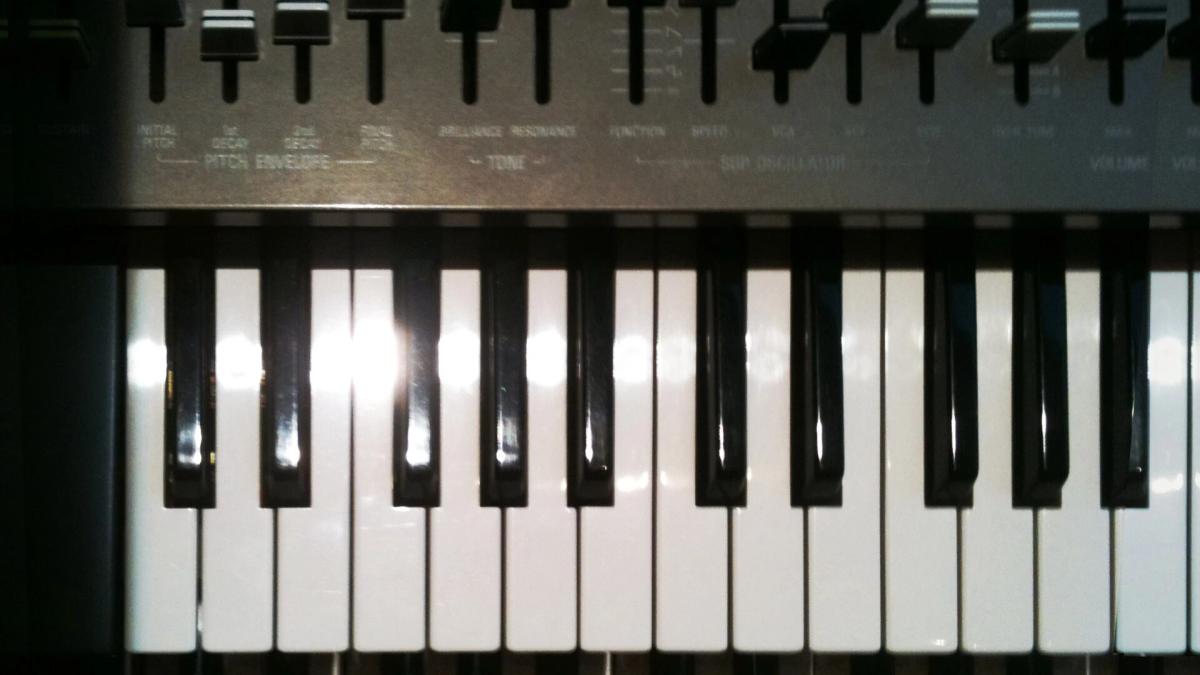
Production numbers are just as fuzzy. Wikipedia says the total is unknown but thought to be under 100, with at least 13 known to exist outside Japan. The Amberian Dawn report says only a few dozen were made. Reid writes that Yamaha spent 2,000,000 pounds on development, a figure that appears only in his article. What can be said with confidence is that the Yamaha GX-1 was never a commercial success, and was never meant to be one.
Stevie Wonder, Keith Emerson and the rock-star owners
If the GX-1 had a flagship customer, it was Stevie Wonder. Reid writes that Wonder owned two and used one extensively on Songs in the Key of Life, released in 1976. Wikipedia adds that he reportedly called it the “Dream Machine” because of its three keyboards, though that nickname appears in only one of the sources I could check. Reid also repeats a story that Wonder’s equipment manager once moved a GX-1 on a forklift and was stopped by the Los Angeles police on the 101 Freeway.
Keith Emerson was the other loyal customer. Reid quotes him describing his first GX-1 as a turning point for Emerson, Lake & Palmer, and he sold two of them in 1995 before moving to the United States. Wikipedia credits the instrument with appearing on Works Volume 1, Works Volume 2, Love Beach and the 1977 Works orchestral tour, and says Emerson later bought the GX-1 that John Paul Jones had used on Led Zeppelin’s In Through the Out Door.
The Amberian Dawn report claims that the first three units went to Wonder, Emerson and the producer Mickie Most, though that is a single-source statement. Wikipedia adds that Aphex Twin later acquired a GX-1 from Most’s estate.
Benny Andersson and the ABBA years
The most documented individual instrument may be Benny Andersson’s. The Amberian Dawn report says he acquired one of the last GX-1s made in early 1979 and used it on ABBA records between 1979 and 1982. It also toured with the group in 1979 and appeared later on the musical Chess.
After that the story turns into a familiar tale of obsolete hardware. The report says the instrument fell into disrepair in the late 1980s. It stood in ABBA The Exhibition from 1999 to 2001, was stored at Polar Studios until that studio closed in 2004, and moved to Andersson’s Riksmixningsverket studio in Stockholm in 2011.
In 2014 Andersson decided to restore it. It left in spring 2015 and came back that autumn, and he says it has never sounded better. By the report’s account it is one of very few fully working examples left.
Final perspective
The Yamaha GX-1 is easy to read as an absurd object, a three-keyboard, near-one-tonne synthesizer that almost nobody could afford. A better reading is that it was the point at which Yamaha learned how to build a polyphonic analog synthesizer at scale. Yamaha’s history calls the CS series the first non-Electone products to inherit SY-1 technology, and Reid says the CS50, CS60 and CS80 inherited GX1 features.
Yamaha describes the CS-80 as eight-note polyphonic, 82 kilograms and 1.28 million yen. Reid dates the CS50, CS60 and CS80 to 1976, while Yamaha’s page gives 1977 for the CS-80, so the exact year is one of the loose ends.
Whatever the date, the progression is plain. The GX-1 was the expensive experiment, and the CS-80 was the result you could actually put on a stage. The few people who owned the original were, in effect, living inside the prototype. That says something about how music technology often advances: not through the instrument that sells, but through the one built before anyone knew what it was for.
That is why the Yamaha GX-1 story keeps drawing musicians and historians back to it.
What makes the Yamaha GX-1 story memorable is how ordinary the people involved were, and how improbable the outcome turned out to be. Anyone retelling the Yamaha GX-1 story has to admit that part of it comes down to timing and luck. The Yamaha GX-1 story also shows how quickly a promising idea can slip out of public view.
Revisiting the Yamaha GX-1 story today, it is striking how many details were lost or rewritten over the years. Each retelling of the Yamaha GX-1 story adds a little more context to what the original documents leave out. If there is one lesson in the Yamaha GX-1 story, it is that technology rarely follows a straight line.
Related stories
Sources