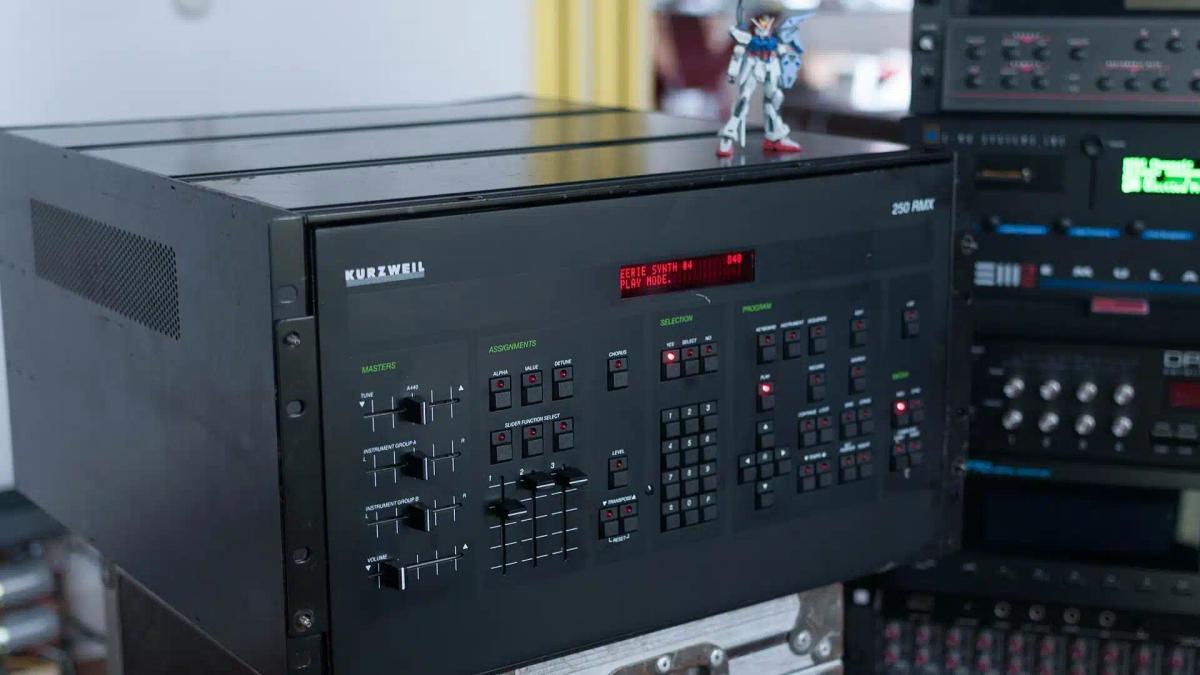
The hardware was substantial. The review lists an 88-note keyboard, about two megabytes of ROM, twelve 12-bit converters and twelve-note polyphony, with a sequencer of twelve tracks and about thirty factory sounds including piano, organ, strings, brass, bass, guitar and drum kits. Wikipedia describes the same architecture as twelve separate converters and CEM 3335 analog envelopes. The prototype, it says, had a sampler and a battery-backed sequencer.
Price, tests and a verdict
The money was the first obstacle. The 1984 review reports that the UK recommended price was 10,995 pounds before VAT, and that the original launch in June 1983 had quoted a price under 10,000 dollars before exchange rates moved. Add-ons such as a sound modelling program, a sound laboratory and an Apple Macintosh brought the reviewer’s total to about 18,035 pounds.
The prototype was demonstrated in June 1983, according to the Technical Grammy announcement, and the K250 was introduced commercially in 1984, while Wikipedia’s K250 article says it was unveiled at the 1984 Winter NAMM show. Sources therefore differ on the exact unveiling.
The reviewer, David Ellis, tested it head-to-head with a Bösendorfer nine-foot concert grand. He found the Bösendorfer won on both timbre and dynamics, though he called the velocity-dependent tone of the K250 very impressive. He also criticised audible sampling regions across the keyboard, weak trumpet and trombone, looping artifacts in the strings and an unfinished sequencer. His verdict supported the design principles but questioned the practicality of ROM storage and the cost. The review also notes that Wonder owned both a Kurzweil Reading Machine and a K250.
What happened to the Kurzweil K250
The instrument stayed in production for several years. Wikipedia says it was made until 1990, while Kurzweil’s own product history says it was produced from 1984 to 1989, so accounts differ. The keyless K250 Expander appeared in 1985 and the rack-mount RMX in 1986, according to the company’s history. Young Chang acquired Kurzweil Music Systems in 1990, Wikipedia says, and Hyundai Development Company acquired Young Chang in 2006.
The company went on to build further lines. Wikipedia lists the K2000 of 1991, which introduced the V.A.S.T. synthesis engine, and the K2500 of 1995 and 1996, which raised polyphony to 48 voices. A new K2700 workstation appeared in late 2021. Ray Kurzweil himself received the 2015 Technical Grammy on February 7, 2015, for his achievements in music technology.
Final perspective
The Kurzweil K250 matters because of the way it was imagined. Kurzweil did not set out to make a better synthesizer. A musician asked for the warmth of acoustic instruments combined with the control of a computer, and Kurzweil took the request seriously, which made his reading-machine technology a musical tool.
It also shows how new instruments are judged against old ones. The 1984 review put the K250 next to a concert grand, and the grand won. That is hardly a surprise, but the fact that the comparison was made at all shows how far the ambition had moved. The Kurzweil K250, with its price, its flaws and its adviser, was one of the first serious attempts to ask whether a machine could stand beside a real piano.
That is why the Kurzweil K250 story keeps drawing musicians and historians back to it.
What makes the Kurzweil K250 story memorable is how ordinary the people involved were, and how improbable the outcome turned out to be. Anyone retelling the Kurzweil K250 story has to admit that part of it comes down to timing and luck. The Kurzweil K250 story also shows how quickly a promising idea can slip out of public view.
Revisiting the Kurzweil K250 story today, it is striking how many details were lost or rewritten over the years. Each retelling of the Kurzweil K250 story adds a little more context to what the original documents leave out. If there is one lesson in the Kurzweil K250 story, it is that technology rarely follows a straight line.
Related stories
Sources