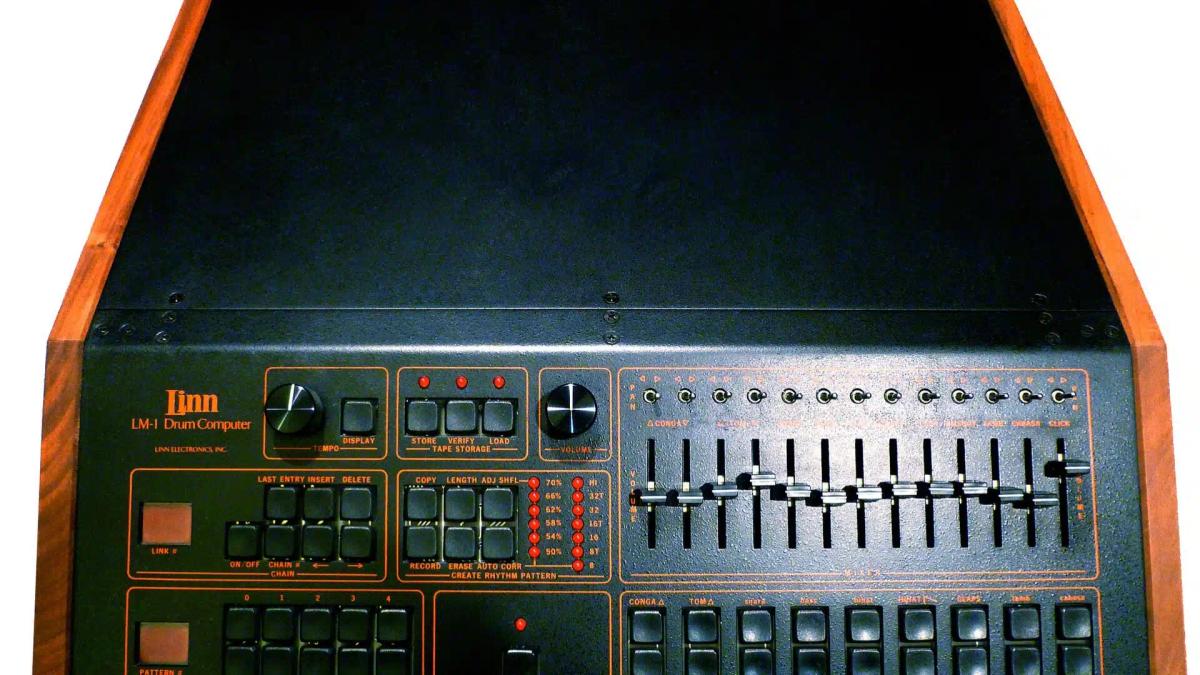
She describes a temperamental device that depended on warming up and could drift in timing if it got too hot. What Prince valued were the individual outputs and the tuning knob for each sound, which let him shape every drum separately.
Rogers also recalls that he ran some of the percussion through Boss and Roland guitar pedals. Hi-hat, cabasa and claps could pass through a distortion pedal, and she mentions a delay pedal as well. Linn, asked about this, said he would not doubt it, and noted that Prince seemed to hear the sound he wanted and applied guitar-world processing to drums.
The groundwork was laid before Purple Rain. The credits of the 1999 album, released on October 27, 1982, list the LM-1 on tracks one through ten, and the record’s sound is built on drum machine and synthesizers. The follow-up single “Little Red Corvette” reached number six on the Billboard Hot 100.
How the knock in “When Doves Cry” was made
“When Doves Cry” was recorded at Sunset Sound in Los Angeles. According to Wikipedia, tracking took place on March 1, 1984, with overdubs the next day, a mix on March 3 and edits on March 4 and 5. Prince wrote and recorded it after the other tracks for Purple Rain were done, reportedly after director Albert Magnoli asked for a song for a film sequence. Prince sang all the vocals and played every instrument, and the credits list guitar, a Yamaha DX7, an Oberheim OB-Xa and the LM-1.
Linn gave a detailed account of the drum sound in a 2017 interview with The Current. The knocking pulse, he said, is the machine’s cross-stick snare sample, tuned down by about an octave or more. Prince also turned the tambourine into a loose, jangling noise that no longer resembles a tambourine. A flanger was applied to the drum machine so its tone sweeps up and down. The same article reports that the LM-1 beat sits under the opening guitar solo and is looped through the track.
The detail worth noticing is that nothing here is exotic. These were the same twelve sounds every other owner had. Prince simply detuned them, bent them and processed them until they were unmistakable.
The song with no bass
The arrangement is bare. Wikipedia states plainly that “When Doves Cry” has no bass line, which was highly unusual for a dance record of its decade. Prince said an early version had one. After a conversation with singer Jill Jones, he judged the song too conventional with it and took it out. Bassist Brown Mark added bass parts when the song was played live on the Purple Rain Tour.
Without the bass, the drum machine has to carry the low end and the pulse, which is why its tuning matters so much. The vocals, the synth lines and the guitar all sit on top of that machine and almost nothing else. The record became Prince’s first number one on the Billboard Hot 100, staying there for five weeks from July 7 to August 4, 1984, and Billboard ranked it the top single of the year.
What happened to Linn and his machines
Linn replaced the LM-1 with the LinnDrum in 1982, a cheaper and more stable machine with more memory and cymbals. To cut costs, he removed independent tuning from most of the drums. Linn notes that this change made extreme tunings like the knocking sound on “When Doves Cry” impossible, and Prince kept using the original. Linn says a magazine once showed Prince’s original LM-1 at Paisley Park, displayed with a lamp, like a shrine. He never met Prince, despite trying to reach him through a roadie and a manager.
The business did not last. The Linn 9000, released in 1984 as an integrated drum machine and MIDI sequencer, gained a reputation for software bugs, and Wikipedia notes that this contributed to the collapse of Linn Electronics in February 1986. The ideas lived on. Linn worked with Akai on the MPC60, released in 1988, and it went on to shape pop and hip hop production.
Final perspective
The LM-1 story is usually told as a tale of realism: a guitarist sampled real drums, and pop music changed. That is true as far as it goes. What Prince’s records show is the other half. Once a machine can reproduce a snare, the interesting move is to stop asking it to reproduce a snare.
The limits helped. Twelve sounds, no cymbals and crude 8-bit samples left room for a musician with a clear idea to turn the Linn LM-1 into a voice. Linn built a better metronome. Prince used the tuning knobs and a stack of guitar pedals to turn it into a hook, and in doing so showed a generation of producers that the character of a drum machine lives in what you do to it.
Related stories
Sources