Home›Articles›Keith Emerson Moog: The one-take solo that launched the…
Articles

Keith Emerson Moog: The one-take solo that launched the monster modular

Keith Emerson: At the end of “Lucky Man,” Emerson, Lake and Palmer’s debut hit, a Moog synthesizer swoops from a low drone to a high, gliding line. It was…

Bernardo de Azevedo
Bernardo de Azevedo
· Updated
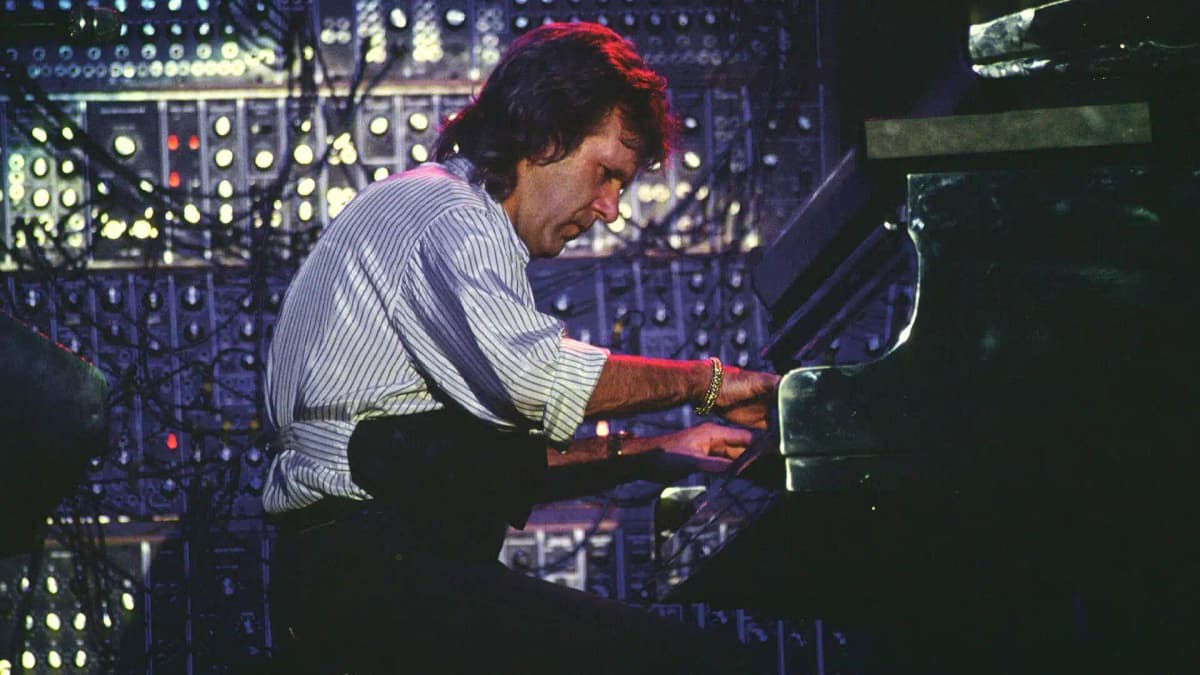
Keith Emerson Moog - historic photo

At the end of “Lucky Man,” Emerson, Lake & Palmer’s debut hit, a Moog synthesizer swoops from a low drone to a high, gliding line. It was also, by Keith Emerson’s own later account, an improvised take he never wanted released.

That small accident sits at the start of a larger story. Over the following years, Emerson turned the Moog modular from a studio curiosity into a stage spectacle, dragging a cabinet that weighed several hundred pounds around the world and fighting its tuning every night. How did a musician who made a reputation by abusing a Hammond organ come to define the Moog for a generation of rock fans?

Table of Contents

  • Keith Emerson Moog: from the Hammond to a record-shop revelation
  • Borrowing Mike Vickers’s synthesizer
  • A solo that was meant to be a rehearsal
  • The monster arrives
  • Fighting the tuning
  • Friendship with the maker
  • Final perspective

Keith Emerson Moog: from the Hammond to a record-shop revelation

Keith Emerson was born in Todmorden, Yorkshire, on 2 November 1944, and he made his name in the late 1960s with The Nice, a band that treated the Hammond organ as a stage prop as much as an instrument. According to Wikipedia, he hit the organ, pushed it over and wedged knives between the keys to sustain notes. The Nice formed in 1967 and split in March 1970.

His introduction to the Moog came through a recording. Wikipedia says Emerson first heard one when a record-shop owner played him Wendy Carlos’s Switched-On Bach in 1968, and Sound on Sound’s account places the shop in Soho. For a keyboard player already restless about the limits of the organ, the album suggested that a new sound world was possible. The problem was access, because very few people in Britain owned a Moog.

Borrowing Mike Vickers’s synthesizer

The solution was Mike Vickers, the former Manfred Mann player, who was one of the first musicians in the UK to own a Moog. Wikipedia reports that Vickers paid £4,000 to have his shipped from the United States. In February and March 1970, Emerson performed with The Nice and the Royal Philharmonic Orchestra at the Royal Festival Hall, playing Richard Strauss’s “Also sprach Zarathustra” with Vickers’s Moog. Vickers stayed beside the instrument and changed the patches.

Sound on Sound adds that Emerson wrote to Moog when he formed ELP later that year, and that Walter Sear, Moog’s East Coast salesman, replied. Emerson bought a modular system with money from the new band’s record deal. The same article says Moog rarely sold outside the United States at that time, so British customers had little support, and that Emerson left his instrument with Vickers for a week. Vickers set up the patches that became the basis of ELP’s early sounds and drew cabling diagrams for him.

A solo that was meant to be a rehearsal

Emerson, Lake & Palmer formed in 1970 with Greg Lake and Carl Palmer, and signed to Atlantic Records after about four months of rehearsal. Their performance at the Isle of Wight Festival that year was seen by a crowd Wikipedia estimates at roughly half a million. The first album introduced the Moog in the final section of “Tank” and in the solo on “Lucky Man,” according to the Bob Moog Foundation.

The “Lucky Man” solo has the best story. Wikipedia reports that Emerson recorded it in one take, “just jamming around,” and that every available track had already been used, so there was no chance to try again. He was devastated to learn the take would be on the record. It begins as a low drone on D and leaps up two octaves, using the glide control throughout.

Years later he is quoted as saying it was the solo he had to live with, and in the late 1970s, having forgotten it, he asked Keyboard magazine for a transcription. The single came out in December 1970 in Europe and February 1971 in the United States, reaching number 48 on the Billboard Hot 100.

Wikipedia credits The Monkees’ “Daily Nightly” (1967) as the earliest rock recording to use a Moog for a lead line, so Emerson’s solo was not the first. It was, however, among the first to reach a very large audience.

The monster arrives

After that debut, Emerson’s setup grew. Wikipedia says he was the first artist to tour with a Moog synthesizer, and that his “Monster Moog” weighed about 550 pounds, stood ten feet tall and took four roadies to move. A Thump obituary, citing the New York Times, says it comprised 81 modules.

Sound on Sound gives a lower weight of about 400 pounds, noting that the system began as a single cabinet that could be carried under one arm and kept growing through the 1970s with extra oscillators, filters, sequencers and custom parts.

The two numbers probably describe different moments in the instrument’s life.

On stage the rig became part of the act. Thump reports that Emerson ended shows by deploying bat wings from the modular unit, and he threw knives at a board. Wikipedia adds that the band’s 1973 and 1974 tour set the Moog running at the close of the show with the instrument angled toward the audience. By then the synthesizer had moved from studios to arenas, and Emerson was its most visible ambassador.


Fighting the tuning

The Moog modular was notoriously unstable. Wikipedia says its oscillators often drifted out of tune as the temperature changed, which is not a comfortable property for a stage instrument lit by hot lights. The Bob Moog Foundation tells a story from ELP’s 1972 album Trilogy: Emerson’s Minimoog solo on “From the Beginning” was recorded at about four in the morning after an engineer accidentally erased the first version, and Emerson says the replacement is just slightly out of tune.

He said that getting the Minimoog in tune was always a challenge.

The modular also demanded technique. The same Foundation article describes how the “Toccata” sound on Brain Salad Surgery (1973) was built from patches that modulated in two directions at once, and how on a live version of “Mass” Emerson exploited a glitch in the ribbon controller to produce stuttering sounds and manual pitch slides. What looks like excess in photographs was also a form of engineering.

Friendship with the maker

Emerson’s relationship with Bob Moog is described warmly in several sources. The Foundation article calls Moog a friend and says he was amazed at how quickly Emerson turned new knowledge into artistic results, quoting Moog on Emerson’s habit of turning knobs and flipping switches to see what happens. Wikipedia reports that Moog gave him prototypes, including the Apollo, which debuted on “Jerusalem” on Brain Salad Surgery.

Sound on Sound corrects a popular story that Moog dismissed Emerson’s requests. It says the company had built performance instruments for the 1969 Jazz in the Garden concert, that Moog’s engineers added custom features to Emerson’s system, including a vibrato switch and a tuner, and that photographs show Moog and Emerson together at Rich Stadium in Buffalo in 1974. Even so, the Moog company was sold, and by Works in 1977 Emerson had moved to Yamaha’s GX-1 and the Korg PS-3300.

Final perspective

Keith Emerson’s use of the Moog is often remembered for size and theatre, but the sources show something more specific: a player who learned the instrument by borrowing one, built a working partnership with its maker and its programmer, and made a one-take improvisation into a signature. The “Lucky Man” solo is a good example, because its charm comes from the fact that it was never carefully planned.

The story also shows how early synthesizers behaved in the field. They drifted, they weighed too much, they needed a specialist like Mike Vickers to set up their sounds, and they rewarded a performer willing to treat the equipment as part of a stage show. In 2014, Moog announced a recreation of Emerson’s system, a project Sound on Sound described as a complete rebuild rather than a restoration.

That a company would reconstruct a particular man’s collection of cabinets suggests how closely the instrument and the player were linked in public memory.

That is why the Keith Emerson story keeps drawing musicians and historians back to it.

Few chapters of synthesizer history show as clearly as Keith Emerson how far a single idea can travel.

Looking back, the Keith Emerson episode suggests that the most unusual stories are often the most instructive ones.

For anyone tracing the history of electronic instruments, Keith Emerson is a name worth remembering.

What makes the Keith Emerson story memorable is how ordinary the people involved were, and how improbable the outcome turned out to be. Anyone retelling the Keith Emerson story has to admit that part of it comes down to timing and luck. The Keith Emerson story also shows how quickly a promising idea can slip out of public view.

Revisiting the Keith Emerson story today, it is striking how many details were lost or rewritten over the years. Each retelling of the Keith Emerson story adds a little more context to what the original documents leave out. If there is one lesson in the Keith Emerson story, it is that technology rarely follows a straight line.

Related stories

Sources

Bernardo de Azevedo
Written by
Bernardo de AzevedoFounder & Editor

His connection with music began at age 6, in the 1980s, when his father introduced him to Jean-Michel Jarre's Rendez-Vous on vinyl. He works professionally in the legal field, while synthesizers became his space for abstraction and creative exploration. Founder of The Synth Source.