Table of Contents
- Beatles Moog: a demonstration in Los Angeles
- A waiting list and an album called Electronic Sound
- An instrument in a small room at Abbey Road
- The uncredited programmer
- Four songs, four ways to use a synthesizer
- Noise, tension and an abrupt ending
- Final perspective
Beatles Moog: a demonstration in Los Angeles
The trail begins in October 1968, when Harrison travelled to Los Angeles to produce sessions for Jackie Lomax’s album Is This What You Want?. According to the Beatles Bible, he met Bernie Krause there, a Moog exponent who also represented the company. On 11 November Krause added Moog parts to five of Lomax’s songs, and Harrison then asked him for a demonstration. Krause stayed in the studio into the early hours of 12 November, and the demo was recorded.
Harrison was impressed enough to want his own instrument. Back in England he phoned Krause and asked to buy one, and Krause told him he would have to join the waiting list like any other customer, with a deposit paid through Apple. That detail is easy to miss, because it shows how unusual the Moog still was. Even a Beatle could not skip the line.
A waiting list and an album called Electronic Sound
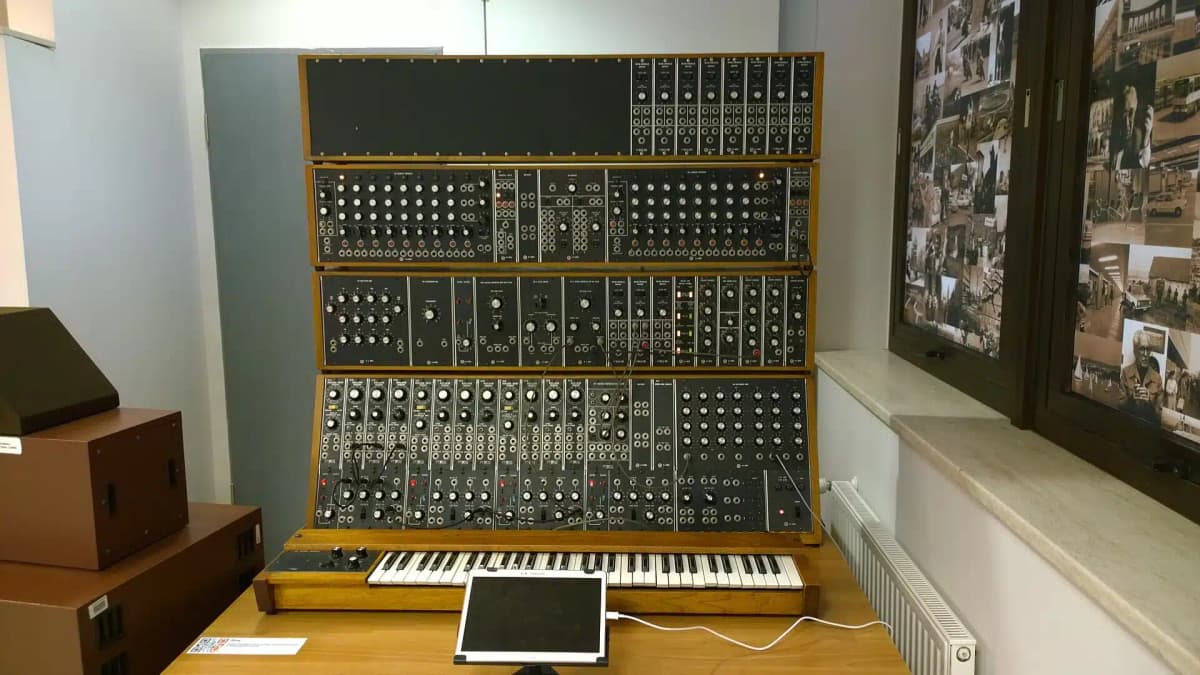
The Moog arrived in London in early February 1969. The Beatles Bible calls it a Moog IIIp, whereas another account describes it as a Moog Modular 3, so the exact model is described differently across sources. Its first home was Kinfauns, Harrison’s bungalow in Esher, not the recording studio.
Harrison put it to use almost immediately. His album Electronic Sound, released on the Beatles’ Zapple label in the UK on 9 May 1969 and in the US on 26 May, contains two pieces. “No Time Or Space” was edited down to about twenty-five minutes from Krause’s Los Angeles demonstration tape, and “Under The Mersey Wall” was Harrison’s own recording at Kinfauns.
Krause objected when Harrison planned to release the demo, according to the Beatles Bible, and his name was later painted over on the cover, though the sleeve still says “Assisted by Bernie Krause.” The other piece is credited to “Rupert and Jostick The Siamese Twins,” which were the names of Harrison’s cats.
An instrument in a small room at Abbey Road
In early August 1969 the Moog was set up at EMI Studios for the Beatles, according to the Beatles Bible. The engineer Geoff Emerick, quoted by MusicRadar, remembered it arriving packed in eight huge boxes. A blog summary of the sessions places it in Room 43 at Abbey Road, installed with the help of Mike Vickers.
How the instrument got there is one of the points on which the sources differ. Emerick said that Robert Moog himself had given a demonstration at EMI some months before Abbey Road was recorded. Paul McCartney, in a podcast quoted by MusicRadar, said that “Maxwell’s Silver Hammer” was recorded around the time of Moog’s visit, and that George Martin knew Moog and asked him to show the band the synthesizer.
Others say it was simply Harrison’s machine. The accounts are not necessarily contradictory, but I could not reconcile them from the sources I read.
The uncredited programmer
The man who knew how to make the machine work was Mike Vickers. According to Electronic Sound magazine, Vickers was a woodwind player who had played guitar with Manfred Mann, had helped to orchestrate “All You Need Is Love” for the 1967 Our World broadcast, and bought a Moog IIIc directly from Robert Moog in 1968. He learned to program it from Moog himself and was probably the only Moog programmer for hire in Britain at the time.
The same article says Harrison was the Moog company’s first UK-based customer and that the Moog used on Abbey Road was the first to arrive in the country, with Vickers’s instrument second. In August 1969, Electronic Sound reports, Vickers programmed the Moog for the Beatles in a single afternoon. He received no credit on Abbey Road, which was released on 26 September 1969.
Vickers later recorded library albums for the KPM music library, including A Moog For All Reasons, according to the same article. Harrison’s own recollection, in the Anthology quotes collected by the Beatles Bible, is that he did not think even Mr. Moog knew how to get music out of it, which fits the importance of someone like Vickers.