Home›Articles›Wendy Carlos: How a Manhattan apartment studio scored K…
Articles

Wendy Carlos: How a Manhattan apartment studio scored Kubrick and Disney’s digital world

Wendy Carlos: Wendy Carlos is usually introduced as the person who made the synthesizer famous with Switched-On Bach. The more unusual part of her career…

Bernardo de Azevedo
Bernardo de Azevedo
· Updated
Wendy Carlos - historic photo

Wendy Carlos is usually introduced as the person who made the synthesizer famous with Switched-On Bach. The more unusual part of her career begins afterwards, when two film studios asked a composer who worked alone in a Manhattan apartment to supply the sound of futures that did not yet exist.

The results were very different. For Stanley Kubrick she helped invent a menacing electronic voice for A Clockwork Orange, and for Disney’s Tron she faced a schedule that forced her to repair an orchestra with synthesizers. Both stories show that behind the glossy image of electronic music sat a lot of improvisation.

Table of Contents

  • Wendy Carlos: the apartment that became a studio
  • Switched-On Bach and the cost of one note at a time
  • A Clockwork Orange: the vocoder and a tape sent to Kubrick
  • The Shining: four hours of music, almost none used
  • Tron: an orchestra recorded in two days
  • What the Crumar GDS fixed
  • Final perspective

Wendy Carlos: the apartment that became a studio

Wendy Carlos was born in 1939 in Pawtucket, Rhode Island. According to MusicRadar she earned degrees in music and physics at Brown University, then a master’s in composition at Columbia, where she studied with Vladimir Ussachevsky and Otto Luening. She first saw the Moog synthesizer at the Audio Engineering Society show in New York in 1964, back when it was a set of separate modules, and became a friend and consultant to Robert Moog. Wikipedia credits her with suggesting several features of the instrument, including the touch-sensitive keyboard.

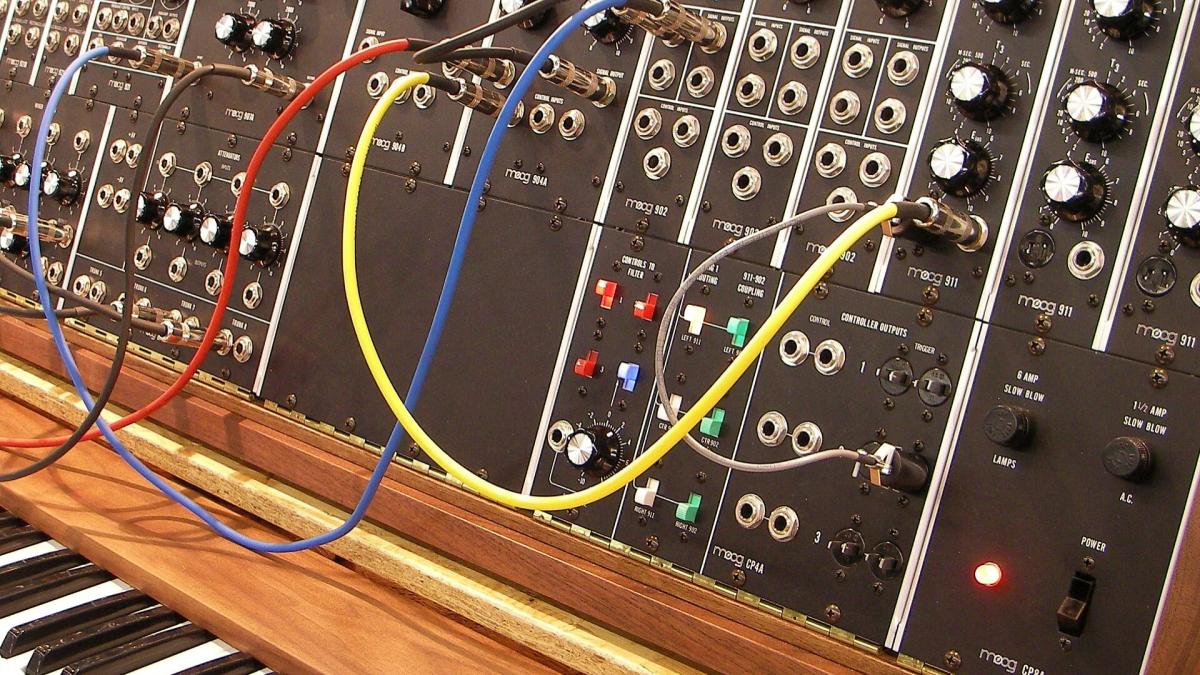
Mix magazine says she began building her own studio in a Manhattan apartment in 1966, around a custom Moog and Ampex tape machines. She started with an Ampex 350 stereo recorder, moved on to a 440B and later built an eight-track recorder herself, along with a mixer, a power amplifier and a pair of speakers.

Moog delivered a custom system to the apartment in 1967, and MusicRadar says that in return she made a demo recording to help him sell his gear. The studio would later become the place where she worked with her producer, Rachel Elkind.

Switched-On Bach and the cost of one note at a time

The Moog of that period could play only one note at a time, so every polyphonic passage on Switched-On Bach had to be built from individual lines. Wikipedia says the album was recorded in 1967 and 1968 over about five months and roughly 1,000 hours of work, and released in October 1968 by Columbia Masterworks. Carlos found the detached recording process disturbing as a way of making music.

The instrument itself was demanding. According to Mix, the Moog’s oscillators drifted out of tune, so Carlos and Elkind recorded only a measure or two at a time, writing down dial settings to recreate each imitation of an instrument. Elkind made a click track to hold the tempo, and Carlos said that you could never play faster than moderato.

The result was a surprise hit. Wikipedia reports that the album reached No. 10 on the Billboard 200, won three Grammys at the 1970 ceremony and became the second classical album to sell more than a million copies. Glenn Gould called it one of the great feats in keyboard performance history. The same article notes that Robert Moog played the third movement of the Brandenburg Concerto No. 3 at a 1968 Audio Engineering Society conference and received a standing ovation.

A Clockwork Orange: the vocoder and a tape sent to Kubrick

Kubrick came to Carlos through a piece she had already made. Electronic Sound reports that she had used a spectrum follower, which converted the human voice into an electronic signal, to make a machine version of the choral movement of Beethoven’s Ninth, and had also developed a piece called “Timesteps”.

After reading Anthony Burgess’s novel, Carlos and Elkind learned that Kubrick was filming it. Mix says that after principal photography ended Elkind got a tape of the choral piece and “Timesteps” to him, and that he liked both and invited them to England.

Kubrick used a synthesized version of Purcell’s Music for the Funeral of Queen Mary from 1695 as the title theme, and a portion of “Timesteps” during the Ludovico treatment scene. On the 1972 soundtrack album, Wikipedia says, “March from ‘A Clockwork Orange’” was the first recorded song to use a vocoder for the singing. Elkind sang most of the electronic vocal parts, as Mix explains, while Carlos sang some shorter chorus lines so they would not merge with Elkind’s tenor solo.

The sync problem was practical. SMPTE time code was not yet common, Mix says, so they recorded a 60 Hz tone on one of the eight tracks for Kubrick’s engineers to line up the music. They also placed short sine-tone blips on the film’s audio track at each cue point and bought a used Moviola to watch scenes. A landmark of electronic film music was synchronized with a tone generated from a patch cord, alligator clips and VU meter lights, plus a 35mm dubber borrowed from Eric Siday.

The Shining: four hours of music, almost none used

The second collaboration ended unhappily. Electronic Sound says Carlos and Elkind spent months on an electronic score for The Shining, producing about four hours of music and sending acetates to Kubrick while he filmed. Warner Bros. reportedly found the music very scary. Kubrick used very little of it, and the main surviving piece is the opening sequence.


Music editor Gordon Stainforth told the magazine that Kubrick encouraged him to layer Penderecki pieces and to “sandwich” Carlos cues, and that only the opening title remains unaltered. Elkind later described the experience as unhappy and said she stopped working after it. It was the last time Carlos worked with Kubrick, and about 35 cues were eventually issued on the two-volume Rediscovering Lost Scores in 2005.

Tron: an orchestra recorded in two days

By Tron, Carlos’s method had changed. The 1982 Disney film asked for a score in which, as Crooked Marquee reports from a Keyboard interview, a symphony orchestra with synthesizer represented the computer world and a string orchestra alone represented the real one. The album, released on 9 July 1982, the day the film opened, mixed the analog Moog with a Crumar General Development System, a digital synthesizer that Wikipedia says was one of only ten made.

The schedule was the problem. Crooked Marquee says the edited film arrived only in February, with the London Philharmonic Orchestra booked for late March. Wikipedia says Disney hired the orchestra because it worried Carlos might not finish the score on time. The orchestra reportedly had two days to record about fifty-five minutes of music, and Carlos later said her music, with its changing time signatures, was too difficult for the orchestra to play in the time allotted.

What the Crumar GDS fixed

Carlos solved the problem after the fact. She used synthesizers to add color, to double lines she felt had been poorly played and to add lines the orchestra had missed or recorded badly. Wikipedia says she replaced parts of the orchestral performances with GDS performances, which turned a rescue operation into a hybrid sound.

Other decisions were out of her hands. Wikipedia says Disney replaced the second part of her end titles with “Only Solutions” by Journey, which had been added after Supertramp pulled out, though the soundtrack album keeps her complete end-title piece. Crooked Marquee adds that she was busy with the album and was not present for the final mix, and that the score was mixed lower than the sound effects.

Final perspective

Looking back at Tron helps explain why Carlos’s work from Switched-On Bach onward still matters. Each project was made with equipment that did not quite do what the idea required: a Moog that could play one note at a time, a voice converter built before any film had asked for it, a digital synthesizer of which only ten existed. She treated those limits as a design problem rather than a reason to stop.

MusicRadar calls Tron her last major soundtrack, and she went on to the digital-era album Digital Moonscapes in 1984. The larger lesson of her film work may be how much of electronic music history rests on practical craft. Sync tones, click tracks, a rented orchestra and a few overdubs made a futuristic sound possible, and the people who remember the sound seldom hear the rescue work underneath it.

That is why the Wendy Carlos story keeps drawing musicians and historians back to it.

Few chapters of synthesizer history show as clearly as Wendy Carlos how far a single idea can travel.

Looking back, the Wendy Carlos episode suggests that the most unusual stories are often the most instructive ones.

For anyone tracing the history of electronic instruments, Wendy Carlos is a name worth remembering.

What makes the Wendy Carlos story memorable is how ordinary the people involved were, and how improbable the outcome turned out to be. Anyone retelling the Wendy Carlos story has to admit that part of it comes down to timing and luck. The Wendy Carlos story also shows how quickly a promising idea can slip out of public view.

Revisiting the Wendy Carlos story today, it is striking how many details were lost or rewritten over the years. Each retelling of the Wendy Carlos story adds a little more context to what the original documents leave out. If there is one lesson in the Wendy Carlos story, it is that technology rarely follows a straight line.

Related stories

Sources

Bernardo de Azevedo
Written by
Bernardo de AzevedoFounder & Editor

His connection with music began at age 6, in the 1980s, when his father introduced him to Jean-Michel Jarre's Rendez-Vous on vinyl. He works professionally in the legal field, while synthesizers became his space for abstraction and creative exploration. Founder of The Synth Source.