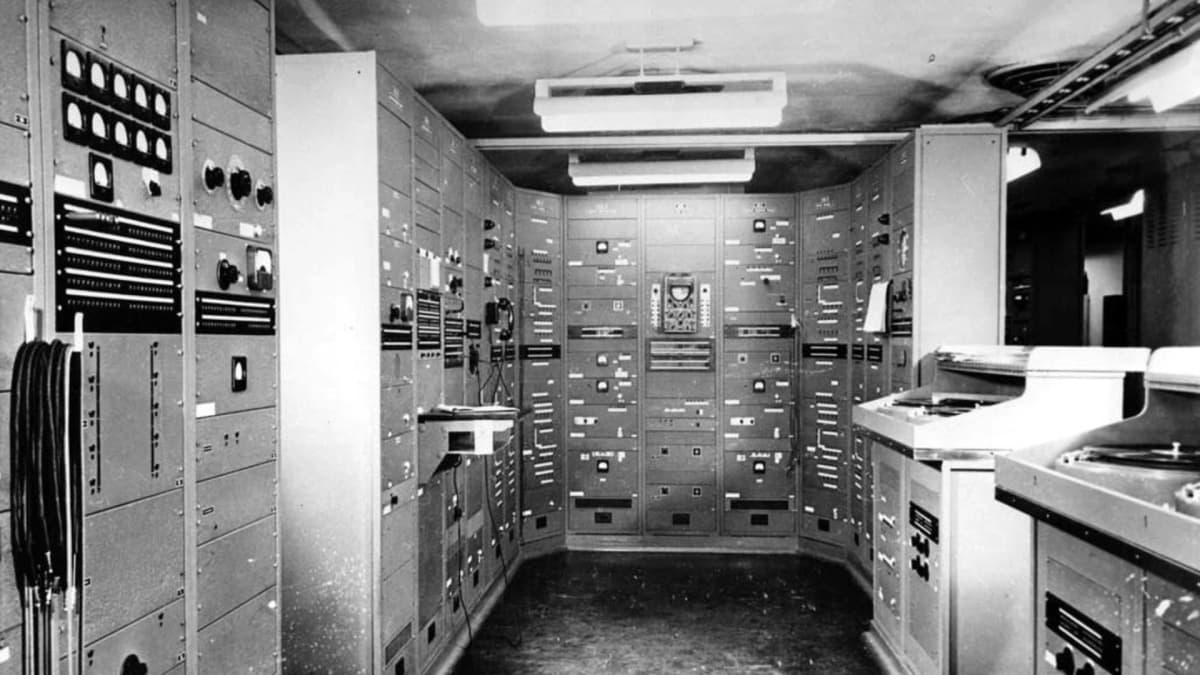
Synchronization was the hard part. Operators listened for a click at an agreed time and started the turntables together, using fine adjustments to hold them in step. If the systems drifted apart, only garbled speech came through. The Quietus notes that the two-turntable setup has been compared to DJing, an argument made in Dave Tompkins’s book How to Wreck a Nice Beach. Around 3,000 conferences required at least 6,000 pressed records, per 99% Invisible.
A machine that needed a basement
Each terminal was enormous. The Finest Hour article in the Churchill Centre’s journal describes roughly forty racks of vacuum-tube equipment weighing about 55 tons, occupying 2,500 square feet and using 30,000 watts, and notes that each terminal was air-conditioned. Wikipedia says the figure was over 50 tons. The 805th Signal Service Company installed and maintained the machines.
The London terminal arrived on HMT Queen Elizabeth in May 1943. Because it was too large for the Downing Street Annexe, Finest Hour says, it was installed in the basement of Selfridge’s Annexe on Oxford Street, about a mile away, and linked by an underground cable. The first terminal was in the Pentagon.
About a dozen terminals were eventually installed, and the system supported roughly 3,000 high-level conferences. Service began in mid-July 1943, and Wikipedia says that after the invasion of Germany, investigators found that the Germans had recorded its traffic but mistaken it for a complex telegraphic code.
Churchill, Roosevelt and what the legend gets wrong
The popular image is of Churchill and Roosevelt using SIGSALY to talk freely. The Finest Hour article, by Christopher Sterling, complicates it. Churchill apparently did not use SIGSALY until April 1944, and then only occasionally, since he preferred the older scrambler. Roosevelt chose not to install the main Washington terminal in the White House, perhaps because he knew Churchill’s working hours and did not want to be put on the spot without time to consider an issue.
The longest call came afterwards. Churchill’s first SIGSALY call after Roosevelt’s death in April 1945 was to Truman, and two weeks later they held a two-hour discussion about tentative German surrender offers, the longest SIGSALY call ever made. Most of the traffic was between military commanders rather than heads of government, and fewer than twenty-five senior British leaders were cleared to use the London terminal.
The first conference, as Wikipedia and the Quietus describe it, linked the Pentagon with London on 15 July 1943. Alan Turing, who had to be allowed to see the device after high-level negotiations, reported his evaluation to Churchill.
From secrecy to the synthesizer
The system stayed secret for roughly three more decades after the war. Finest Hour says it became public in news accounts in mid-1976, when more than thirty Bell Labs patents were granted, and 99% Invisible says most information was declassified in the mid-1970s after AT&T sued the US military under the Freedom of Information Act. The terminals themselves were scrapped after the war.
By then the technology had begun a second life in music. Red Bull Music Academy traces a path from Werner Meyer-Eppler, who promoted the vocoder for electronic music in Detmold in 1949, through Sennheiser and Siemens machines in the 1950s, to Wendy Carlos’s work on A Clockwork Orange and Kraftwerk’s Autobahn in 1975. It reports that by 1978 the Korg VC-10 cost about $500, compared with around $10,000 for earlier Sennheiser units, which made vocoders far more accessible.
Final perspective
SIGSALY teaches a lesson that the music industry sometimes forgets: a sound can be a by-product. The vocoder voice we now hear on pop records exists because engineers once needed to protect a conversation, and a robotic buzz was an acceptable price for secrecy. Nobody involved was trying to design an instrument.
The system also shows how little a good story needs in order to spread. The Churchill and Roosevelt image is vivid, but the surviving evidence points to a quieter reality of military conferences, two synchronized turntables and a maintenance routine so heavy that, per the Quietus, every eight hours of operation required sixteen hours of calibration. When the vocoder next appears on a chorus, it is worth remembering that it comes from a machine built to make speech impossible to understand for anyone who was not meant to hear it.
Related stories
Sources