Home›Articles›Speak and Spell: How a $50 spelling toy became a voice …
Articles

Speak and Spell: How a $50 spelling toy became a voice for electronic music

Speak and Spell: The Speak and Spell was designed to teach children to spell. Instead it also gave a generation of musicians a cheap, battery-powered voice with…

Bernardo de Azevedo
Bernardo de Azevedo
· Updated
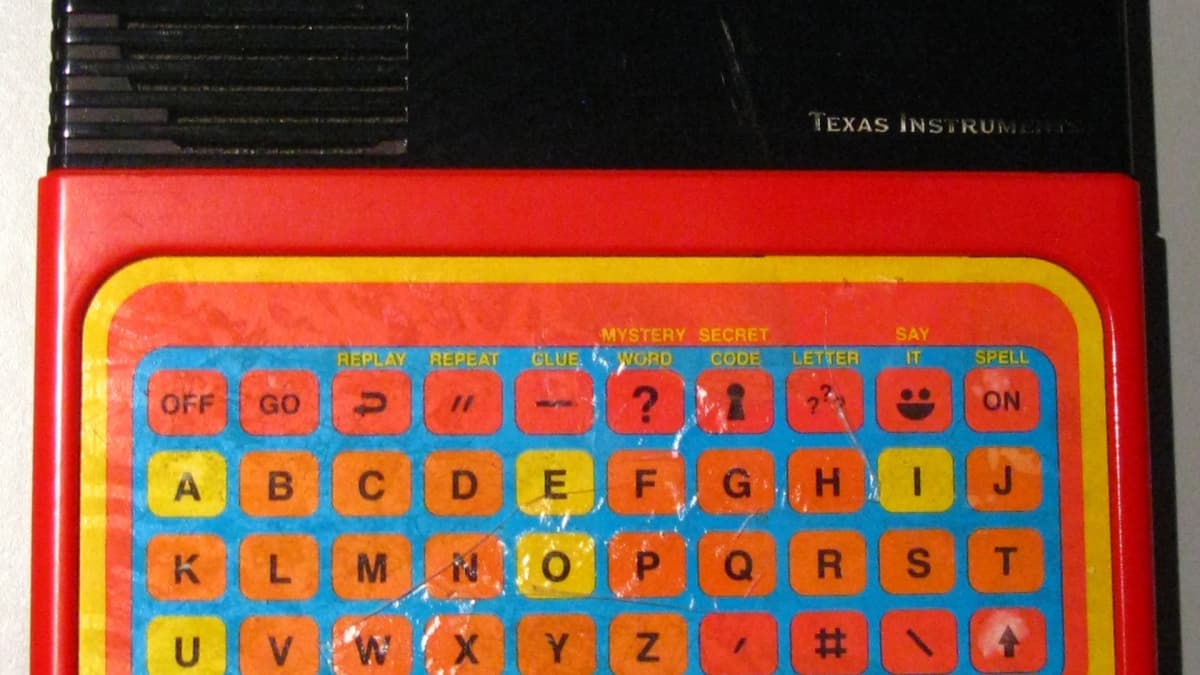
Speak & Spell - historic photo

The Speak & Spell was designed to teach children to spell. Instead it also gave a generation of musicians a cheap, battery-powered voice with a distinct accent, one that could be sampled, rewired or simply invoked in an album title.

The toy is often described as a Kraftwerk instrument. That is where the story needs the most care, because the evidence for what Kraftwerk actually used is thinner and more contradictory than the legend. What is well documented is how the toy was built, and why musicians found it so useful once it existed.

Table of Contents

  • Speak & Spell: a talking toy that began with a spelling problem
  • The chip that learned to speak
  • Kraftwerk and the problem of the missing receipts
  • A band named after a toy
  • The toy that was meant to be opened
  • Why the voice stuck
  • Final perspective

Speak & Spell: a talking toy that began with a spelling problem

Texas Instruments developed the Speak & Spell after the success of its Little Professor math calculator. According to Tedium, the team realised that a spelling toy needed speech, which seemed too complex for a portable device at the time. The Vintage Computing and Gaming interview with Richard Wiggins says Paul Breedlove, who came up with the idea of a spelling aid, won a small amount of funding in November 1976 to test it and proposed the name “The Spelling Bee”. Wikipedia and Tedium give the initial budget as $25,000.

The team had distinct roles. Gene Frantz handled overall product design and later became project manager, Larry Brantingham worked on the integrated circuit, and Wiggins proposed the speech-generation approach. The Institute of Electrical and Electronics Engineers dates Wiggins’s demonstration of the concept to December 1976, shown to Breedlove, Brantingham and Frantz at TI’s Dallas lab, and says the team created the Speak & Spell in April 1978. The product was introduced at the summer Consumer Electronics Show in Chicago in June 1978 and reached stores by Christmas.

The chip that learned to speak

The device’s centrepiece was the TMS5100, internally the TMC0280. The IEEE calls it the industry’s first digital signal processing integrated processor, and says it used linear predictive coding to generate speech. In plain terms, the chip passed stored data through a mathematical model of the human vocal tract rather than playing a recording. Wikipedia says speech data was stored on a pair of 128 Kbit ROMs.

Wiggins’s central contribution, according to the interview, was promoting linear predictive coding, which makes speech from a small amount of data. In 1976, memory could not hold recorded speech, and other approaches were rejected for poor quality or excessive complexity. The unit knew about 200 words, and because the word data had to be prepared and hand-edited in the lab, it could not say anything typed into it.

Tedium adds that the voice was modeled on a Dallas disc jockey, and that the suggested retail price was $50. The rest of the hardware was ordinary. Tedium lists a TMS1000 processor, which cost about $2 and also appeared in Milton Bradley’s Simon, plus two 128-kilobit ROM chips and the speech chip.

The same article reports that testers complained there were too few words, that the voice was monotonous and that children would get bored, and that TI responded with cartridges, more responses and games. Wiggins recalled that focus groups had not clearly anticipated how appealing a talking product would be to small children, and that TI’s president and board thought it was priced too low when they first saw it.

It appeared on the cover of Business Week on 18 September 1978, and versions were later made for several languages, including French, German, Japanese, Italian and Spanish. The IEEE dedicated a milestone plaque to the toy at TI’s Dallas campus on 15 October 2009.

Kraftwerk and the problem of the missing receipts

The musical lore starts with Kraftwerk’s Computer World, released on 11 May 1981. Wikipedia’s article on the toy says Kraftwerk used samples from its opening sequence. Zoe Blade’s notebook goes further, saying the group used its bootup sound as the intro to “Home Computer”, and that the vocals of the title tracks came from the Texas Instruments Language Translator, a related product. A Gearnews article from 2025 says the voice in “Computerwelt” came from a Texas Instruments electronic translator.

These claims overlap but are not identical, and none comes from the band. A discussion thread about the vocals on “Numbers” shows posters disagreeing between the Speak & Spell and the Language Translator, with no band member quoted. Wikipedia’s page on the album says it was produced “completely analogue”, with no computer technology involved, and lists an Orchestron, a Synthanorma sequencer, electronic drums and vocoders, and says a Stylophone features on “Pocket Calculator”.

The safest reading is that Kraftwerk used Texas Instruments speech hardware and that the Speak & Spell may have supplied some of its start-up sounds, but that the details are secondhand.

A band named after a toy

The better-documented link is a band name. Wikipedia reports that Daniel Miller suggested the title of Depeche Mode’s debut after the toy, which had recently become available in the UK. The name was meant to suggest a band taking its first steps, in a nod to the toy’s child audience. The album was released in the UK on 29 October 1981 on Mute and recorded at Blackwing Studios in London, where the 8-track system meant the sessions were essentially live with few overdubs.

Miller also brought an ARP 2600 and a sequencer to the studio. The source does not say whether the toy itself appears on the record, and it is worth remembering that the title is a reference rather than evidence of an instrument.

The toy that was meant to be opened

Other musicians used the voice itself. According to Zoe Blade’s notebook, Erasure used the toy on “Sweet, Sweet Baby” and “Brother and Sister”, both from 1989, and Jean-Michel Jarre used it on “Touch to Remember” in 2007. Wikipedia lists Beck and Röyksopp & Robyn among artists who used its vocal portions. LFO, in the track named after themselves in 1990, had it say the group’s name.

The toy’s real career as an instrument came through circuit bending. Wikipedia describes musicians opening the case, cross-wiring terminals and adding switches or potentiometers. Tedium credits Reed Ghazala, considered the father of the practice, with modifying these devices from the start, and notes that artists including Beck and Venetian Snares used circuit-bent units. Ghazala’s own history begins with a 1960s accident involving a different device, though Wikipedia’s page on him says his work progressed with the 1978 arrival of the Speak & Spell.

Why the voice stuck

Catalin Bread’s account lists the practical reasons. The Speak & Spell was cheap and battery-powered, so mistakes were unlikely to cause harm and, at worst, would simply reset it. Many ended up in thrift stores, where experimenters bought them in large numbers. Its speech chip gave it a distinctive voice, and it could act as a crude vocoder.

There is another oddity in the design. Wikipedia notes that pressing more than three keys in the same row can cause key jamming or ghosting even without modification. A toy built to teach children to type one letter at a time became interesting precisely when the user tried to do something it was never intended to allow.

Final perspective

The Speak & Spell also had a second cultural life. In 1982 it appeared in Steven Spielberg’s E.T. the Extra-Terrestrial, where it became a key component of the alien’s homebuilt communicator, and TI produced a movie-themed cartridge, according to Tedium. For many people the toy’s voice stayed linked to a feeling of cheap technology reaching out to something much larger.

For musicians the lesson is less sentimental. The Speak & Spell mattered because it put speech synthesis, an expensive laboratory technology, into a mass-market object that could be bought, broken and rewired. The legend of Kraftwerk’s use is hard to verify, but the more reliable record shows a toy that gave a name to a band and a body to a craft. Its voice was never designed for music. That was the reason so many people were willing to push on it.

Related stories

Sources

Bernardo de Azevedo
Written by
Bernardo de AzevedoFounder & Editor

His connection with music began at age 6, in the 1980s, when his father introduced him to Jean-Michel Jarre's Rendez-Vous on vinyl. He works professionally in the legal field, while synthesizers became his space for abstraction and creative exploration. Founder of The Synth Source.