Home›Articles›Circuit bending: How a short-circuited toy amplifier in…
Articles

Circuit bending: How a short-circuited toy amplifier in a desk drawer started a new kind of instrument

circuit bending: Most electronic instruments begin with a design. Circuit bending began with a mistake: a small amplifier left in a drawer with its case…

Bernardo de Azevedo
Bernardo de Azevedo
· Updated
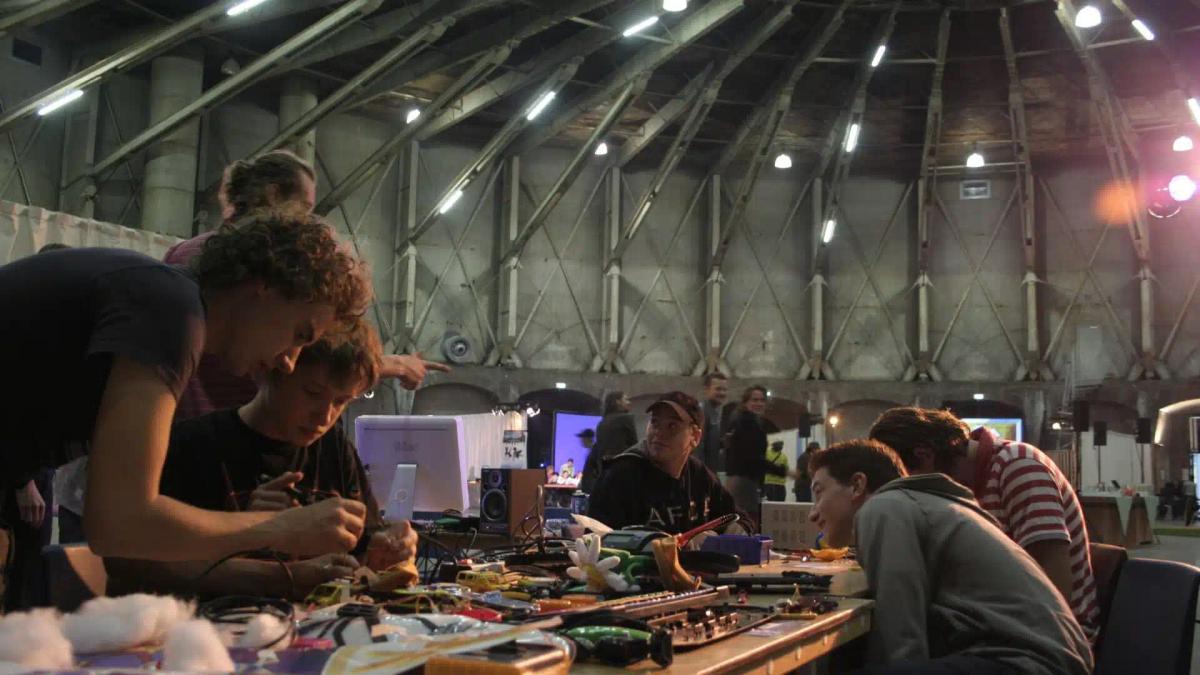
Circuit bending - historic photo

Most electronic instruments begin with a design. Circuit bending began with a mistake: a small amplifier left in a drawer with its case open, shorting against something metal and making noises nobody had planned. The teenager who heard it, Reed Ghazala, decided the accident was worth repeating on purpose.

That decision grew into a global practice of opening cheap electronics and rewiring them into noise machines. The story is simple, but the sources tell it in slightly different ways, and those differences say something about how a craft becomes a legend.

Table of Contents

  • Circuit bending: the art of the creative short circuit
  • The drawer, the amplifier and the sound
  • From accident to instrument
  • Naming the thing: EMI and 1992
  • How a bent toy is made
  • Why Speak & Spell became the favorite victim
  • Final perspective

Circuit bending: the art of the creative short circuit

Wikipedia defines circuit bending as modifying the circuits of devices such as children’s toys and digital synthesizers to change or control their sound, usually by taking the device apart and adding switches and potentiometers. Practitioners often start with inexpensive second-hand electronics, including toys, keyboards, drum machines and electronic learning aids. The practice is commonly associated with noise music, although the same article notes that many other musicians have experimented with it.

Ghazala himself describes it as the electronic art of the creative audio short circuit. The key idea is that a manufactured device contains more sounds than its designers intended, and that a screwdriver, a wire and some patience can bring them out. Wikipedia mentions earlier tinkerers too, including Serge Tcherepnin, who is said to have found points in transistor radio circuits that responded to touch and wired them to body contacts on the case.

Swiss duo Voice Crack, according to the same page, began making music from what they called cracked everyday electronics in 1984. Ghazala’s contribution was to turn a hunch into a method and a name.

The drawer, the amplifier and the sound

Ghazala was born in Cincinnati, Ohio, and Wikipedia says he discovered the technique in the 1960s. The date is where the accounts begin to differ. The Morning News places the incident in the summer of 1966. NAISA says Ghazala dates it to 1966 or 1967, and CDM, quoting a letter, says 1966–67 when he was 15. Vice gives 1967, and Synthtopia says mid-1960s. Whatever the year, the broad outline is stable.

A small battery-powered amplifier, described as a toy transistor amplifier or a 9-volt unit, sat in his desk drawer. Its case had been opened, so the circuit board was exposed, and the power was on. According to the Morning News, he was sorting through dismantled electronics when he accidentally joined the board to a metal object and heard a burst of noise.

In Synthtopia’s version the amplifier shorted by itself in the drawer, and produced tones that rose repeatedly in pitch, like a siren, which he found remarkable because sirens of the day were purely mechanical. Vice and NAISA say the sounds resembled the large synthesizers of the era.

From accident to instrument

The important thing is what he did next. NAISA reports that he asked what could be done on purpose if such sounds could occur by accident. In his interview with Synthtopia, he says he started shorting the amplifier at other points to see which other hidden sounds might appear, and that he never saw the exercise as junk. He called it magic.

His first instruments grew from there. The Morning News names the first as “The Odor Box”, which he used as a soloing instrument in a friend’s band, and describes later inventions such as “trigon incantors” and “photon clarinets”. CDM, quoting a letter, gives a different early instrument from 1967: a bent amplifier with aluminum-foil body contacts, a brass-nail patch bay and spinning speakers, which an irate audience destroyed and he later rebuilt. The two descriptions may refer to different instruments, and the sources do not settle it.

Naming the thing: EMI and 1992

For a long time the craft had no name. Ghazala says in a 2008 GetLoFi interview that he named it “circuit-bending” in 1992 in the magazine Experimental Musical Instruments, known as EMI, and that naming things gives them life. CDM places the first use in Volume VIII, Number 1, from September 1992, and says he wrote about twenty unpaid articles for the magazine over seven years, introducing the art to the public.

Soon afterwards he launched the website anti-theory.com, which CDM describes as the first online circuit-bending gallery and how-to and which remained free. He has also said his guiding principle is teaching bending for free. He later wrote Circuit-Bending: Build Your Own Alien Instruments, published by Wiley in 2005. His recorded output is listed as well: Wikipedia mentions many Sound Theater cassettes released between 1982 and 1989, and the “From the pages of EMI” cassette series issued under the magazine’s label from 1992 to 1997.

Wikipedia adds that he has built instruments for or consulted for Tom Waits, Peter Gabriel, King Crimson and the Rolling Stones, a claim Vice repeats.


How a bent toy is made

The method is more systematic than the legend suggests. According to Catalin Bread’s account, a bender connects two wires with alligator clips at one end, then touches the free ends to different points on a running circuit board until the device glitches. When a pleasing result appears, the bender can insert a component between the clips, such as a potentiometer, capacitor or photocell, which Ghazala names in that interview.

If it still sounds good, wires are soldered to those points and a switch is mounted on the case. Many benders add a quarter-inch output jack so that the sound bypasses the toy’s own speaker. Touch-sensitive points can be extended to body contacts that complete the circuit through the player’s skin.

The approach also requires a certain attitude. Ghazala describes the process as chance-based, comparing it to suminagashi, the Japanese art of floating ink, and to dye migration. The Morning News describes the typical bending session as shorting two points on an exposed board, often with a screwdriver, while the device plays a note. The result is closer to exploration than to design.

Why Speak & Spell became the favorite victim

Texas Instruments released the Speak & Spell in 1978, debuting it at the CES trade show, according to Catalin Bread’s blog. It used the TMC0280, which that source calls the first speech synthesizer on a single chip. Wikipedia says Ghazala’s work progressed with the 1978 introduction of the toy.

The reasons for its popularity among benders are practical. It was cheap, battery-powered and unlikely to cause harm if something went wrong; at worst, the source says, it would power-cycle. Its low price meant many ended up in thrift stores, where experimenters bought them in large numbers, and its speech chip gave it a distinctive voice. The community that grew up around such devices has its own institutions: the Morning News notes the BENT Festival, hosted annually since 2004 by The Tank in New York.

It also mentions Tree Wave, whose Paul Slocum modified an Epson LQ-500 printer to play melodies, and the Dutch musician Gijs Gieskes, who began bending in the mid-1990s and has used a modified Game Boy.

Final perspective

Circuit bending is often described as a hobby, and in some senses it is. But Ghazala’s own framing, in a 2004 paper for the Leonardo Music Journal titled “The Folk Music of Chance Electronics”, treats it as a tradition. According to the abstract, the paper begins with his first experiments in chance electronics in junior high school and covers his method and the many instruments that resulted.

What gives the story weight is the reversal in it. The usual route to a new instrument runs through a laboratory, a company or a patent. This one ran through a broken toy, a desk drawer and a teenager willing to treat a fault as information. Circuit bending shows that the line between a mistake and a method can be very thin, and that a craft can spread without any permission if someone writes down how it works and gives the instructions away.

That is why the circuit bending story keeps drawing musicians and historians back to it.

Few chapters of synthesizer history show as clearly as circuit bending how far a single idea can travel.

Looking back, the circuit bending episode suggests that the most unusual stories are often the most instructive ones.

For anyone tracing the history of electronic instruments, circuit bending is a name worth remembering.

What makes the circuit bending story memorable is how ordinary the people involved were, and how improbable the outcome turned out to be. Anyone retelling the circuit bending story has to admit that part of it comes down to timing and luck. The circuit bending story also shows how quickly a promising idea can slip out of public view.

Revisiting the circuit bending story today, it is striking how many details were lost or rewritten over the years. Each retelling of the circuit bending story adds a little more context to what the original documents leave out. If there is one lesson in the circuit bending story, it is that technology rarely follows a straight line.

Related stories

Sources

Bernardo de Azevedo
Written by
Bernardo de AzevedoFounder & Editor

His connection with music began at age 6, in the 1980s, when his father introduced him to Jean-Michel Jarre's Rendez-Vous on vinyl. He works professionally in the legal field, while synthesizers became his space for abstraction and creative exploration. Founder of The Synth Source.