A hit in about thirty countries
The single came out in 1982. Wikipedia reports that it reached No. 2 in West Germany in April and in the United Kingdom in July, and No. 3 in Canada in December. It topped the charts in several countries, including Austria, New Zealand, South Africa and Switzerland, and was a hit in about 30 countries. The same page puts worldwide sales at about 13 million copies, while the Ear of Newt interview piece says the single had passed four million, so the true figure is uncertain.
A profile of Krawinkel, who wrote the music, describes the song as lo-fi and repetitive, with barely any guitar, and presents Trio’s sparse style as a reaction to the expensive production of Tangerine Dream and Kraftwerk. That article adds that the single was kept off the UK top spot by the theme from Fame. The sparseness was a choice, and it made the record sound unlike anything else on the radio.
The tune that outlived the instrument
“Da Da Da” returned in 1997, when a Volkswagen Golf commercial in the United States prompted a re-release. Songfacts, whose account includes the usual caveats about reader comments, says the ad showed two young men moving an old chair. Earlier, in the late 1980s, an Ariston washing-machine advert parodied it, with stop-motion animation partly by Aardman.
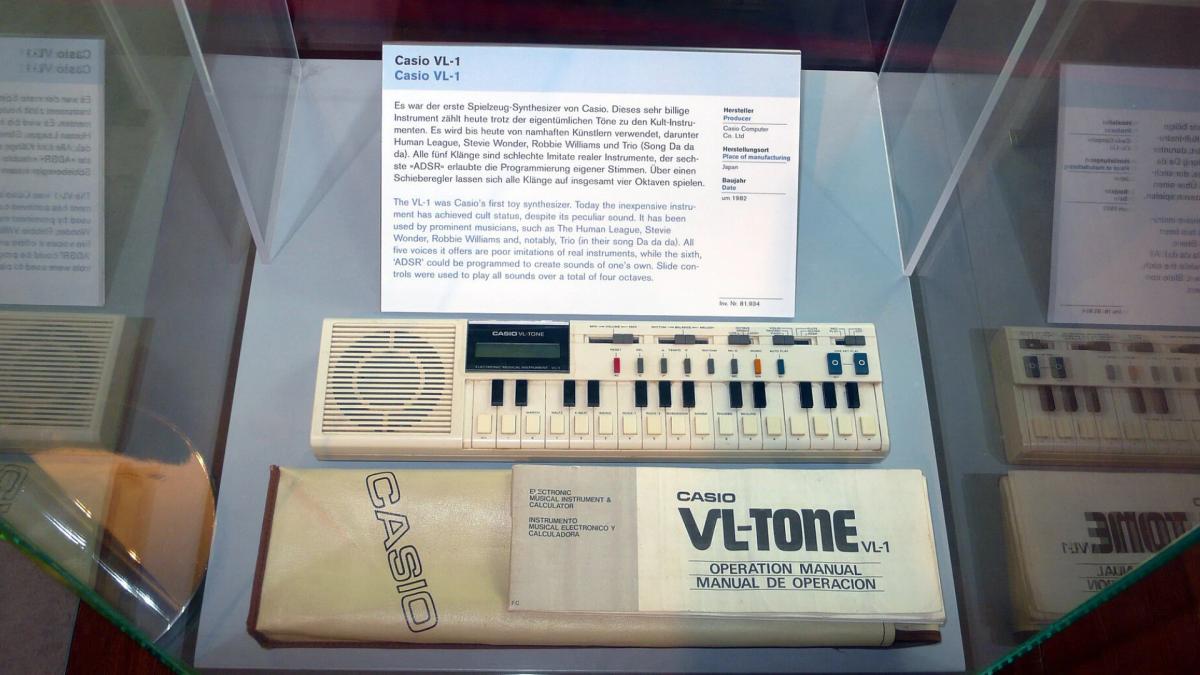
MusicTech describes the VL-1 as widely popular with teenagers in the early 1980s, which helps explain why so many people recognised the sound. Other musicians used the VL-1 too, and Wikipedia says Hazel O’Connor used its Rock-2 drum sound on her album Cover Plus. Wikipedia credits the Human League with using it on “Get Carter” from Dare, and Fergie used one of its default beeps for the melody of “Clumsy” in 2007.
One persistent mix-up deserves correction: Kraftwerk’s “Pocket Calculator” is often linked to the VL-1, but MusicTech says that song used sounds from a Texas Instruments calculator. The Casio is not on that record.
Trio themselves did not last. Wikipedia says the 1985 film Drei gegen Drei was a commercial flop, that drummer Peter Behrens left over financial disagreements, and that the band broke up in 1986. Krawinkel died in 2014 and Behrens in 2016, leaving Remmler as the only living former member. The song they made from a calculator’s rhythm preset is the part of their work that stayed in circulation.
Final perspective
The VL-Tone’s reputation is that of a joke instrument, and Wikipedia says it is valued for its kitsch appeal among electronic musicians. That description is accurate but incomplete. The Casio VL-Tone gave Trio a rhythm, a tone and a degree of constraint that matched their aesthetic, and the band built something memorable out of almost nothing.
The record also reminds us that the history of pop is full of hits made with tools that were not meant for the task. The sources disagree on the VL-1’s release year, its sequencer capacity and the song’s sales, and each disagreement is a reason to treat the legend with care. What does not change is the evidence of the recording itself: a preset called Rock 1, a plain piano voice and a band confident enough to leave everything else out.
That is why the VL-Tone story keeps drawing musicians and historians back to it.
Few chapters of synthesizer history show as clearly as VL-Tone how far a single idea can travel.
Looking back, the VL-Tone episode suggests that the most unusual stories are often the most instructive ones.
What makes the VL-Tone story memorable is how ordinary the people involved were, and how improbable the outcome turned out to be. Anyone retelling the VL-Tone story has to admit that part of it comes down to timing and luck. The VL-Tone story also shows how quickly a promising idea can slip out of public view.
Revisiting the VL-Tone story today, it is striking how many details were lost or rewritten over the years. Each retelling of the VL-Tone story adds a little more context to what the original documents leave out. If there is one lesson in the VL-Tone story, it is that technology rarely follows a straight line.
Related stories
Sources