Home›Articles›Stylophone: How a mail-order toy with a metal keyboard …
Articles

Stylophone: How a mail-order toy with a metal keyboard ended up inside ‘Space Oddity’

Stylophone: The Stylophone was sold as a toy, played with a pen and priced to be bought by schoolchildren. It also appears in one of the most famous songs…

Bernardo de Azevedo
Bernardo de Azevedo
· Updated
Stylophone - historic photo

The Stylophone was sold as a toy, played with a pen and priced to be bought by schoolchildren. It also appears in one of the most famous songs about space ever recorded, in the hands of a young singer who was writing a melody for a hit he did not yet have.

How it got there is a small story about marketing, fashion and an object whose history even a museum cannot fully nail down. It is also a case study in how cheap electronics can enter serious music through the side door.

Table of Contents

  • Stylophone: a keyboard that is also a circuit board
  • Brian Jarvis and the umlaut
  • Selling a toy: the Rolf Harris campaign
  • How the Stylophone reached David Bowie
  • Space Oddity: the toy at Trident Studios
  • A short life and a long afterlife
  • Final perspective

Stylophone: a keyboard that is also a circuit board

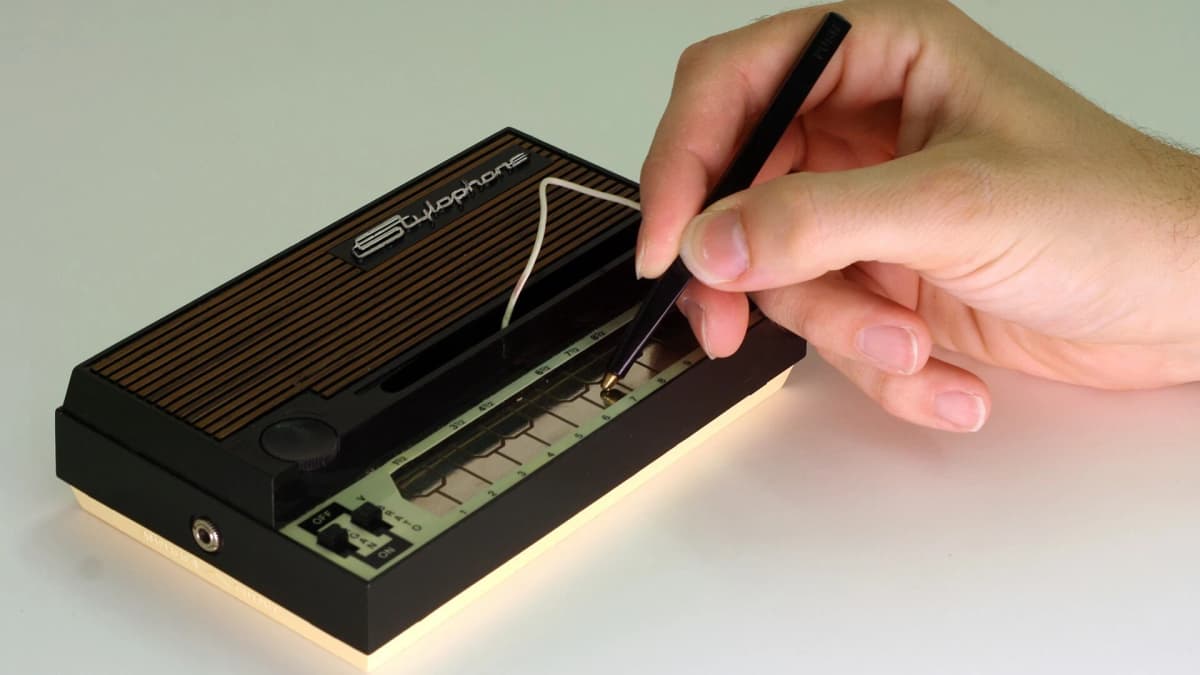
The Stylophone is a miniature analog synthesizer with a keyboard made of metal printed directly on a circuit board. Wikipedia explains that each note runs through a resistor of a different value to a voltage-controlled oscillator, and that the player touches a key with a stylus to complete the circuit. The front has a power switch and a vibrato control, and the back has a tuning potentiometer.

The 120 Years of Electronic Music site gives more detail: a single oscillator, a 20-note metal-plate keyboard on the board, a hand-held stylus and a design intended to be as cheap as possible. The sound is a simple buzzing square wave with no envelope control, which can be given vibrato from a sine-wave low-frequency oscillator. There is nothing hidden. Every part of its character comes from the simplicity of the circuit.

Brian Jarvis and the umlaut

Wikipedia credits Brian Jarvis with inventing the Stylophone in 1967, and says Dubreq of London produced it from 1968. According to the 120 Years page, the Dübreq company was a Leeds film production and recording studio, and the umlaut in its name was added to suggest German quality. The same page gives the original price as £8 18s 6d by mail order, which it equates to about £95 in current money. Wikipedia says around three million units were sold in the original production run.

Those numbers make the Stylophone one of the most widely sold electronic instruments of its era, although it was never treated as one. The Victoria and Albert Museum notes that Dubreq Stylophones were first released in London in 1968 and were initially marketed as children’s toys, but that musicians soon adopted them.

Selling a toy: the Rolf Harris campaign

The face of the Stylophone in Britain was the entertainer Rolf Harris. Wikipedia says he was the UK advertising spokesman for several years and appeared on the manufacturer’s play-along records. The V&A’s example carries his image on the box and on a cut-out strap, and its instructional record is titled as Rolf Harris introducing the Stylophone system. The 120 Years page says his enthusiastic endorsement helped the instrument sell widely.

That history is complicated. Harris was found guilty on 30 June 2014 at Southwark Crown Court of twelve counts of indecent assault against four women, and was sentenced on 4 July 2014 to five years and nine months in prison, according to Wikipedia. His honours were later revoked. The Stylophone’s promotional story cannot be told without him, but it is also a story of marketing that long outlived the public image it relied on.

How the Stylophone reached David Bowie

The standard line is that Marc Bolan gave David Bowie a Stylophone. The V&A holds a boxed example linked to Bowie, and its record notes that it has long been rumoured to be a 1968 gift from Bolan, after Bowie saw Bolan playing one while Tyrannosaurus Rex performed at the Royal Festival Hall. The David Bowie Archive’s own record reads “given to DB by Marc Bolan”.

Tony Visconti disputes it. The museum quotes him as saying everyone was given a batch of them at the same time, and that the Stylophone was a complimentary sample sent to Bowie’s manager, Ken Pitt. The V&A concludes that it is unclear how Bowie obtained the instrument.

He appears with one in publicity images from November 1968, and he played it on Top of the Pops in 1969, although that broadcast has been wiped from the BBC archives. The Wikipedia entry on the song adds that Bowie said Bolan suggested adding it.

Space Oddity: the toy at Trident Studios

According to Wikipedia, Bowie used the Stylophone to compose the melody of “Space Oddity”, and played it on the January 1969 demo and on the album version. The sessions for the single began at Trident Studios in London on 20 June 1969. Producer Gus Dudgeon planned the Stylophone and Mellotron parts in advance, and Rick Wakeman recorded his Mellotron part in two takes after hearing the demo once. Tony Visconti, who saw the song as a novelty, declined to produce it, so Dudgeon took over.

The first documented steps were modest. The January 1969 demo featured John “Hutch” Hutchinson on acoustic guitar and Bowie on Stylophone and vocals, and on 2 February 1969 a session at Morgan Studios in London, made for the film Love You till Tuesday, added Colin Wood on Hammond organ, Mellotron and flute.

The album version at Trident had Mick Wayne on electric guitar, Herbie Flowers on bass, Terry Cox on drums and Wakeman on Mellotron, plus an uncredited orchestra, with Bowie on 12-string acoustic guitar, Stylophone and handclaps. Bowie’s overdubs were finished a few days later, after he fell ill with conjunctivitis.

The single came out on 11 July 1969, five days before the Apollo 11 launch, and the label rushed it to capitalise on the Moon mission. The BBC used it as background music for the landing coverage, then stopped playing it once it noticed the lyrics until the crew had returned home. The Stylophone’s role is easy to miss on the finished record because it blends into a track with a full orchestra, but the V&A describes the sound it gives the recording as a warbling vibrato.

The song then had a second life: a UK reissue on 26 September 1975 reached No. 1 in November, and Bowie recorded an acoustic version in September 1979.

A short life and a long afterlife

Dubreq went on to expand the range. Wikipedia lists the 350S of 1971, with more notes, several voices, a wah-wah effect and two styluses, then the Pianomate of 1972, which attached to an acoustic piano, and the Mini-Amp of 1973. Production of the original range ended in 1975. The 120 Years page says fewer than 3,000 of the more ambitious 350S were made, a small fraction of the three million sold overall.

Yet the Stylophone kept turning up. John Lennon played one during a rehearsal of George Harrison’s “Old Brown Shoe” on 28 January 1969, Kraftwerk used it on “Pocket Calculator” in 1981, and Bowie returned to it on “Slip Away” from Heathen in 2002. Pulp, Orbital and others have used it too. Ben Jarvis, the inventor’s son, re-formed Dubreq in 2003, and Re:creation relaunched the Stylophone in October 2007.

Final perspective

The Stylophone matters because it made the mechanism of electronic music visible and cheap. A child could see the keys, hear the oscillator and understand that touching metal with a pen was enough. Professional musicians gradually noticed that this transparency, and the odd wobble of the sound, could be used as a feature rather than treated as a limitation.

The Bowie story also teaches a lesson about provenance. We know with some certainty that the instrument was in the room, that he used it to write the melody and that it appears on a hit. We do not know how it got to him, and the best evidence, from a museum and a producer, points in different directions. Even the history of a plastic toy can contain a gap, and it is worth writing around that gap honestly rather than filling it with a better story.

Related stories

Sources

Bernardo de Azevedo
Written by
Bernardo de AzevedoFounder & Editor

His connection with music began at age 6, in the 1980s, when his father introduced him to Jean-Michel Jarre's Rendez-Vous on vinyl. He works professionally in the legal field, while synthesizers became his space for abstraction and creative exploration. Founder of The Synth Source.