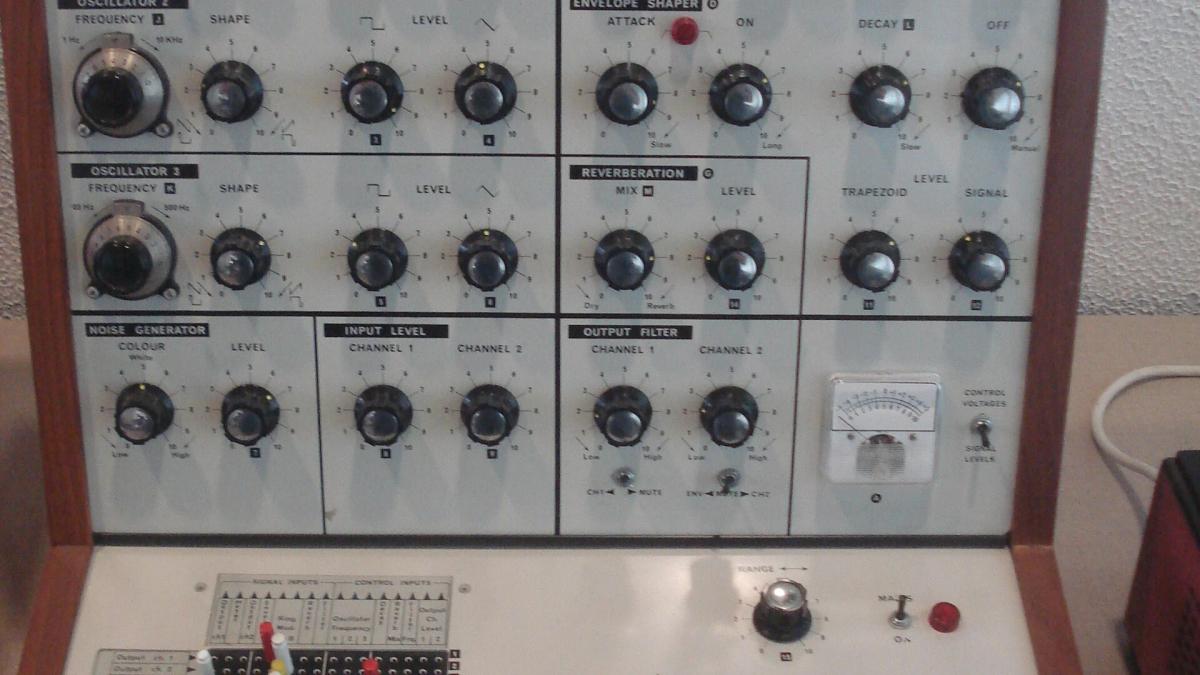
Rock finds the pin matrix
Wikipedia lists Pink Floyd, Brian Eno (with Roxy Music and on his own), Hawkwind, the BBC Radiophonic Workshop, King Crimson, The Who and Todd Rundgren among its users. The Yahoo-hosted obituary says Pete Townshend used it for the organ track on “Won’t Get Fooled Again”, from Who’s Next in 1971, and Sound on Sound’s obituary says Zinovieff gave Ringo Starr a VCS3 and a lesson on it.
The case mattered, because Wikipedia stresses that the VCS3 sat entirely in a small wooden box, unlike the large American cabinets. EMS then sold a briefcase version, the Synthi A, which Sound on Sound describes as functionally identical to the VCS3 in a Spartanite attaché case, followed by the Synthi AKS.
Sound on Sound lists their prices as £198 and £420, while the room-sized Synthi 100 cost £6,500 and only about 30 were made. The VCS3 sat between the studio and the stage, which is why so many different kinds of musicians found a use for it.
Pink Floyd’s own VCS3 use did not stop with one album. Wikipedia lists Obscured by Clouds (1972), The Dark Side of the Moon (1973) and Wish You Were Here (1975) as records where the band used it.
The Dark Side of the Moon and the problem of attribution
Pink Floyd are the band most associated with EMS gear. The Yahoo-hosted obituary says David Gilmour visited Zinovieff’s Putney home, after which the Synthi AKS featured prominently on The Dark Side of the Moon. The same obituary reports Gilmour’s remark that Zinovieff built the thing in his garden shed.
Here the common story needs a correction. “On the Run” is often credited to the VCS3, but Wikipedia says its main sequenced part was played on the Synthi AKS, with the VCS3 supplying other sounds, including an effect resembling a passing vehicle with a Doppler shift. Gilmour developed the basic sequence idea and Roger Waters improved it with a different note pattern, and both are credited as writers.
The sequence was reportedly recorded slowly and sped up on playback, and runs at 165 beats per minute. The album was recorded over about 60 days between 31 May 1972 and 9 February 1973.
The wider picture is muddier. Wikipedia’s page on the album lists the VCS3 on “Brain Damage” and “Any Colour You Like” and the Synthi A on “Time” and “On the Run”. A Guitar Player feature says the solo on “Any Colour You Like” came from the Synthi AKS instead.
Accounts differ, and anyone repeating a simple “VCS3 on Dark Side” line is compressing a family of EMS instruments into one name. The same Guitar Player article records another EMS device, the Synthi Hi-Fli guitar processor, a prototype that Gilmour bought in 1972.
Final perspective
The VCS3’s legacy is that of a machine that was good at being strange. It was unreliable at tuning, awkward to patch and produced in small numbers, yet it supplied the sounds that British rock bands could not get any other way, and it did so because its makers needed a product after their ideal studio ran out of money.
EMS did not last. Sound on Sound’s obituary says the company went bankrupt in 1979, overtaken by American and Japanese manufacturers. Zinovieff died in 2021 aged 88, having returned to composing in his later years. The lesson of the VCS3 is that a lot of music history is written by commercial accidents.
A studio that could not pay for itself became a tiny box that bands could afford, and the sounds it made were so closely tied to a single moment that people still reach for the name decades later, sometimes for the wrong track.
Related stories
Sources