Home›Articles›Mellotron: How an unreliable tape keyboard gave ‘Strawb…
Articles

Mellotron: How an unreliable tape keyboard gave ‘Strawberry Fields Forever’ its dream

Mellotron: The Mellotron was never meant to sound dreamy. It was built to replace string sections and choirs on a budget, and it was a mechanical headache…

Bernardo de Azevedo
Bernardo de Azevedo
· Updated
Mellotron - historic photo

The Mellotron was never meant to sound dreamy. It was built to replace string sections and choirs on a budget, and it was a mechanical headache that musicians fought on stage. Yet in November 1966 a flute line played on one opens “Strawberry Fields Forever”, and the instrument became the sound of a whole kind of psychedelic wistfulness.

The song’s flute introduction is among the most recognisable keyboard parts in pop, and it was played on a machine whose notes were pieces of recorded tape. The story of how that machine reached Abbey Road runs through an American inventor, three brothers in Birmingham, and a Moody Blues keyboardist. Along the way it picks up one persistent myth, and a question that matters more: why did the Mellotron’s flaws end up being the point?

Table of Contents

  • Mellotron: the keyboard that played tape
  • An American idea that needed an English rescue
  • The tester who sold it to the Beatles
  • One flute line, two versions of a song
  • The myth of Lennon’s own machine
  • Why the flaws became the sound
  • Final perspective

Mellotron: the keyboard that played tape

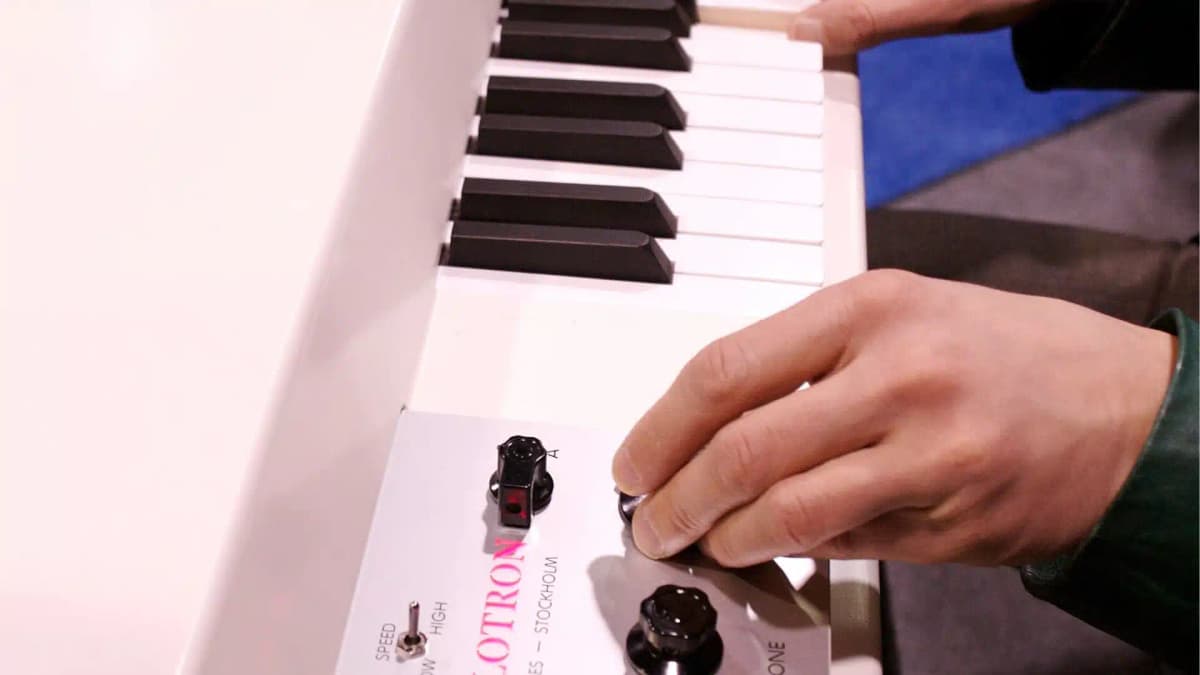
A Mellotron is not a synthesizer in any usual sense. Each key is attached to its own length of tape, and pressing the key pushes that tape against a spinning capstan so it passes over a playback head. Release the key and a spring pulls the tape back to its starting point. What you hear is a real recording of a real instrument, but only for as long as the tape lasts, which on a Mellotron is roughly eight seconds according to the Beatles Bible.

That design explains most of the character. Because the tapes run through a mechanism with its own wow and flutter, each note wavers slightly, and no two presses sound identical. Wikipedia’s account adds that a harder touch on the keys even produces something akin to aftertouch. The individual notes were also recorded one at a time, so the players on the original sessions had no neighbouring notes to tune against. The Mellotron is therefore an instrument made of small inconsistencies, stacked 35 to a keyboard.

An American idea that needed an English rescue

The concept came from California. According to the history on mellotron.com, Harry Chamberlin had the idea in 1946, after recording himself playing organ at home and realising that the recording could be triggered note by note. He built a series of tape-driven keyboards, but his sales agent, Bill Fransen, reportedly found the mechanism unreliable, with a failure rate he put at around 40 percent.

In 1962 Fransen took two Chamberlin Musicmaster 600 models to England, hunting for a company that could make 70 matching tape heads. He found Frank, Norman and Les Bradley of Bradmatic Ltd, a tape engineering firm in Birmingham, who thought they could improve on the design. Bandleader Eric Robinson helped finance the recording of the instrument’s sounds at IBC Studios in London, and together with the Bradleys and Robinson’s son-in-law, the magician David Nixon, he formed Mellotronics to sell the result.

Chamberlin objected to the copying, since Fransen had not made clear to the Bradleys that the concept was not his to license. A 1966 deal let both companies carry on making instruments independently. Bradmatic later renamed itself Streetly Electronics, and by the time the company folded in 1986 about 2,500 Mellotrons had been built since 1963. Those are modest numbers for an instrument that shaped so many records.

The tester who sold it to the Beatles

The bridge between a Birmingham factory and Abbey Road was Mike Pinder. By his own account he worked for about 18 months at Streetly in the mid-1960s, testing finished instruments and suggesting changes. When he joined the Moody Blues he bought a second-hand Mellotron from a working men’s club in Birmingham and built the band’s early sound around it.

Pinder says he introduced all four Beatles to the instrument, and that within a week each of them had what he called a “Fab-Tron”. Treat that as his recollection rather than settled history, though Wikipedia’s article on the Mellotron repeats it as his claim. A Mellotron certainly entered Lennon’s life in 1965: Wikipedia’s article on the song says he bought one in August of that year and used it on home demos at Kenwood, his house in Weybridge.

Even so, the band’s producer was not a believer. George Martin was unconvinced by the instrument, according to Wikipedia, though the Beatles went on using Mellotrons on Magical Mystery Tour in 1967 and on The Beatles in 1968.

One flute line, two versions of a song

“Strawberry Fields Forever” began its life in the studio on 24 November 1966 at EMI Studio 2, according to the song’s Wikipedia entry. The first takes were gentle, with the Mellotron closer to backing than to feature. Paul McCartney played the Mellotron on take 7 and wrote the melody of the introduction, using the instrument’s flute sound. Thomann’s gear feature places that sound in the right-hand Bank 4 of the instrument they identify as a Mk II.

The flute itself was a composite. Wikipedia notes that the flute tape on a Mellotron combines alto and soprano flute recordings, which partly accounts for the slightly uncanny quality of that opening phrase. It has the colour of a real flute without the breath of one player behind it.

The released track is actually two recordings joined together. Take 7 was the lighter, original arrangement. Take 26 was a faster, higher-pitched version with brass and cello scored by Martin. The two were spliced around the middle of the second chorus, and engineer Geoff Emerick sped up take 7 and slowed down take 26 so the two would match in speed and key, on 22 December 1966.

The song, written in C major on acoustic guitar, ends up sitting around B-flat. The pitch shifting gives Lennon’s vocal a swimming quality that now feels inseparable from the song.

The Mellotron has one more role late on. The coda uses Mellotron flutes recorded in reverse from a setting called “Swinging Flutes”, overdubbed on 9 December 1966, and George Harrison used the instrument’s guitar setting for slide-guitar sounds and Morse-code-like blips. The Beatles Bible credits Lennon and McCartney with Mellotron on the track and does not say who played the introduction, so the McCartney attribution rests on Wikipedia and Thomann.

The myth of Lennon’s own machine

It is easy to assume that the Mellotron on the record is the one Lennon owned. Far Out magazine says no. Lennon’s instrument was a black Mellotron Mk II, one of only six made in that finish, shipped to his Weybridge home and heard on demos and on Unfinished Music No. 1: Two Virgins.

The magazine states that it was never used on a Beatles record, and that the Mellotron on “Strawberry Fields Forever” was a different Mk II hired for the sessions. Thomann also says the Beatles rented one for Abbey Road.

Lennon’s own machine had a strange afterlife. When he tried to use it on the Imagine sessions, the tapes had tangled and it could not be played, a detail confirmed independently by Pinder, who recalled that he played tambourine on a track instead. Engineer Jack Douglas claimed it later moved to New York and sat in the basement of the Record Plant.

It ended up with Interscope’s founders, and in 1992 Trent Reznor borrowed it for the Broken EP. In 2009, Streetly Electronics restored it, and it remains at the label’s headquarters.

Why the flaws became the sound

The Mellotron’s problems were physical. Pinder called the tape-frame mechanism the weakest link and said it caused most of his on-stage breakdowns. He swapped the tube preamp for a transistor one and the AC motors for DC motors, which stopped the detuning caused by power drain, and he rearranged tape sets to keep his machine alive, and the Mark V of 1975 grew from his idea of putting two tape frames in one cabinet.

None of that matched the original pitch, which was an instrument that could reproduce violins, cellos, flutes and choirs from a keyboard. A flute that is a little too soft, a string pad that wavers and a choir that is plainly made of tape turned out to suit a song as dreamlike as this one. The Mellotron could not quite impersonate a flute, and that imperfection is part of why the intro sounds the way it does.

Final perspective

The Mellotron’s story is a reminder that instruments rarely become important for the reasons their designers gave. Chamberlin and the Bradleys wanted a reliable substitute for musicians. What they delivered was a machine whose approximation of real sounds was unmistakable, and that made the approximation itself an artistic choice.

“Strawberry Fields Forever” locked that choice into pop history within weeks of its recording. Later bands, from the Moody Blues to King Crimson to modern retro-minded producers, were chasing the same quality that the Beatles stumbled into at Abbey Road. Today digital Mellotrons exist that sample the tapes without the tangles, but players still reach for the old flute bank to get a similar effect.

The lesson is that musical technology tends to be remembered by its failures: the wobble, the hiss, the eight-second limit. Those are what listeners can recognise a half-century later, long after a perfect imitation would have been forgotten.

Related stories

Sources

Bernardo de Azevedo
Written by
Bernardo de AzevedoFounder & Editor

His connection with music began at age 6, in the 1980s, when his father introduced him to Jean-Michel Jarre's Rendez-Vous on vinyl. He works professionally in the legal field, while synthesizers became his space for abstraction and creative exploration. Founder of The Synth Source.