Home›Articles›Vako Orchestron: The optical-disc keyboard that gave Kr…
Articles

Vako Orchestron: The optical-disc keyboard that gave Kraftwerk its choir

Orchestron: The Vako Orchestron looks like a footnote: a keyboard from the mid-1970s that read sounds from plastic discs with a beam of light, sold in tiny…

Bernardo de Azevedo
Bernardo de Azevedo
· Updated
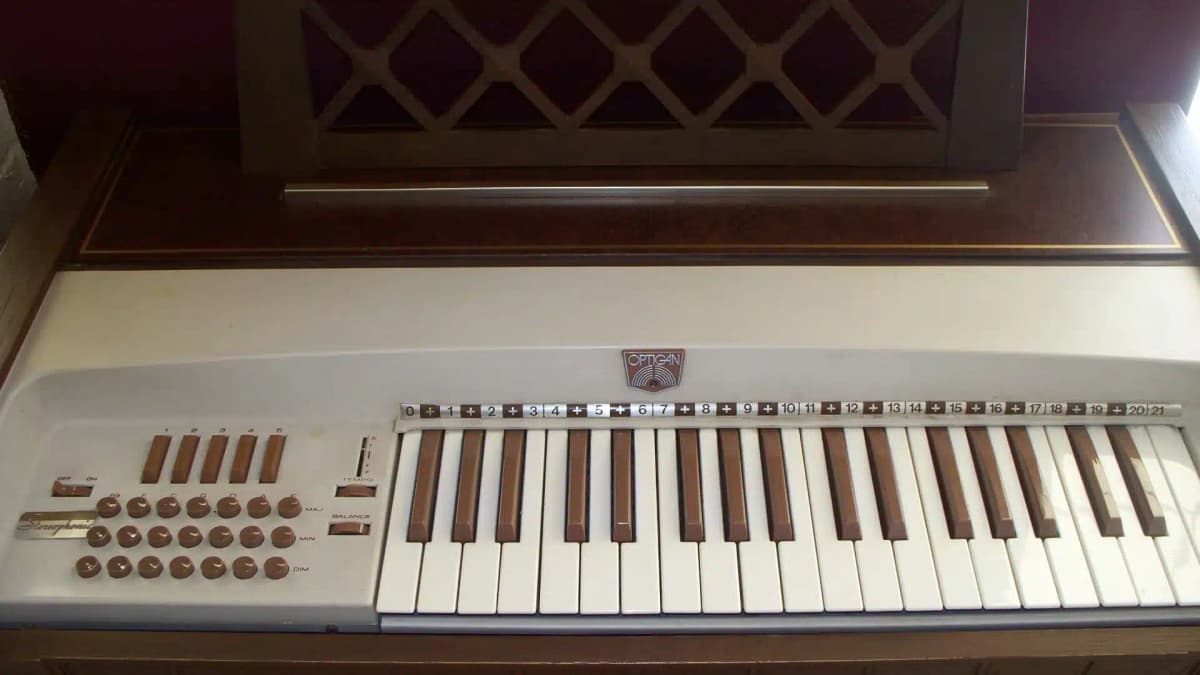
Vako Orchestron - historic photo

The Vako Orchestron looks like a footnote: a keyboard from the mid-1970s that read sounds from plastic discs with a beam of light, sold in tiny numbers by a company that did not last. Yet its choir and violins are all over some of the most influential electronic records of the decade.

The strangest part is the pedigree. The Orchestron was a professional version of a toy organ made by Mattel, and its best-known user bought one on tour in America. How a children’s product became a pillar of Kraftwerk’s sound is a story about technology that was too limited to succeed and too distinctive to disappear.

Table of Contents

  • Vako Orchestron: a professional version of a toy
  • Mattel’s Optigan and sound as a film soundtrack
  • David Van Koevering and the Mellotron alternative
  • What a disc could and could not do
  • Kraftwerk’s choir and violins
  • The Yes myth and other users
  • Final perspective

Vako Orchestron: a professional version of a toy

Wikipedia describes the Orchestron as a 1970s keyboard that amplifies sounds stored as optical tracks on interchangeable discs. It was the professional version of Mattel’s Optigan, which was aimed at amateurs. Vako Synthesizers Inc., founded by David Van Koevering, a former Moog technician and salesperson, began building improved Optigans under the Orchestron name in 1975, with the aim of competing with the Mellotron.

The principle is simple to state. Each key plays a short looped track on a disc, a light beam passes through the disc and the variations in light intensity are amplified. The best-fidelity sounds sat on the outer rings of the discs, and those were the rings used for the Orchestron. Everything that makes the instrument interesting, from its grain to its limits, comes from that arrangement.

Mattel’s Optigan and sound as a film soundtrack

The Optigan came first. Wikipedia says its name combines “optical” and “organ”, that engineering began in 1968 and that the first patents were issued in 1970. The Optigan Corporation, a Mattel subsidiary in El Segundo, California, released it in 1971, and it was made in nearby Compton. An actor, Carl Betz, appeared in a TV commercial around 1971, and it was promoted in at least one Sears-Roebuck catalog.

Playback worked like a motion-picture optical soundtrack, with a light bulb and photodiodes reading a 12-inch clear plastic disc. Each disc carried 57 concentric tracks: 37 for single notes on the right-hand keyboard, 21 for chords played with the left hand and 5 for percussion, effects and vamps. Home buyers got discs with titles like “Big Organ & Drums” and “Latin Fever”. There were drawbacks. Notes had no attack or decay, changing the tempo also changed the pitch, and dust and scratches caused clicks, pops and crosstalk between tracks.

In 1973, Miner Industries of New York City bought the rights, and its subsidiary Opsonar produced the instrument. Production of the Optigan and its discs ended in 1976, according to Wikipedia, though another source puts its discontinuation around 1973, so the end date is not settled.

David Van Koevering and the Mellotron alternative

The Orchestron’s pitch was a comparison with the Mellotron. Compared with tape, it removed the roughly eight-second playback limit, so notes could sustain as long as a key was held. Gforce Software adds that it was smaller and more portable, and that sounds could be changed quickly by swapping a disc instead of a bulky tape frame. The instrument was also more reliable, according to Wikipedia, because there was no tape to foul.

The initial library had eight sounds, per Gforce: cello, choir, flute, French horn, Hammond B3, pipe organ, saxophone and violin. Unlike Optigan discs, Orchestron discs held only individual notes across a 37-note keyboard, with no chords, effects or rhythms. Gforce reports that Paul Beaver, one half of Beaver and Krause, created some of the sounds, and notes a rumor that others were taken from original Optigan master recordings.

Wikipedia lists a family of models: the Model A, identical to the Optigan, then the Model B, the Model C in a black housing, the Double C and the Model D in a road case, from which point the company was called Viking Keyboard Systems. There was also a Model X prototype built for Patrick Moraz and a Phase 4 prototype combining disc sounds with built-in synthesizers.


The venture did not succeed. The same article says the company folded only a few years after the Orchestron debuted, and Hollow Sun says several keyboardists tried demos but did not buy. Estimates of how many were made vary: Wikipedia gives 70 to 100, and Gforce says 50 to 100, with roughly 40 surviving.

What a disc could and could not do

The disc format has its own personality. Wikipedia says the sound quality was lower than the Mellotron’s, and that the attack transient is lost and a thump can occur when the loop repeats. Producers often mask this with effects. Zoe Blade’s notebook says the recordings are about two seconds long and loop, with a slight thud at the loop point and audible scratches.

Gforce describes the sounds as lo-fi, perhaps slightly better than the Optigan’s, with a grainy, cinematic quality that works well alongside high-fidelity sounds. That is an apt summary of why a technically worse instrument kept finding users. A string pad with scratches sits differently in a mix than a clean one, and it carries a hint of old film.

Kraftwerk’s choir and violins

Wikipedia says Kraftwerk used the Orchestron on Radio-Activity (1975), Trans-Europe Express (1977) and The Man-Machine (1978). It adds that Florian Schneider bought a Model A on the group’s 1975 US Autobahn tour, that the instrument is heard on the live album Concert Classics, and that Ralf Hütter played it on the studio albums. The Wikipedia page for The Man-Machine credits Hütter with Orchestron, alongside a Synthanorma Sequenzer, synthesizer, vocoder and voice.

Track details are less well documented. Zoe Blade’s notebook says the Orchestron provides the choir on “Radioactivity” and “Uranium” and the violins on “Trans-Europe Express”, and cites Karl Bartos’s memoir as a source. The Wikipedia entry for the Trans-Europe Express album does not mention the Orchestron, so those track attributions rest on a single secondary source. What can be said with confidence is that the instrument became a signature part of the band’s sound.

The Yes myth and other users

A common belief is that Yes used the Orchestron on Relayer in 1974. Wikipedia says that is wrong: Patrick Moraz only acquired his in 1975. He had a three-manual Model X built, and he used a Model B on his solo album The Story of I (1976). The Model X broke and disappeared during repair.

Other users came and went. Wikipedia lists Dee Palmer of Jethro Tull on Too Old to Rock ‘n’ Roll: Too Young to Die! (1976), Tony Carey and David Stone with Rainbow, and Al Greenwood on Foreigner’s “Cold as Ice” (1977) using the violin sound. Later users include the Arctic Monkeys on AM (2013) and Fleet Foxes’ Robin Pecknold on “Jara” (2020).

For the Optigan itself, Wikipedia lists Steve Hackett on Defector (1980) and says Tom Waits is among the artists who have used one. It names Bruce Haack’s Captain Entropy (1973) as the earliest recording to use one, and says David Lynch reused the “Big Band Beat” disc in a 2017 episode of Twin Peaks.

Final perspective

The Orchestron’s history looks like a failure on paper: perhaps a hundred units, a company that folded and a name that most listeners would not recognise. The musical record says something different. In a decade when the Mellotron dominated the market for orchestral sounds, a few players preferred a cheaper and less accurate machine because it sounded different, and one of them was Kraftwerk.

It also shows how an instrument can leave the market and remain in circulation. Pea Hicks and his team, Wikipedia says, later released new discs and remastered originals, and Hollow Sun’s Optomotron offers samples from the discs and master tapes with a “worn” setting that restores the scratches. Later sounds include trombone, trumpet, vibraphone, female voice, string ensemble, piano and marimba, according to Wikipedia. The impulse to keep the imperfections is the point: the scratches are part of what players are buying.

Related stories

Sources

Bernardo de Azevedo
Written by
Bernardo de AzevedoFounder & Editor

His connection with music began at age 6, in the 1980s, when his father introduced him to Jean-Michel Jarre's Rendez-Vous on vinyl. He works professionally in the legal field, while synthesizers became his space for abstraction and creative exploration. Founder of The Synth Source.