

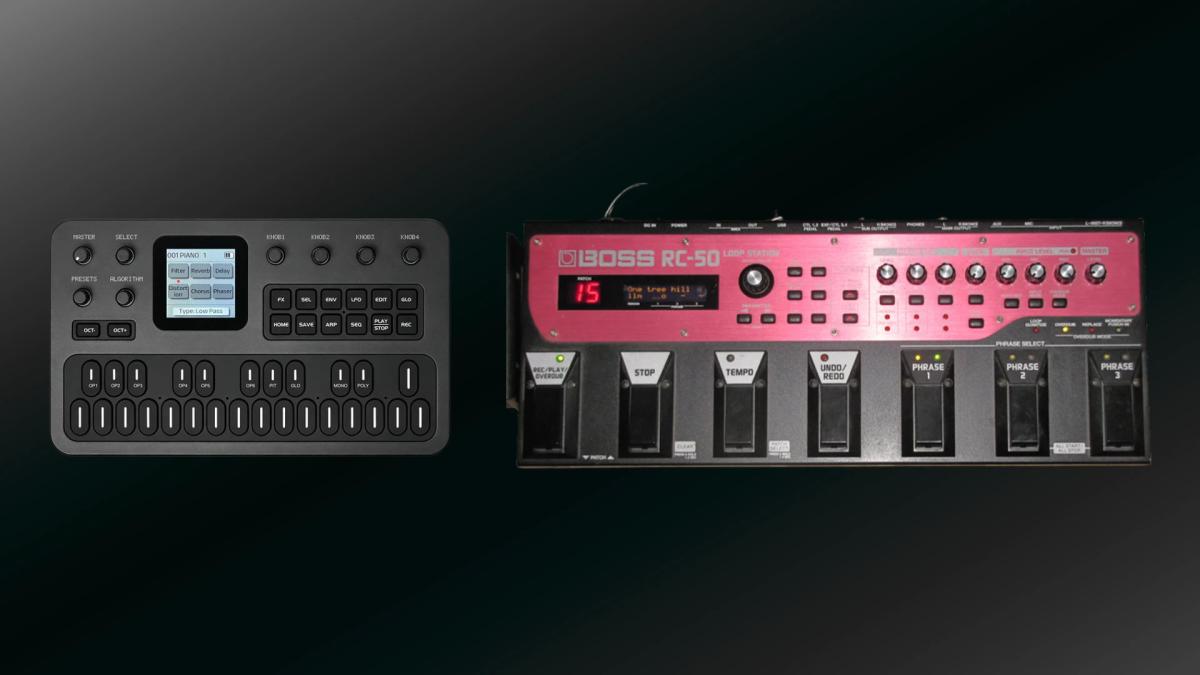
Tonitor firmware is a free replacement operating system for the M-VAVE FM-1, written by Nuno Zimas on top of the Felucca codebase and released under the GPL-3.0. It is aimed at electroacoustic experiments, live ambient playing and general sound exploration, and it leaves out the tempo grid found in groovebox-style firmwares. The central question is whether a 27-key pocket keyboard can work as a loop-based texture instrument rather than a pattern machine, and what the project gives up in order to get there.
Table of Contents
What Tonitor firmware leaves out on purpose
The project README describes Tonitor as “not a groovebox”. There is no tempo, no step sequencer in the conventional sense, no pattern memory and no drum kit. What it offers instead is six tracks of what the author calls sound objects, each with its own engine, its own settings and its own free loop recorder. The Tonitor project page frames the whole instrument around that idea.
The manual explains the consequence in practical terms. Loops run without a grid, and each overdub keeps its own length, so layers drift against one another and the texture changes over time without further input. That suits drones, slow transformations and dark ambient material, and it works against anything that needs to lock to a beat. Readers who want the hardware background should start with the site’s M-VAVE FM-1 profile.
Eight engines sharing twelve voices
In Tonitor firmware each track picks one of eight engines, and the six tracks draw on a common pool of twelve voices rather than owning a fixed number. The README notes that the CALIGULA organism is the exception, since it runs outside that pool.
The first is a six-operator FM engine built on the msfa core from Dexed. ANIMA is a lo-fi synthesizer ported from an opcode in Vascular, and CALIGULA is an eight-oscillator organism based on the LYRA-8 architecture. RUSSOLO works with noise, logic operations and damaged sample buffers, drawing on techniques from the Noisferatu project.
DRUID is a fixed-point port of the Mutable Instruments Rings resonators, with plucked, struck, bowed and rattled excitation. BAYAREA, ported from a Vascular opcode, combines a morphing oscillator with two FM modulators, a wavefolder and a low-pass gate. HIVE stacks seven oscillators per voice under a moving filter, and OBRADOR is an analog polysynth modelled on the Oberheim SEM. Each engine has its own sound families and 64 preset slots.
The HOME key draws a new sound for the selected track. Three generative paths, AMBIENT, EXPERIMENTAL and OPEN, bias what HOME chooses, and sounds that are already playing are not affected when the path changes. Each track also has two LFOs with four modulation slots, a four-knob macro page and an ADSR envelope.
Loopers, physics sequencers and play-along modes
The looper is the core of the Tonitor firmware instrument. Every track can hold up to ten overdubs, played forwards, in reverse, as a pendulum or at random, at half, normal or double speed. Notes held while SHIFT is pressed are latched, which is how drones are sustained under the loops, and a chord mode is available per track.
Two optional sequencers sit beside the loopers. BALLSY is a physics sequencer in which one to eight balls bounce inside a box and every wall hit plays a note of the current scale. BRICKLAYER is a step sequencer of up to 32 steps with rate, harmony and variation controls. According to the changelog, a track can run only one of the two at a time.
A third group of features, called play-along, lets one track act as a guide while others follow in REACT, SHADOW or ARPEGGIO mode. The white keys play a scale chosen at random at start-up, and the manual notes that incoming MIDI notes are not quantised to it. That is a limit worth knowing before connecting an external keyboard.
Snapshots, sessions and USB audio
In the Tonitor firmware each session stores up to 16 snapshots of the whole machine state, and recalling one can either jump immediately or morph over as much as 30 seconds. The FM-1 keeps 64 session slots in flash, and sessions include loops, latched notes, reverb settings and the snapshots themselves. For a live set this is the feature that turns a pile of loops into something that can be steered from one passage to the next.