Home›Articles›Isao Tomita: The Moog III that Japanese customs refused…
Articles

Isao Tomita: The Moog III that Japanese customs refused to believe was an instrument

Tomita: Isao Tomita was among the first people to import a Moog synthesizer into Japan, and the officials at the border did not think it was a musical…

Bernardo de Azevedo
Bernardo de Azevedo
Isao Tomita - historic photo

Isao Tomita was among the first people to import a Moog synthesizer into Japan, and the officials at the border did not think it was a musical instrument. The accounts of how he got it released differ, but they share one point: it took pictures of Western musicians, or of a Western record, to prove what the machine was.

What followed was a series of electronic albums that reinterpreted Debussy, Mussorgsky and Holst, and a quiet influence on a generation of Japanese electronic musicians. How did one composer get a Moog III through customs, and how much of the legend can be checked?

Table of Contents

  • Isao Tomita: a composer before a synthesist
  • A record that sent him to the Moog
  • Three versions of the customs story
  • Learning an instrument with no manual
  • Snowflakes Are Dancing and the labels that said no
  • A pupil, a band and a quiet lineage
  • Linz, 1984: the synthesist outdoors
  • Final perspective

Isao Tomita: a composer before a synthesist

Tomita was born in Tokyo on April 22, 1932, and died there on May 5, 2016, at 84, of heart failure, according to Wikipedia and Resident Advisor. He did not begin as an electronic musician. The Ars Electronica blog says he studied music theory at Keio University, and Wikipedia notes that in 1965 he wrote the music for the Japanese animated series Kimba the White Lion.

Open Culture, citing his New York Times obituary, adds that he grew up in 1930s Japan with little access to Western music and first heard it through U.S. Army broadcasts after the war.

By the time the Moog entered his life, he was an established composer for television and animation. That background matters, because his synthesizer work always carried the imprint of an arranger. He reworked existing orchestral music, the sort that audiences already knew, and let the new timbres do the surprising.

A record that sent him to the Moog

The trigger was a record. Sound on Sound says that after hearing Wendy Carlos’s Switched-On Bach, Tomita traveled to the United States to get a custom-built Moog III. The Ars Electronica blog places the first hearing in Osaka during the 1970 Expo, and says he bought a Moog III-P afterward. Wikipedia puts his acquisition in the late 1960s, while Paste gives 1971 for the import, so the date of purchase depends on the source. The record that inspired him, Switched-On Bach, came out in 1968, according to Open Culture.

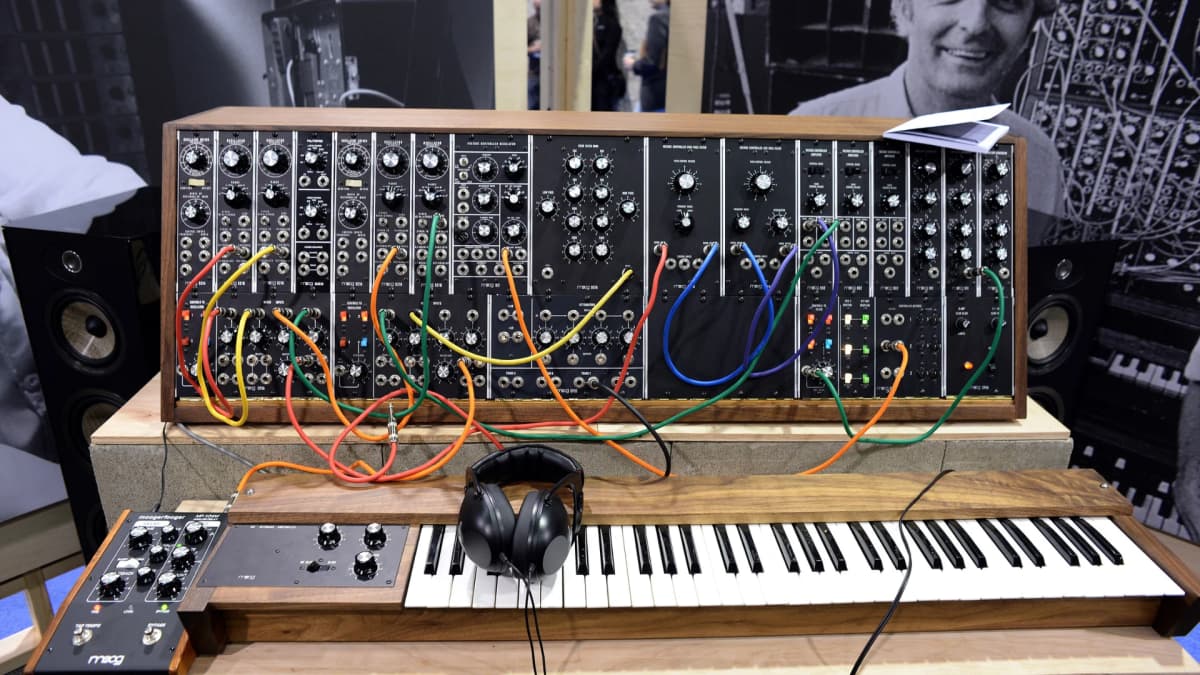
Resident Advisor describes him as one of the first people in Japan to import and own a Moog III P. Matsutake, his later assistant, said in an interview with the Electricity Club that he believes Tomita was among the first to import this type of instrument privately, apart from some universities. That is a cautious claim, and it is worth keeping cautious. The Sound on Sound obituary calls the instrument the first of its kind in Japan, but a first is hard to prove.

Three versions of the customs story

Getting the instrument into the country was a problem. According to Ars Electronica, the Moog cost over ten million yen at the time, and customs initially held the keyless instrument for a long time because officials mistook it for military equipment. The blog says it was released after Tomita showed customs a photo of Keith Emerson performing on stage with a synthesizer.

Open Culture, citing the New York Times, tells it a little differently: Japanese customs officials had trouble accepting the Moog as an instrument, and Tomita held up the cover of Switched-On Bach to show what it was. Hideki Matsutake gave a third version in the Electricity Club interview. He said the fixed exchange rate, a very high luxury excise tax and a lack of trading companies for such goods all made importing difficult.

A Hong Kong trading firm did not help, but Aska Trading agreed to bring it in. Officers did not believe the machine was a musical instrument, and it was held at Haneda Airport for about ten days. Tomita asked Robert Moog to send photos of musicians, including Stevie Wonder, playing Moog instruments, and those finally satisfied the officials.

All three accounts agree on the core: customs doubted it was an instrument, and visual proof of other musicians settled the matter. They disagree on whether the proof was Emerson, an album cover or photos from Moog’s own office. The material read for this article does not say whether any of the three comes from a direct witness.

Learning an instrument with no manual

There were no manuals, the Ars Electronica blog says, so Tomita spent a long time learning to create sounds. Open Culture adds that he struggled at first to get anything but noise from the analog machine, which was a thicket of filters, oscillators, amplifiers and controllers, and that Switched-On Bach was almost his only model.

Vice quotes a 2012 Resident Advisor interview in which Tomita said he had no idea how the Moog was meant to sound. He started by trying to recreate sounds he already knew and discovered new ones through experimentation. Matsutake offered a related lesson: Tomita taught him that a synthesizer has no inherent character, so the player must design every sound and have a clear idea of the palette before starting.

His first electronic album was Electric Samurai: Switched On Rock, released in Japan in 1972 and in the United States in 1974, per Wikipedia. According to Open Culture it covered rock songs including “Let It Be” and “Bridge Over Troubled Water.” Sound on Sound notes his later use of a sequencer to control a synth’s filter cutoff, producing vocal-like articulations that it calls the singing synth.

Snowflakes Are Dancing and the labels that said no

His breakthrough was Snowflakes Are Dancing, a 1974 album of Debussy arrangements. The Ars Electronica blog says major Japanese labels rejected it because they did not know what genre it was. RCA’s American label signed and released it, and it reached number two on the Billboard Classical chart and earned a Grammy nomination. Wikipedia and Vice say it received four nominations in 1975. Resident Advisor adds that it was the first Grammy nomination for a Japanese artist.

The production was long. Vice, the jpopgo interview and the Ars Electronica blog all give about sixteen months, while Wikipedia says fourteen, so the longer figure has more support. The polyphony was built through multitrack recording. Vice reports that the liner notes listed a 36-module Moog, five tape recorders and four mixers, and that Tomita reportedly slept at the studio, though the article frames that as a report.

Vice also says hundreds of thousands of copies sold in the United States. Wikipedia calls it the top-selling classical album of its year. The two claims are consistent, but neither source gives a precise sales figure.

A pupil, a band and a quiet lineage

Hideki Matsutake joined Tomita as an apprentice at about 19, introduced through his father’s agency connections, according to the Electricity Club interview. He later became Yellow Magic Orchestra’s sound programmer. Vice’s obituary says YMO spent studio time analyzing how Tomita made his sounds, that Ryuichi Sakamoto owned all of Tomita’s records, and that Matsutake said YMO’s sound was definitely rooted in Tomita’s music.

Matsutake bought his own Moog IIIc in 1972, also through Aska Trading. With the luxury tax of around 200 percent, plus commission and shipping, he says it cost about ten million yen. That figure is close to the one Ars Electronica gives for Tomita’s III-P, and the match is reassuring, even though the two machines were different models.

Linz, 1984: the synthesist outdoors

Tomita did not stay in the studio. In 1984, at Ars Electronica in Linz, he staged a large open-air event. Wikipedia says he mixed tracks live in a glass pyramid over an audience of about 80,000. The Ars Electronica blog describes sound on boats along the Danube, speakers suspended from a helicopter and Tomita performing inside a glass pyramid on a crane, with about 100,000 spectators. The audience figure differs by source.

The blog reports Ars Electronica’s Stocker describing the event as a democratic act that brought expensive technology and classical music to the public. In another detail, Wikipedia mentions that his version of The Planets, released in 1976 or 1977 depending on the passage, caused a controversy because Gustav Holst’s daughter Imogen Holst refused permission for the interpretation.

Final perspective

The most useful thing about Isao Tomita’s story is the gap between a technology and the institutions around it. A Moog III could be built in the United States, but in Japan someone had to persuade a customs desk that it belonged in the category of music. He did it with images of other musicians, or of an album cover, and the same impulse shaped his career: he made the unfamiliar legible by attaching it to something audiences already loved.

It also shows how unreliable origin stories can be, even for events within living memory. Three accounts of the same customs episode differ on the proof that mattered. What survives all of them is the practical lesson. An instrument becomes an instrument when enough people agree to treat it as one, and sometimes the first agreement is won at an airport.

Related stories

Sources

Bernardo de Azevedo
Written by
Bernardo de AzevedoFounder & Editor

His connection with music began at age 6, in the 1980s, when his father introduced him to Jean-Michel Jarre's Rendez-Vous on vinyl. He works professionally in the legal field, while synthesizers became his space for abstraction and creative exploration. Founder of The Synth Source.