Home›Articles›I Feel Love: The borrowed Moog modular that would not s…
Articles

I Feel Love: The borrowed Moog modular that would not stay in tune

I Feel Love: “I Feel Love” is often described as the song that invented electronic dance music. The people who made it, by their own accounts, thought they…

Bernardo de Azevedo
Bernardo de Azevedo
· Updated
I Feel Love - historic photo

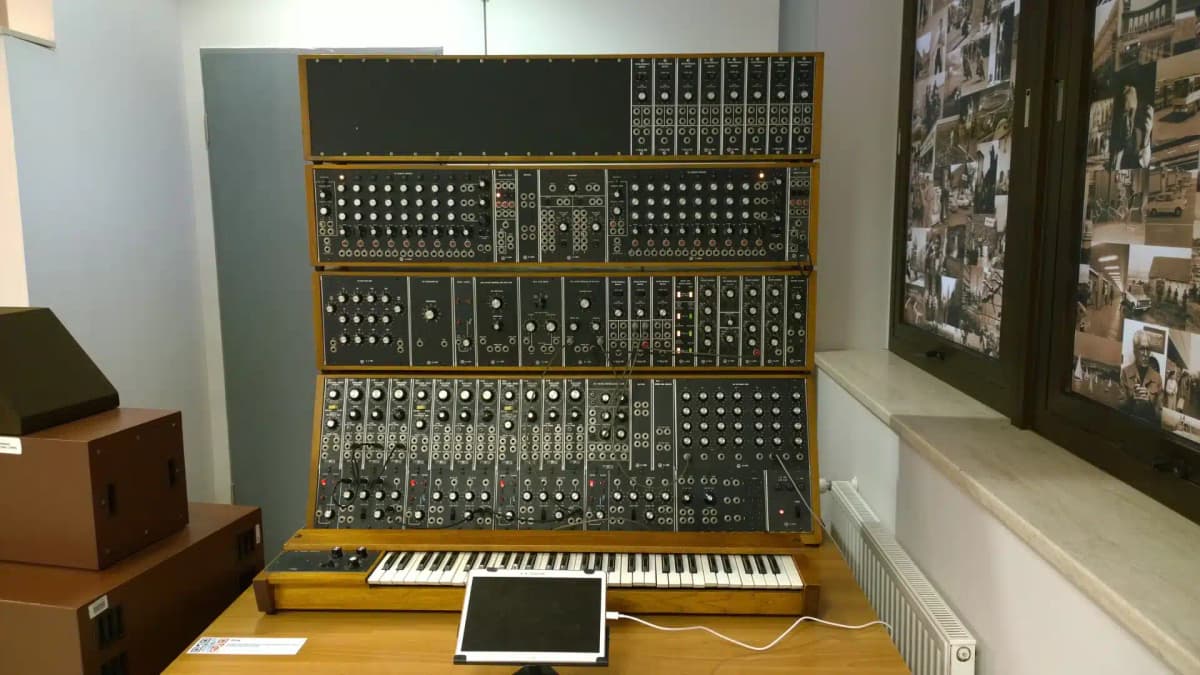
“I Feel Love” is often described as the song that invented electronic dance music. The people who made it, by their own accounts, thought they were finishing an album. A borrowed Moog modular, a technician who knew how to make it behave and a singer who finished her part in a single take produced a record that Brian Eno reportedly heard as the future.

The legend is tidy, but the workflow was anything but. The Moog drifted out of tune within seconds, the sounds took half an hour to patch, and the sources disagree on who played the kick drum. How did something so unstable end up sounding so exact?

Table of Contents

  • I Feel Love: a closing track for a concept album
  • A Moog on loan
  • Taming the tuning
  • A bass line that flickers
  • The kick drum question
  • A B-side that turned into the A-side
  • The remixes and the reputation
  • Final perspective

I Feel Love: a closing track for a concept album

The song is the last track on Donna Summer’s album I Remember Yesterday. Wikipedia explains that the album was meant to trace popular music from the 1950s toward the future, and that producers Giorgio Moroder and Pete Bellotte wanted a futuristic mood for the final piece. Bellotte wrote the lyrics, and Summer is credited as a composer.

The recording took place at Musicland Studios in Munich. Wikipedia dates it to 1976, while the Mojo Time Machine feature places it in early 1977, and the album itself came out in May 1977, so the year of the sessions is a point on which accounts differ. Sound on Sound adds that the song was recorded in two to three hours, and that it was a late addition to the album with no special expectations.

Bellotte told the magazine that at the time he and Moroder did not think the track was revolutionary, just a decent one.

A Moog on loan

Moroder had been interested in synthesizers since discovering them in 1970, Sound on Sound reports, and he said the Moog could do far more than play a low note. But the machine he used for this track was not his own. Wikipedia says the team borrowed a Moog from the classical composer Eberhard Schoener. In the Sound on Sound telling, Moroder explained that Schoener’s large Moog was hard to access and that his team sneaked in to use it while Schoener was away.

Schoener’s assistant, Robby Wedel, is the crucial figure. Sound on Sound describes him arriving with four cases containing the Moog and setting it up, and Wikipedia says he showed the team how to sync the parts using a click track. Moroder called that a revelation and described Wedel as the unsung hero. In a 2014 interview at Moogfest, recorded by Noisey, Moroder said the track was made entirely on the Moog modular, with one possible exception: an Italian polyphonic synthesizer at the start.

He added that he thought Wedel was the engineer who got the sounds working, though he said it with a hedge. Wikipedia’s article itself says only “Moog synthesizer,” so the word modular rests on Moroder’s own recollection.

Taming the tuning

Moroder composed the backing track and bass line before the melody, which Wikipedia calls unusual for disco at the time. The bass line was the foundation of the record. He told Noisey that the sequence was programmed so that each key pressed transposed the pattern to a new pitch.

The practical problem was tuning. Wikipedia says the Moog drifted out of tune quickly, so it was recorded in bursts of 20 to 30 seconds and retuned between them. Moroder gave Noisey a similar picture: the instrument was often out of tune and he had to retune it repeatedly, and he re-recorded in blocks of about eight to ten bars, returning to sync each time. A single sound could demand around twelve oscillator connections and at least half an hour of patching.

Syncing the parts was a separate matter. Sound on Sound reports that Wedel recorded a reference pulse on track 16 of a 16-track Studer A80 and locked the Moog to it, so that every later synthesized part stayed in time with the first. Moroder’s version, in the Noisey interview, was a click on tape that triggered the Moog’s start.

A bass line that flickers

What reaches the listener is a bass line that seems to strobe. Wikipedia explains the mechanism: each note of the bass line is doubled by a delay effect, with the dry line in the left channel and the delayed copy in the right. The result is a flickering effect that makes a repeating pattern feel as if it is breathing.

The processing was modest. Bellotte told Sound on Sound that only compression and reverb from an early Lexicon unit were used, with the Moog sent directly into the console. The vocals were recorded through Neumann U87 microphones. Summer sang her part in a single take, and Wikipedia notes that she used head voice rather than the chest voice typical of disco. Moroder told Mojo that she finished in about ten minutes.

The kick drum question

Rhythm is where the sources split. Wikipedia says the hi-hat was made by processing white noise from the Moog with an envelope. It also says the Moog could not produce a satisfactory kick drum, so the drummer Keith Forsey played the kick, making it the only element other than the vocals not played by a machine.

Moroder told Noisey that percussion was built from white noise with certain frequencies filtered out, and that Forsey played all the drums except the bass drum, which he said was the part the Moog could not do convincingly. Forsey, he added, needed five or six takes. Mojo agrees that Forsey supplied the bass drum.

Sound on Sound tells it differently. Its feature says Wedel simulated the hi-hat, snare, bass drum and a swell pad on the Moog, and it links the four-on-the-floor kick pattern to an earlier session jam by Forsey. Since three sources point to a played kick and one to a synthesized one, the cautious statement is that Forsey is widely credited with the kick, though accounts differ.

A B-side that turned into the A-side

Mojo reports that the track first appeared as the B-side to “Can’t We Just Sit Down (And Talk It Over),” until club success made it the A-side. Moroder described it to Mojo as just an album track, and said that he later sensed it could point to the future but did not expect its impact. He also said he had considered the cantina music from Star Wars as a model before deciding the sound had to be made entirely with computers.

The single reached number one on the UK Singles Chart in July 1977 and stayed there for four weeks, according to Wikipedia. It reached number six on the Billboard Hot 100 in the week of November 12, 1977, and number three in West Germany. Sound on Sound adds that Casablanca’s Neil Bogart asked for three edits of the song for the single release, and that Bellotte thought they improved its flow.

The remixes and the reputation

The reputation of the record grew from its listeners. Sound on Sound quotes Brian Eno in 1977 calling it the one to look to, saying that this is it and to look no further. Wikipedia relays David Bowie’s recollection that Eno came running in during the recording of Bowie’s Berlin albums and said he had heard the sound of the future, predicting that it would change club music for the next fifteen years.

The DJ Patrick Cowley made an extended remix from a vinyl copy of the original, not from Moroder’s master tapes. Early versions circulated as an underground bootleg before the Disconet remix service picked them up. In mid-1980, it was released on a limited DJ-only Disconet pressing titled “I Feel Love / I Feel Megalove,” which became highly sought after.

Casablanca released the remix as a 12-inch in the UK in 1982. Mojo lists the Human League, Blondie, Sparks and Simple Minds among admirers, and notes that Moroder later worked with Daft Punk on Random Access Memories in 2013.

Final perspective

The history of I Feel Love shows how much of an electronic record’s precision comes from human labor. The Moog was unstable, so it was retuned and recorded in short bursts. The clock was unreliable, so a technician locked it to a tape pulse. Each sound took about half an hour to patch by hand. The mechanical perfection that later producers copied was, in practice, a long series of repairs.

It also shows how little a creator’s intention can say about a record’s meaning. The men who made it treated it as an album closer. Listeners heard a template. The Moog modular on this track was borrowed, and so, in a way, was the future it seemed to describe.

That is why the I Feel Love story keeps drawing musicians and historians back to it.

Few chapters of synthesizer history show as clearly as I Feel Love how far a single idea can travel.

Looking back, the I Feel Love episode suggests that the most unusual stories are often the most instructive ones.

For anyone tracing the history of electronic instruments, I Feel Love is a name worth remembering.

Related stories

Sources

Bernardo de Azevedo
Written by
Bernardo de AzevedoFounder & Editor

His connection with music began at age 6, in the 1980s, when his father introduced him to Jean-Michel Jarre's Rendez-Vous on vinyl. He works professionally in the legal field, while synthesizers became his space for abstraction and creative exploration. Founder of The Synth Source.