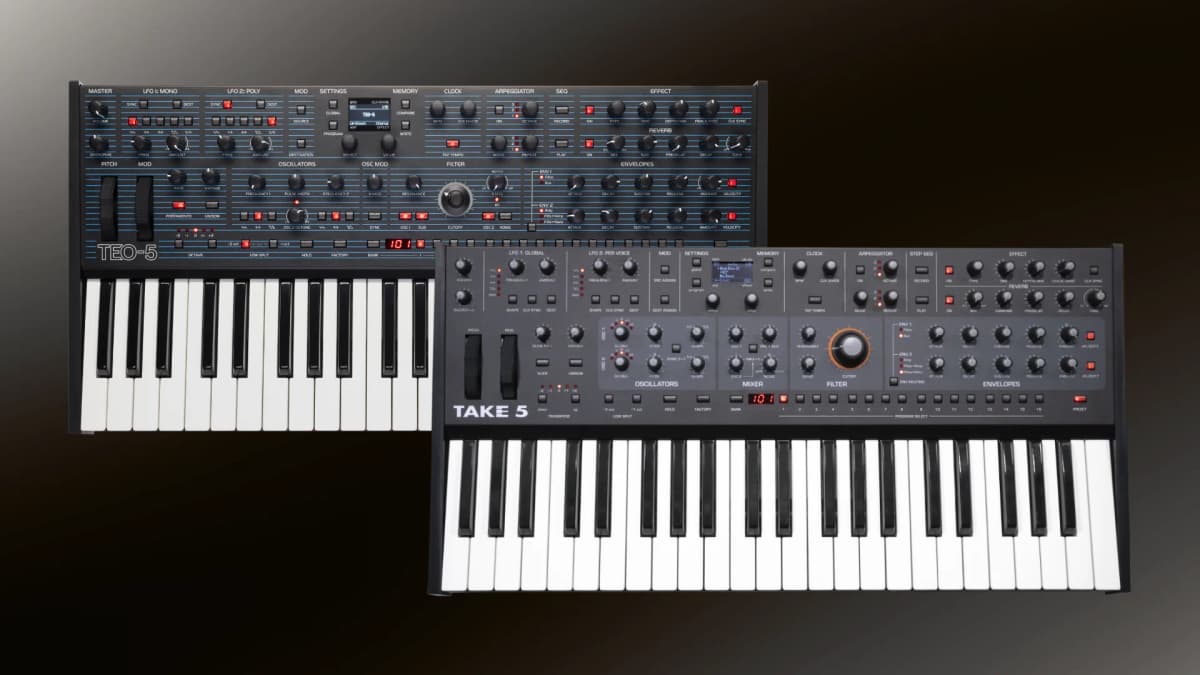
The filters: SEM morph against 24 dB Prophet-style
The TEO-5 has a state-variable filter with a morph control. Opening the morph just slightly gives a sound he says no synth without an Oberheim SEM-style filter can reproduce. He describes its resonance as unusually musical: it does not self-oscillate, but there is no bass drop-off, and he calls it his favorite filter of all time, with the caveat that he is biased.
The Take 5 has one comically big knob and a more aggressive, self-oscillating filter. Its drive control is the key. With oscillators at a low level and a driven resonance signal you get resonant peaks that do not sound harsh. With less resonance, no drive and more oscillator level, you get the classic Prophet sound: straightforward, woody, warm and mid-range forward. He notes this is something the Prophet-5 and Prophet-6 cannot do because they lack the drive knob.
In the TEO-5 vs Take 5 comparison, price and playability matter as much as raw sound.
Effects: delay, BBD and reverb
The delay settings are essentially identical on both, and he finds the BBD delay better than the other delay types on both instruments. The reverb is where he hears a difference. Even with matching settings, with the TEO-5 offering a size control where the Take 5 offers damping, he finds the TEO-5’s reverb nicer and has a harder time getting reverbs he likes on the Take 5. He suspects the reverb differs between the two and invites viewers to confirm.
The TEO-5 vs Take 5 question rarely has a single right answer, because it depends on how you actually work.
TEO-5 vs Take 5: which one makes more sense?
His verdict is that he prefers the TEO-5, though not as much as he expected, mainly because he loves the sound of Oberheim synthesizers. The Take 5 is better for plucks and keyboard sounds: velocity-sensitive electric pianos through tape or BBD delay, and a chill, Boards of Canada-style mood. The TEO-5 is a synthwave machine, energetic and well suited to electronic and dance music.
He closes by praising Sequential for achieving such a professional sound in a small form factor, and tells buyers they cannot go wrong: pick whichever sounds better to you.
That is the TEO-5 vs Take 5 decision in short: match the instrument to the sound and workflow you actually want, and weigh the price difference before you commit.
If you are still undecided in the TEO-5 vs Take 5 matchup, think about which controls you would reach for every day.
Related comparisons
Sources
- TEO 5 vs. Take 5 (Devin Belanger (Miles Away), YouTube). This article is an original editorial analysis based on that video’s transcript.