Table of Contents
- Suzanne Ciani: from Wellesley piano to a Berkeley soldering bench
- Building her own Buchla
- New York, 1974: a synthesizer and a lot of cold calls
- The Coca-Cola sound
- Musical effects: pinball, logos and a film score
- What the machine cost her
- Final perspective
Suzanne Ciani: from Wellesley piano to a Berkeley soldering bench
Suzanne Ciani was born on 4 June 1946 and raised in Quincy, Massachusetts. She began piano lessons at the age of six, studied liberal arts at Wellesley College from 1964 to 1968, and took evening classes at MIT, where, according to Wikipedia, she first learned about music technology. In 1968 she began a master’s degree in composition at the University of California, Berkeley.
Berkeley is where she met Don Buchla. Accounts of how they met differ slightly. Wikipedia says she was introduced through a boyfriend, a Daze Digital profile says it happened through performances for the sculptor Harold Paris, and an NPR transcript simply places the meeting in Berkeley.
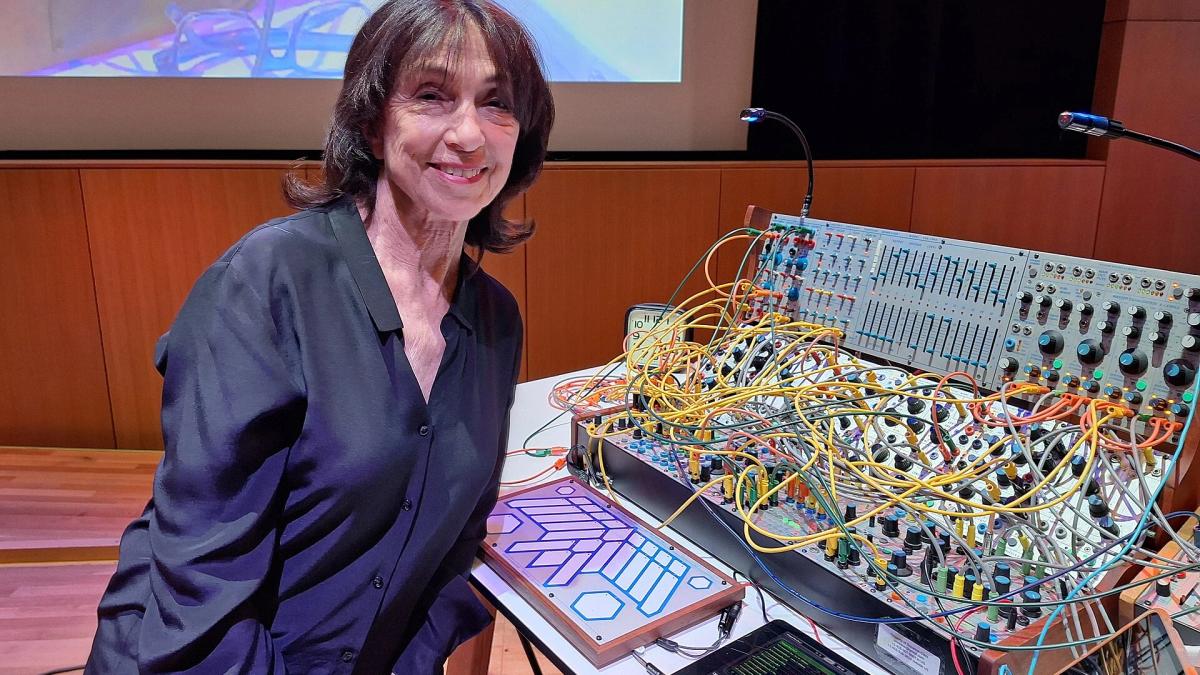
In the NPR interview she describes her first sight of his synthesizer as a tall tower of modules in a large, dark room. The instrument gave her something she valued: a way to control her own composing without relying on others to realise her music.
Building her own Buchla
A Buchla was expensive, and Ciani paid for hers partly by working for the maker. Wikipedia reports that she worked at Buchla and Associates, soldering and drilling for three dollars an hour, to earn money toward a Buchla 200. Daze Digital adds that the instrument cost $8,000, which she raised by making jingles, sound beds and logos for clients including AT&T and Clairol.
Tom Tom Magazine reports that her first day at the workshop ended in dismissal over a faulty solder joint blamed on her, and that she came back the next day.
She finished her Berkeley degree in 1970 and released her first record, Voices of Packaged Souls, made with Harold Paris at the radio station KPFA. Sources disagree on whether it appeared in 1970 or 1971, and Wikipedia says only fifty copies were initially pressed. Ciani also took a summer computer-music course at Stanford, taught by Max Mathews, John Chowning and Leland Smith. The tone of all this is modest. She was a graduate student with a very unusual instrument and no obvious employer.
New York, 1974: a synthesizer and a lot of cold calls
In April 1974 Ciani moved to New York. Wikipedia says she brought only her clothes and the Buchla, and Daze Digital adds that she stayed on a friend’s couch and later slept on the floor of Philip Glass’s studio in SoHo. A profile on Spencer Tweedy’s Substack says she cold-called advertising agencies until they gave her commercial sound-design work.
The cold calling worked. Within a few years she was an in-demand session musician, and commercial work paid for her more personal projects. She later described that work to NPR as being like an emergency room, with calls arriving and recording sessions starting the next day.
Wikipedia says she founded a company, Ciani/Musica, to produce jingles and sound logos, and lists clients such as Coca-Cola, Merrill Lynch, AT&T and General Electric. The founding year is disputed: Wikipedia says 1978, while Daze Digital and Tom Tom Magazine say 1974.
The Coca-Cola sound
The sound that made her famous is usually called “pop and pour.” Daze Digital’s account is the most detailed one I found. The client could not say whether the sound would be used in one commercial or in several, so Ciani designed something that would work in any context. She made what she called a perfect rising bubble, a sound with no pitch centre. According to the same article, it has since been used in Coca-Cola commercials worldwide for years.
Ciani told Women in Sound that the sound started on radio and moved to television later. She made it without a picture, and the visuals of a pour were developed afterwards. She also said she preferred the phrase “musical effects” to “sound effects,” because she could control pitch, rhythm and timbre, and she noted that synchronising sound to picture was a manual job with no SMPTE timecode and no personal computers.
The sound was synthesised, not recorded from real soda, according to NPR. No source I read gives the precise year she made it, although Wikipedia places the Coca-Cola recording in the late 1970s.