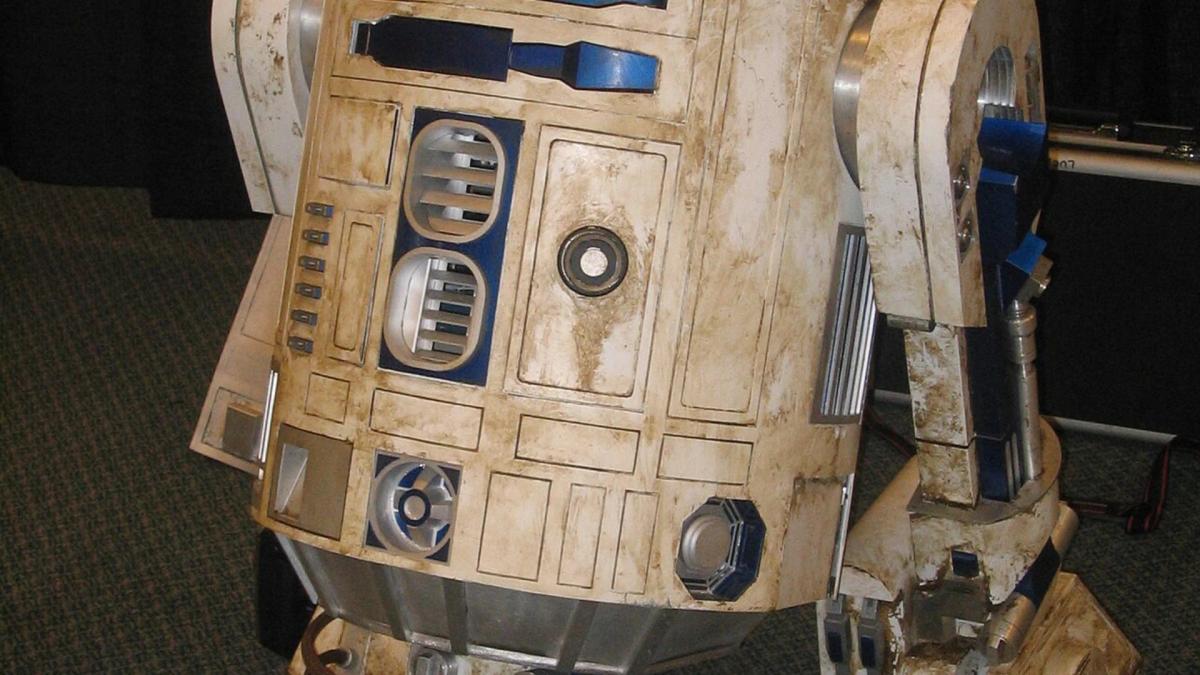
The accounts of the method are not identical: NPR describes playing a keyboard, Designing Sound describes reading lines while turning knobs, and Attack describes patching a sample-and-hold source into a resonating filter. They probably describe different stages of experimentation, but the sources do not say.
The human half
Attack reports that something was still missing, so Burtt plugged the microphone from an old tape recorder into the 2600 and sent his own voice through the resonating filter. In an interview quoted there, he called the human input “the trick.” The resulting character is, as Burtt told NPR, about fifty percent electronic and fifty percent human, which is how the character’s voice was born.
The starwars.com piece gives a similar summary, quoting Burtt’s description of a fifty-fifty mix of synthesizer-generated sound and his own voice making funny inflections. The blend hid the two sources and let the team make Artoo seem to act. Burtt’s voice also supplied R2-D2’s scream. NPR says he recorded it himself in the basement of Lucas’s house, curled up under a large table with a microphone because he had no proper booth, and that the recording was then sped up.
The name “R2-D2” has an equally practical origin. Wikipedia says the sound editor Walter Murch started it, asking for “R-2-D-2” as shorthand for Reel 2, Dialog Track 2. George Lucas, half asleep while writing the script, called it a great name.
It is a neat parallel. The voice came from a blend of a machine and a human performer, and the name came from an editing request. Both were working solutions that stuck because they turned out to be better than anything planned.
Why the ARP 2600 suited the job
The 2600 was a sensible choice for this kind of work. Wikipedia’s ARP Instruments article says Pearlman founded the company in 1969 and that the 2600 went into production in 1971, designed to be easy to use in school and university music departments. Its semi-modular design allowed a sound designer to start from a working signal path and then alter it, which arguably suits experimentation. Attack’s description of a self-resonating filter and a sample-and-hold source suggests that the basic R2-D2 sounds needed very few elements.
The instrument also had a second life in the same franchise. Wikipedia lists Burtt among notable 2600 users and says he also used it for the Ark of the Covenant sounds in Raiders of the Lost Ark. Designing Sound reports that for more recent Star Wars films the ARP was recreated virtually using Symbolic Sound’s Kyma system, and Attack says the designer David Acord took inspiration from Burtt’s approach for BB-8, without copying the 2600.
ARP itself was short-lived. Wikipedia says the company declared bankruptcy in May 1981 after financial trouble linked to the Avatar, which sold poorly and never recouped its development costs. By then the 2600 had been in production from 1971 to 1981.
Final perspective
R2-D2’s voice is a case study in how a sound designer treats a synthesizer: not as a source of finished sounds, but as a filter for a human performance. Burtt began from the premise, handed down by Lucas, that synthesizers made things sound too electronic. What the ARP 2600 gave him was a way to bend his own voice and gestures into something that read as a machine without losing emotion.
That is a lesson with wider reach. One reading of the R2-D2 story is that a synthetic voice becomes believable when a person sits inside the signal chain, and the ARP 2600 made that easy. Burtt later created the voice of WALL-E and of other robots such as M-O, and also served as supervising sound editor on that 2008 film, according to Wikipedia.
The same article records that he received a Special Achievement Academy Award for creating the alien, creature and robot voices in Star Wars. The original achievement, however, was simpler: persuading an audience that a small robot with no language had feelings.
Related stories
Sources