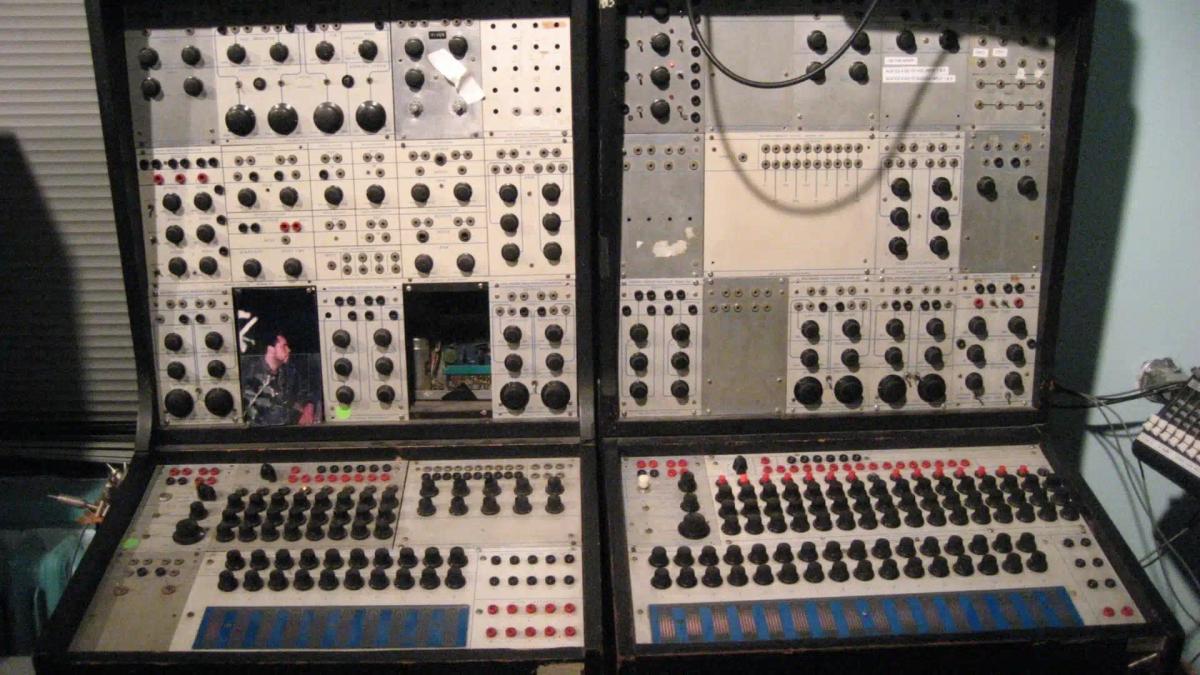
The San Francisco Chronicle’s obituary adds that his modules carried imaginative names, where Moog’s were labelled by function. Buchla said he met Moog around 1968, found their modules strikingly similar, and described a decade in which the two largely ignored each other.
The Acid Test years and the Grateful Dead question
The Buchla’s reputation outside the avant-garde comes from the counterculture. Tom Wolfe’s 1968 book The Electric Kool-Aid Acid Test mentions a Buchla machine “screaming like a logical lunatic,” and Buchla himself recalled hiding in a corner of an Acid Test, operating a mass of speakers and producing what he called mad, lunatic-fringe sound. He said he spent time with Ken Kesey, the Merry Pranksters and the Grateful Dead, and that they had fun.
The popular claim that the Buchla was a Grateful Dead instrument is harder to support. Wikipedia’s article makes no such claim, and a CBS News investigation of the instrument’s psychedelic legends found no documented link between the Buchla and the band. That report places some modules on the Pranksters’ bus in 1966, and it cites a Cal State East Bay engineer who said he felt hallucinogenic effects hours after cleaning a red module.
Joel Davel, a longtime Buchla designer, summed up the situation by noting that there were a lot of legends. The reliable part is the sound-design work around the Acid Tests; the rest is folklore.
A short commercial life, a long influence
Sales were modest: by one estimate from Joel Davel, a longtime Buchla designer quoted by CBS News, about 20 early systems were sold before one reached Cal State East Bay. Wikipedia notes that CBS Musical Instruments briefly distributed the Series 100 in 1969 and then dropped the line, and Red Bull says CBS funded the 200 series that followed in 1970. Buchla’s later instruments included the 500 series, described as the first analog synthesizer that could be controlled digitally, and the portable Music Easel of 1972.
The original instrument has a quiet afterlife at Mills College in Oakland, where Buchla said an offer of $50,000 for it was turned down. Buchla died on 14 September 2016 at the age of 79, a few years after the sale of his company’s intellectual property to investors who built a new brand around it.
Final perspective
The Buchla 100 shows how much of synthesizer history was decided by who the first customers were. Moog’s instruments came with a keyboard. Buchla’s first users were tape composers who spliced, looped and gestured, and his instrument came with touch plates and sequencers. The market followed the keyboard, but the ideas followed Buchla, and today’s modular and semi-modular instruments are full of them.
It is also a lesson about legends. The Buchla became famous partly through stories that no one can fully verify, from the Grateful Dead to the contaminated red module. The documented history is quieter and stranger: a physicist, a grant, a tape studio with surplus oscillators and a design decision to leave out the one thing every musician expected to find.
That is why the Buchla 100 story keeps drawing musicians and historians back to it.
What makes the Buchla 100 story memorable is how ordinary the people involved were, and how improbable the outcome turned out to be. Anyone retelling the Buchla 100 story has to admit that part of it comes down to timing and luck. The Buchla 100 story also shows how quickly a promising idea can slip out of public view.
Revisiting the Buchla 100 story today, it is striking how many details were lost or rewritten over the years. Each retelling of the Buchla 100 story adds a little more context to what the original documents leave out. If there is one lesson in the Buchla 100 story, it is that technology rarely follows a straight line.
Related stories
Sources