Home›Articles›Roland Juno-106: The bestseller whose voice chips are r…
Articles

Roland Juno-106: The bestseller whose voice chips are running out of time

Roland Juno-106: The Roland Juno-106 sold in large numbers, sounds warm and slightly rough, and is still on the wish list of plenty of producers. It also has…

Bernardo de Azevedo
Bernardo de Azevedo
· Updated
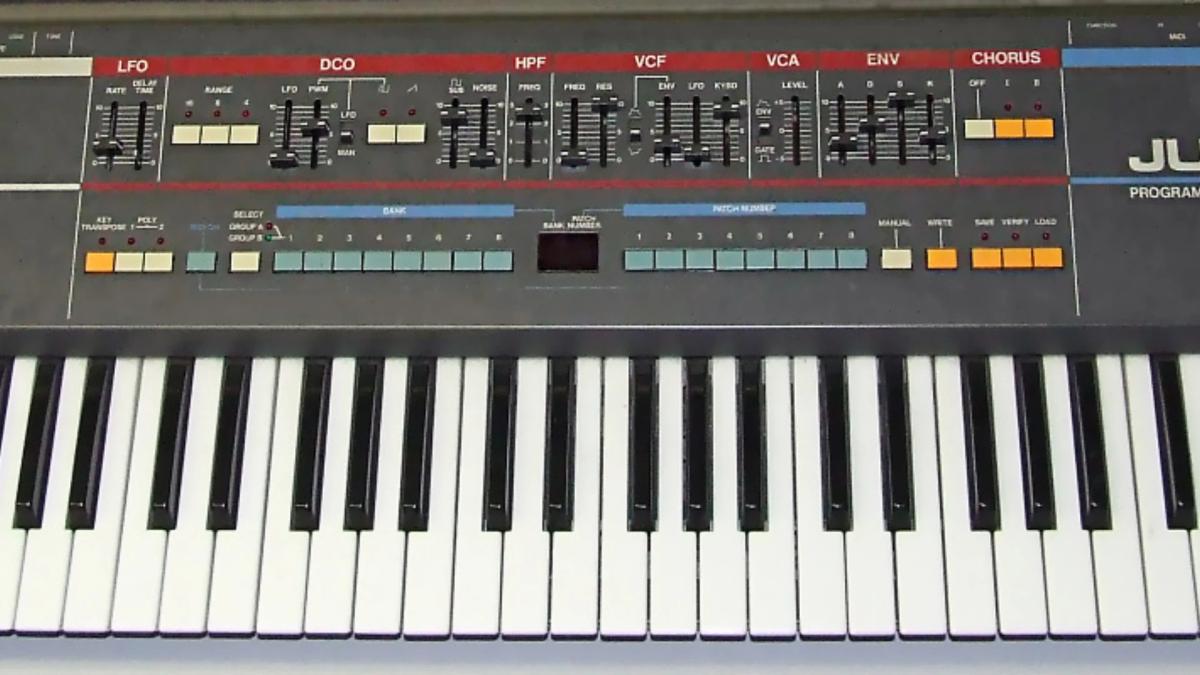
Roland Juno-106 - historic photo

The Roland Juno-106 sold in large numbers, sounds warm and slightly rough, and is still on the wish list of plenty of producers. It also has an Achilles heel. Each of its six voices depends on a custom chip that Roland made once, in the early 1980s, and that has been failing in old instruments ever since.

The Juno-106 is a good example of a design decision that made economic sense in 1984 and became a headache decades later. The question is what exactly the chip was meant to do, why it keeps dying, and why nobody can quite agree on the reason.

Table of Contents

  • Roland Juno-106: a budget polysynth with a MIDI socket
  • What the 80017A chip does
  • How a failing voice sounds
  • Why the chips fail: three explanations
  • The replacement market
  • Who kept the Juno-106 in demand
  • Final perspective

Roland Juno-106: a budget polysynth with a MIDI socket

According to Wikipedia, Roland released the Juno-106 in February 1984. It had six voices, each with a single digitally controlled oscillator, plus a resonant 24 dB per octave low-pass filter, a non-resonant high-pass filter, an LFO and a chorus. Its patch memory held 128 sounds, compared with 56 on the Juno-60, and it added MIDI. The pitch-bend and modulation lever that Roland introduced on it later became a standard feature on the company’s instruments.

A Roland UK advertisement feature in Electronic Soundmaker & Computer Music in June 1984 gives the British price as 800 pounds, essentially the same as the 799 pounds the original Juno-6 had cost, and below the 1,199 pounds listed for the Juno-60. Because the text is a promotional piece, its praise should be discounted, but its description of the sound is useful: it calls the Juno-106 a budget synth that does not cut corners on build quality, with a sound suited to hard-edged funk and electronic music.

Sound on Sound, looking back in 1998, said the Juno-106 remains one of the best-selling synths of all time. Wikipedia describes it as Roland’s bestselling synthesizer until the D-50 later in the decade.

What the 80017A chip does

The part at the center of the story is a Roland custom chip, usually called the 80017A. A post on Matrixsynth describes it as a single chip combining a voltage-controlled low-pass filter and a voltage-controlled amplifier. Roland used it in the Juno-106, the MKS-30 module, the GR-700 guitar synthesizer and the HS60, according to the same post, to keep an analog sound while lowering production costs.

Because the Juno-106 has six voices, it has six of these chips. That is the economy and the risk in one design. The custom part was chosen, per the Matrixsynth post, to help keep costs down. It also means that when one wears out, the owner cannot simply buy a standard component to replace it. The Matrixsynth post on replacements says the original is no longer manufactured and calls its failure the most common Juno-106 fault.

How a failing voice sounds

The symptoms are well documented by repairers. Syntaur lists crackling whenever the affected voice plays, a thin or distorted tone, notes that hang after the key is released, or a voice that makes no sound at all. The Matrixsynth post on the chip describes sudden loud noise after about ten minutes of power-up, and notes that fail to play, typically every sixth note, because one of six voices is dead.

There is a built-in way to find the culprit. Both Syntaur and SynthTweaks describe a test mode: hold the Key Transpose button while switching on, release it, then press Poly 1 and Poly 2 together. The display then shows which of the six voices is sounding as you play a key, so the faulty chip can be identified by elimination. That diagnostic feature is useful, but it also suggests how familiar the problem has been for a long time.

Why the chips fail: three explanations

Here the sources part company. Syntaur says the chips were epoxy-coated when made in the early 1980s and that, decades later, the epoxy becomes conductive with age, which causes the failure. A video summarized on Synthtopia in 2016 says something similar, that the coating Roland used begins to conduct electricity, and that removing it can extend a chip’s life but does not work in every case. The Stompbox Electronics repair guide soaks the chips in acetone for 24 to 48 hours to remove the resin.

SynthTweaks reaches a different conclusion. Its author states that the main cause of faulty chips is poor soldering, meaning dry or cracked joints on the surface-mount components under the black resin. An acetone soak can cure the fault temporarily, he writes, but the underlying solder problem usually returns. Meanwhile the engineer who designed one of the clone chips told Matrixsynth in 2006 that the original was poorly manufactured.

A seller’s post from 2007 adds that Roland changed its production methods after manufacturing problems appeared, and that chips from a later production lot were more reliable, though a commenter said he had seen later date codes fail too. These explanations may all be partly true, and none of the sources consulted for this article offers a definitive answer.


The replacement market

Whatever the cause, owners have options. The Matrixsynth replacement post says an engineer completed a clone of just the amplifier part of the chip in late 2003, and released a full clone for sale in May 2006 after six restarts and months of testing in other people’s instruments. He claimed there was no measurable or audible difference from the original. Today, according to SynthTweaks and Syntaur, Analogue Renaissance sells remanufactured chips, and Syntaur lists them at about 60 dollars each with a discount for a set of six.

Installation is not trivial. Syntaur warns that overheating can lift delicate circuit traces and recommends an experienced technician, and SynthTweaks says replacement chips need recalibration against the service manual. If several chips have gone, Syntaur suggests replacing all six.

Meanwhile Roland has revisited the sound. Wikipedia lists the JU-06 of 2015, a digital recreation priced at 299 dollars at launch, the JU-06A of 2019 and the Juno-X of 2022, which include emulations of the Juno-106. Roland, in other words, has chosen to carry the sound forward in new hardware rather than to rely on the old chips.

Who kept the Juno-106 in demand

The reason anyone bothers is the music. Wikipedia lists a long roster of Juno-106 users that includes Vince Clarke, Frankie Goes to Hollywood, Vangelis, Underworld, Leftfield, William Orbit, Daft Punk, Tame Impala and Calvin Harris. The list spans several decades and many styles of music, which says something about the range of a simple six-voice machine with a chorus.

Roland also sold it in other forms. The Juno-106S and the HS60 Synth Plus, both with built-in speakers, appeared in 1985, and the HS60 is one of the products the Matrixsynth post names as using the 80017A chip. Behringer’s DeepMind-12 of 2016, with twelve voices, was described on Wikipedia as inspired by the Juno-106. Each of these descendants trades on the reputation of the original.

Final perspective

The Roland Juno-106 shows how a cost-saving choice can become a time bomb. In 1984 a custom chip made the instrument affordable and reproducible. Forty years later it is the reason a working example is worth maintaining and a failed one needs surgery.

It also shows how a legend grows around a flaw. The Juno-106’s reputation rests on its sound and its price, but its reputation as a fragile classic has made it a project instrument, with a small industry of chip clones and repair videos. Perhaps that is the real lesson: old synthesizers do not die because the sound disappears, but because a part nobody can buy any more stops working. The Roland Juno-106 survives because people are willing to rebuild it.

That is why the Roland Juno-106 story keeps drawing musicians and historians back to it.

Few chapters of synthesizer history show as clearly as Roland Juno-106 how far a single idea can travel.

Looking back, the Roland Juno-106 episode suggests that the most unusual stories are often the most instructive ones.

For anyone tracing the history of electronic instruments, Roland Juno-106 is a name worth remembering.

What makes the Roland Juno-106 story memorable is how ordinary the people involved were, and how improbable the outcome turned out to be. Anyone retelling the Roland Juno-106 story has to admit that part of it comes down to timing and luck. The Roland Juno-106 story also shows how quickly a promising idea can slip out of public view.

Revisiting the Roland Juno-106 story today, it is striking how many details were lost or rewritten over the years. Each retelling of the Roland Juno-106 story adds a little more context to what the original documents leave out. If there is one lesson in the Roland Juno-106 story, it is that technology rarely follows a straight line.

Related stories

Sources

Bernardo de Azevedo
Written by
Bernardo de AzevedoFounder & Editor

His connection with music began at age 6, in the 1980s, when his father introduced him to Jean-Michel Jarre's Rendez-Vous on vinyl. He works professionally in the legal field, while synthesizers became his space for abstraction and creative exploration. Founder of The Synth Source.