Table of Contents
- Roland Alpha Juno: a synth that arrived in the wrong year
- Eric Persing and the preset called “What The”
- Why it sounds the way it does
- Mundo Muzique, Joey Beltram and “Mentasm”
- From Belgian techno to pop radio
- A sound its maker did not claim
- Final perspective
Roland Alpha Juno: a synth that arrived in the wrong year
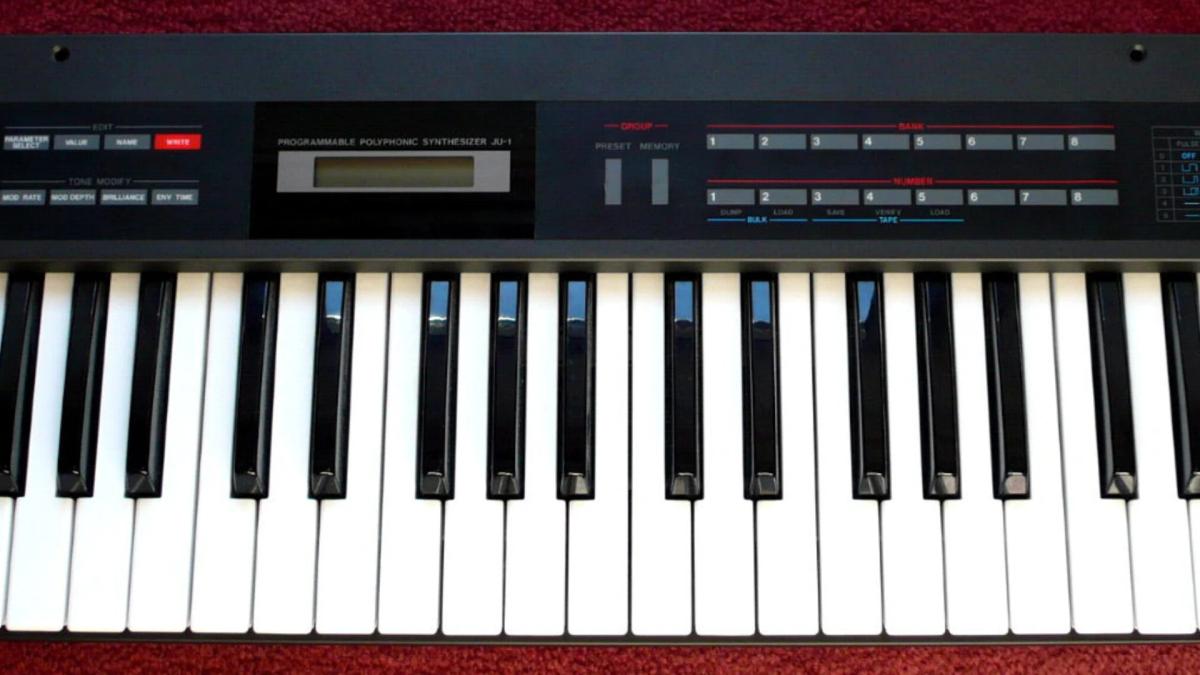
Wikipedia says Roland introduced the Alpha Juno series in 1985, with the Alpha Juno 1 and Alpha Juno 2 released together. Sound on Sound, in a 1998 review, says Roland announced them in the winter of 1985 but gives 1986 as the release year in its price table, so the date depends on the source. The Juno 1 listed at 895 dollars or 575 pounds, and the Juno 2, with a five-octave keyboard and velocity and aftertouch sensitivity, at 1,295 dollars or 799 pounds.
The design was unusual for Roland. Wikipedia describes a six-voice synth with one digitally controlled oscillator per voice, a 24 dB per octave resonant filter and an integrated chorus. It stored 128 patches, 64 preset and 64 user. Instead of knobs and sliders, editing used a continuously rotating Alpha dial and soft-touch buttons, and Roland offered an optional PG-300 programmer, for 200 pounds, that gave every parameter its own control. A rack version, the MKS-50, followed in 1987.
The market was not kind. Wikipedia says the Alpha Junos had little impact on release, overshadowed by Yamaha’s FM synthesizers and the shift toward digital technology. Sound on Sound noted, however, that their MIDI specification was better than that of some cheaper touch-sensitive rivals. The Midnight Rebels post adds that the Alpha Juno was meant to compete with the Yamaha DX7 and flopped at launch, but that its price dropped in the late 1980s, making it affordable for young producers.
Eric Persing and the preset called “What The”
The factory sounds were the work of Eric Persing. A German article on Bonedo says he was Roland’s chief sound designer from 1984 to 2004, that the Alpha Juno 1 was the first synth he made presets for, and that he later founded Spectrasonics. Wikipedia says the preset known as “What The” was created reportedly as a joke. A blog post on Midnight Rebels says the same, adding that it was meant to amuse other engineers, though that source is less authoritative than the others.
Even the origin of the name is slightly ironic. Wikipedia’s Hoover sound article notes that the term “hoover” was not introduced by Persing, and that the sound was originally called the Mentasm. In the United Kingdom and Ireland, “hoover” is a generic word for a vacuum cleaner, which is the comparison listeners made when they heard the swooping, whining tone. None of the sources suggests that anyone at Roland set out to make a sound for dance floors.
Why it sounds the way it does
Wikipedia and Bonedo describe the construction in nearly the same terms. The hoover is a complex waveform built from three oscillators, each an octave apart, with heavy pulse-width modulation and a thick chorus. A fast LFO controls both the pulse width and the chorus, which is where the swirling movement comes from. Wikipedia also notes that the sound is traditionally made on the Alpha Juno 2, the Alpha Juno 1 or the MKS-50, and that the Alpha Juno 2 owner’s manual explains the pulse-width-modulated sawtooth.
The Midnight Rebels post adds that a pitch envelope gives the swell at the start of each note. That detail comes from a single blog source, so treat it as plausible rather than established. What the sources agree on is that the effect comes from stacking and modulating simple elements, not from any exotic technology. It was the sort of patch a player could build with a manual and some curiosity, which is part of why it spread so quickly.
Mundo Muzique, Joey Beltram and “Mentasm”
According to Red Bull Music Academy, the person who made the preset famous was Mundo Muzique, a Queens-born techno producer whose name is Edmundo Perez. The lead sound in “Mentasm” came from the Alpha Juno 1 patch “What The,” which he tweaked and sequenced. He had long been fascinated by it, even though many considered it useless.
He made a demo on cassette in his own studio, and Bonedo says he used a Macintosh SE running Master Tracks Pro to trigger the preset over MIDI with heavy pitch bending. Joey Beltram, working with him as Second Phase, helped finish the track in his New York studio. Because the computer and an Akai MPC60 would not synchronize, they sampled the whole loop into a Casio FZ-1, which also handled the filter sweeps, and programmed the drums on the MPC60.