Table of Contents
- Roland D-50: a synthesizer built around the first 30 milliseconds
- How Linear Arithmetic synthesis worked
- The people and the presets
- Enya, the Ryans and a studio garden in Dublin
- Pizzagogo and the wall of voices
- A number one nobody planned
- Final perspective
Roland D-50: a synthesizer built around the first 30 milliseconds
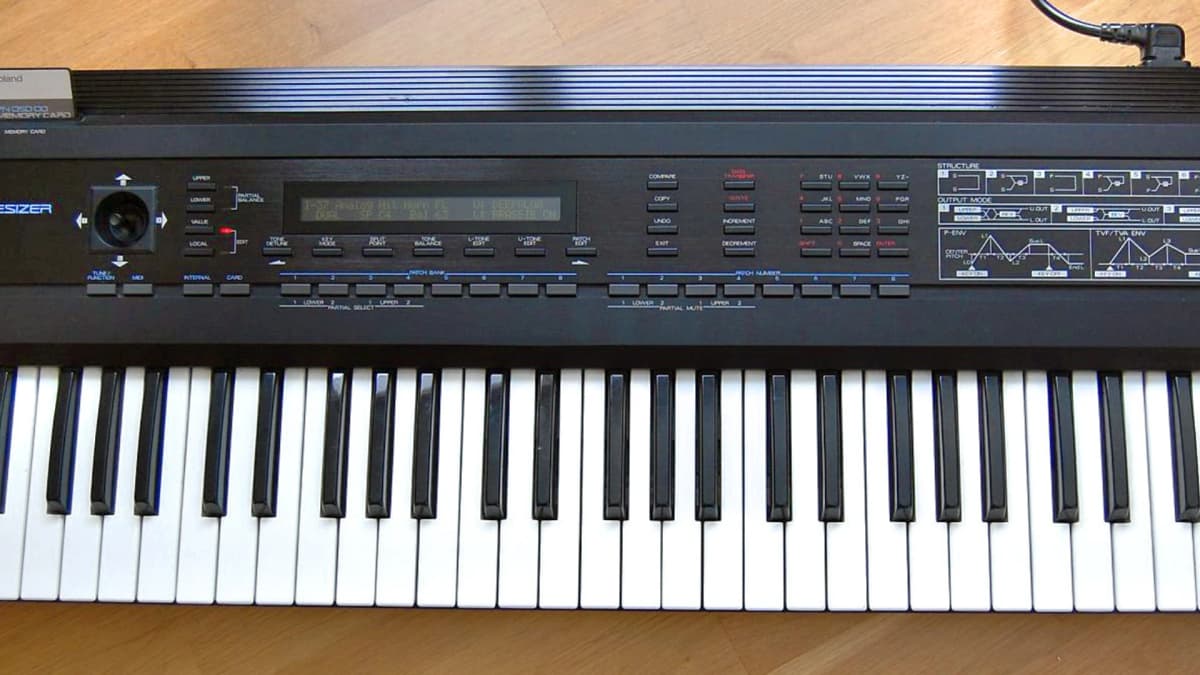
Roland introduced the D-50 in 1987 as its first fully digital synthesizer, and its own anniversary page says it was the first performance synthesizer with integrated digital effects, namely chorus, reverb and EQ. Wikipedia lists a launch price of 1,895 to 2,095 dollars in the United States and 1,445 pounds in the United Kingdom. It had 16 voices, or 8 in dual or split mode, and 64 onboard patches, with optional RAM cards adding 64 more.
Behind the design was an idea about how sounds are perceived. Roland’s page quotes Tadao Kikumoto, the technical R&D leader, saying that most of a sound’s identity forms in the first 20 to 30 milliseconds after the initial touch, as overtones change quickly. That insight explains the architecture. If the attack is the part of a sound that matters most and is hardest to program by hand, then it makes sense to record it and let a synthesizer handle the rest.
How Linear Arithmetic synthesis worked
Wikipedia’s article on Linear Arithmetic synthesis says Roland invented the method and released it with the D-50 in April 1987. A PCM attack transient starts each note, and a subtractive synthesizer sound continues it. The article lists three parts: an attack sample, a body made of a sawtooth or pulse wave passed through a filter, and an optional looped embellishment. The D-50 article adds that Roland stored 47 attack samples in ROM.
The reason was cost and sound. The Linear Arithmetic article notes that re-synthesizing samplers were very expensive at the time, and that Yamaha’s DX7 dominated metallic, percussive sounds, which Roland’s subtractive synths handled poorly. Roland wanted a machine that was easy to program, sounded realistic and still sounded like a synthesizer. Each tone has two partials, and two tones form a patch. Roland’s page says the D-50 has 32 partials in total.
The people and the presets
Roland names its development team. Kikumoto led technical research and development, Toshio Yamabata led the development team, and Kazz Takahashi worked on the physical interface, including the joystick and the optional PG-1000 programmer. Eric Persing and Adrian Scott were the original sound designers, involved from the start of development. Wikipedia says the two authored the presets.
Persing was Roland’s chief sound designer from 1984 into the mid-2000s, and later founded Spectrasonics. Roland’s page also credits him with the hoover sound. Among the D-50 presets, Wikipedia mentions two: “Fantasia,” also known as “New Age Pad,” and “Pizzagogo,” which it describes as having a lively, plucked-strings character.
It adds that Enya’s “Orinoco Flow” featured Pizzagogo with an emphasised attack. The D-50 became the most popular synthesizer on the market after its introduction, Wikipedia says, until the Korg M1 arrived in 1988, and it also won a 1988 TEC Award.
Enya, the Ryans and a studio garden in Dublin
The song began at home. MusicRadar reports that the demos for the album Watermark were recorded at Aigle Studios, which Nicky Ryan and his partner Roma built in their Dublin garden. Enya’s first idea was a chord sequence with a short hook. Nicky developed it into a track and sent it to Rob Dickins, chairman of Warner Music UK, who had asked for a single. Roma then expanded the hook into lyrics that move through real and imagined places.
Dickins wanted a different treatment. He had the tracks re-recorded digitally at Orinoco Studios in London, and the studio’s exotic-sounding name inspired the title. Wikipedia adds that the title alludes both to the studio and to the Orinoco river. Sound on Sound, in March 1989, reported that the album was recorded over about two months at Orinoco on two Mitsubishi 32-track digital machines, and that “Orinoco Flow” began as a chord sequence with a D-50 pizzicato strings preset before being expanded after feedback from Dickins.
Pizzagogo and the wall of voices
MusicRadar says the song’s central pizzicato melody came from a rented Roland D-50 and its Pizzagogo preset, and that Enya found it by accident. Sound on Sound reports that the D-50 featured heavily across the album, with presets mostly edited and layered through multitracking, alongside a Yamaha KX88 master keyboard, a Juno-60 and an Akai S900 sampler.