Home›Articles›Prophet-600: The synthesizer that shook hands with a Ro…
Articles

Prophet-600: The synthesizer that shook hands with a Roland and started MIDI

Prophet-600: At the January 1983 Winter NAMM show, a Sequential Circuits Prophet-600 was connected to a Roland Jupiter-6 with a cable, and notes played on…

Bernardo de Azevedo
Bernardo de Azevedo
· Updated
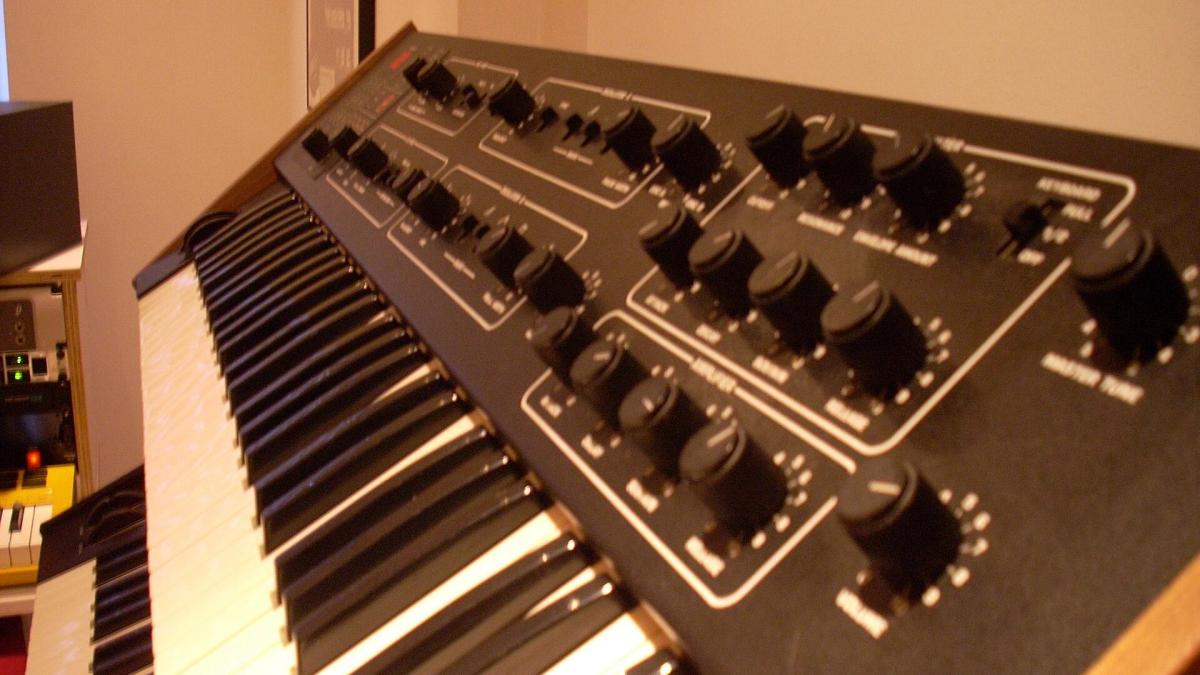
Prophet-600 - historic photo

At the January 1983 Winter NAMM show, a Sequential Circuits Prophet-600 was connected to a Roland Jupiter-6 with a cable, and notes played on one instrument sounded on the other. It was the first public demonstration of MIDI, and it linked machines from two different companies. The Prophet-600 itself was a modest synthesizer, but the cable between them is one of the most consequential pieces of wire in music.

What makes the story unusual is that the standard was built by competitors, at a time when at least some makers, Oberheim and Roland among them, already had interfaces of their own. Dave Smith of Sequential and Ikutaro Kakehashi of Roland came from different countries and business cultures. The question is how they managed to agree, and why a demonstration that could easily have failed worked on the first try.

Table of Contents

  • Prophet-600: a “son of Prophet-5” with a modest job
  • Sequential Circuits before MIDI
  • The problem before MIDI
  • Two founders and a corny name
  • NAMM 1983: the demo nobody had rehearsed
  • What happened to the machines and the companies
  • Final perspective

Prophet-600: a “son of Prophet-5” with a modest job

The Prophet-600 was launched in 1982 and discontinued in 1985, according to Gordon Reid’s retrospective in Music Technology magazine. It was six-note polyphonic, with two oscillators per voice and 100 memories, and a five-octave keyboard that responded to neither velocity nor pressure. The magazine called it a “son of ’5”, a reference to the Prophet-5 that had made Sequential’s name. Vintage Synth Explorer adds a built-in arpeggiator and a two-track real-time sequencer, and says its filter and amplifier sections are of similar quality to those of the Prophet-5.

It was a hybrid design. Reid explains that a Z80 microprocessor calculated the envelopes and the low-frequency oscillator, which were converted to voltages, while the oscillators were Curtis chips. The recommended UK price was 1,650 pounds, which he notes was more than the Prophet-5 cost in 1982. In other words, the Prophet-600 was not a bargain successor. Its historical weight comes from one extra feature: a MIDI socket.

Sequential Circuits before MIDI

Sequential was not a newcomer when the Prophet-600 appeared. According to Wikipedia, Dave Smith founded the company in San Francisco in 1974 and quit his job in early 1977 to work full time on the Prophet-5. That instrument was demonstrated at NAMM in January 1978, with the first units shipping later that year, and Wikipedia describes it as the first fully programmable polyphonic synthesizer. It used microprocessors to store sounds in patch memory.

Music Technology went further in 1990 and called Sequential the most respected synthesizer company in the world in 1980. The same article credits the Prophet-5 as a milestone and says the Prophet-600 and the later SixTrak were respectively the first MIDI keyboard and the first multitimbral Mode 4 instrument from the company. Smith, in other words, arrived at the MIDI discussions with credibility and a product to put on the table.

The problem before MIDI

Before 1983, connecting synthesizers from different makers was awkward. Wikipedia explains that Kakehashi saw the lack of standards as a brake on the electronic music industry. In June 1981 he proposed a standard to Tom Oberheim, whose company used its own Oberheim Parallel Bus. Dave Smith thought that system too cumbersome and wanted something simpler and cheaper.

The Musical Instrument Digital Interface started as a design by Smith and a Sequential engineer, whom Wikipedia names as Chet Wood and the MIDI Association spells Woods. In October 1981 they presented a “Universal Synthesizer Interface” paper at the Audio Engineering Society show. Wikipedia says the design was based on Roland’s Digital Control Bus, and the MIDI Association’s account says it ran at 19.2 kilobaud over ordinary quarter-inch jacks. Roland, Yamaha, Korg and Kawai then discussed and modified it.

Two founders and a corny name

The two principals had very different histories. Kakehashi, who was born in Osaka in 1930 and died in 2017 at the age of 87, founded Ace Tone in 1960 and Roland in 1972, according to Wikipedia. Smith founded Sequential Circuits in San Francisco in 1974. Smith was 32 in 1983, as the MIDI Association notes.

They also disagreed about the name. Wikipedia reports that Kakehashi preferred “Universal Musical Interface,” while Smith found that a little corny and proposed Musical Instrument Digital Interface. The abbreviation MIDI won. Smith later described the final specification as a true cooperative effort between five companies, which the MIDI Association lists as Roland, Yamaha, Korg, Kawai and Sequential, and noted that it was created in Japan.

In February 1982, after a Winter NAMM meeting, those firms agreed to keep working together, and in October 1982 Robert Moog announced MIDI in Keyboard magazine.

NAMM 1983: the demo nobody had rehearsed

The Prophet-600 was the instrument Smith brought to the January 1983 show. The MIDI Association says the public demo connected it to a Roland Jupiter-6, and adds that Sequential had only tested the Prophet-600 with another Prophet-600. Nobody knew whether it would work with a machine from a different company. It did, and the account says the demonstration amazed those who saw it.

The Jupiter-6 was also new. Wikipedia says Roland introduced it in January 1983, with a list price of US$2,995 and six voices. For some years the record of this moment was muddled. Earlier reports named the Roland JX-3P as the second instrument, and CDM reported in 2012 that Smith had found a photograph showing it was actually a Jupiter-6. The confusion probably arose because the JX-3P was the first Roland synthesizer to ship at that show.

A caution about the word “first.” Vintage Synth Explorer calls the Prophet-600 the first commercially available synthesizer to implement MIDI, and CDM says it was the first MIDI-equipped synth to ship, in December 1982. The Sequential Circuits article on Wikipedia calls it only “one of the first.” The shipping date and the label are therefore best treated as established but not unanimous.

What happened to the machines and the companies

The early Prophet-600 was an imperfect MIDI citizen. Music Technology says early units had just one MIDI mode and could not tell channels apart, but that by 1985 the instrument supported 16 channels and program and dump messages. Updates were available for early serial numbers, though the magazine said they were not advertised in the UK.

MIDI itself moved quickly. At Summer NAMM in June 1983, per the MIDI Association, Yamaha showed the DX7 with MIDI and Sequential showed the Prophet-600. The MIDI 1.0 specification was finalized that August. Wikipedia dates the published MIDI 1.0 Detailed Specification to 1985, so the sources use different milestones.

The companies fared differently. Sequential released its last product in 1987, and Wikipedia says Yamaha bought it and shut it down in 1989, after which Smith moved to Korg. He later formed Dave Smith Instruments in 2002. Kakehashi and Smith shared a Technical Grammy in 2013.

Final perspective

The Prophet-600 deserves its place in history for what it did rather than how it sounded. It was an unspectacular hybrid that happened to carry the right socket on the right day. The significance of the January 1983 demo was that it showed rivals could agree on something small, cheap and open, and that this agreement would be worth more than any private standard.

Wikipedia records that the MIDI Manufacturers Association was formed at Summer NAMM in Chicago in 1984, that General MIDI followed in 1991, and that MIDI 2.0 was unveiled at the Winter NAMM show in Anaheim on January 17, 2020. A standard born from one cable at a trade show has therefore been maintained, extended and reintroduced at the same trade show for nearly four decades.

It is a rare case in technology where the winning move was to give up control. Kakehashi and Smith did not build a better synthesizer so much as a shared language, and the language has outlasted every instrument that first spoke it. When a keyboard today triggers a sound in software on a laptop, the cable that quietly linked a Prophet-600 and a Jupiter-6 is still doing the work.

Related stories

Sources

Bernardo de Azevedo
Written by
Bernardo de AzevedoFounder & Editor

His connection with music began at age 6, in the 1980s, when his father introduced him to Jean-Michel Jarre's Rendez-Vous on vinyl. He works professionally in the legal field, while synthesizers became his space for abstraction and creative exploration. Founder of The Synth Source.