Table of Contents
- RCA Mark II: a hit-song machine in a research lab
- From Mark I to Mark II
- Programming with a paper roll
- The Columbia-Princeton Electronic Music Center
- Babbitt, Wuorinen and the composers who stayed
- Why transistors ended the story
- Final perspective
RCA Mark II: a hit-song machine in a research lab
The RCA Mark II traces back to Harry F. Olson and Herbert Belar, RCA engineers who first aimed to build a machine that could write popular songs. According to Perfect Circuit, their earlier Electronic Music Composing Machine analyzed melodies by Stephen Foster, was trained on 11 songs, and used tuning forks for its tones.
The 120 Years of Electronic Music site gives a broader motive: RCA wanted to study what made a hit and generate similar music automatically, and the company also hoped to cut costs by replacing expensive unionized orchestras with automated arrangements.
That commercial plan did not survive the machine. The same source says mainstream musicians found the instrument too complex, so RCA dropped the hit-analysis project before the Mark II was finished. Serialist composers, who wanted to specify every parameter of every note, saw the complexity as an advantage. They became the machine’s audience.
From Mark I to Mark II
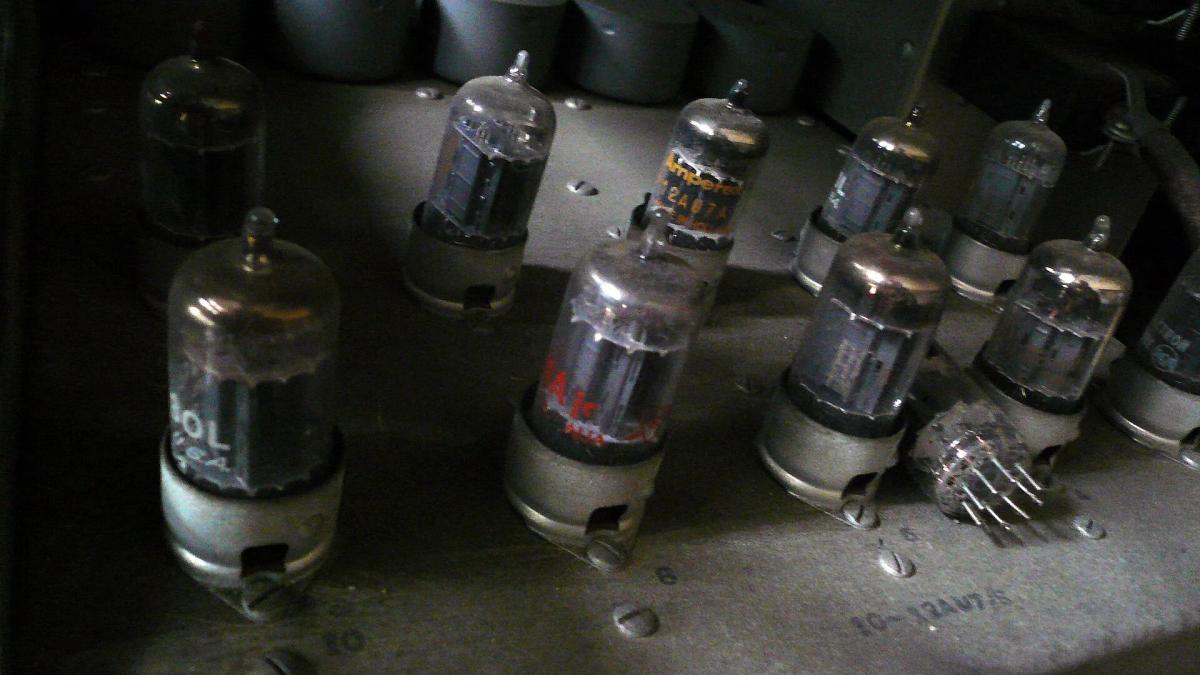
Perfect Circuit says the Mark I was unveiled in 1955 and used punched paper input to generate sine waves with electronically vibrated tuning forks. The Mark II followed in 1957 and was far larger: seven feet tall, twenty feet wide, three tons and about 1,700 vacuum tubes, according to the same source.
Wikipedia adds that the design followed U.S. Air Force construction specifications and included an Air Force oscilloscope. It describes the Mark II as a room-sized array of interconnected components, built entirely from vacuum tubes, with twice as many tone oscillators as the Mark I, a white noise generator and four-note polyphony.
The Mark II added what a composer needed to shape sound. Perfect Circuit lists sine, sawtooth and triangle waveforms, high-pass and low-pass filters, portamento and envelopes, with attack times from 1 millisecond to 2 seconds and decay times from 4 milliseconds to 19 seconds. Signals were routed by hand between modules.
The 120 Years site cites two earlier precedents, the Givelet-Coupleux Organ of 1930 and the Hanert Electric Orchestra of 1945. It says the result offered millions of possible settings, and notes that oscillator counts doubled from 12 in the Mark I to 24 in the Mark II.
Programming with a paper roll
The machine had no keyboard in the musical sense. The composer typed a score in binary code on a typewriter-style keyboard, which punched holes in a paper roll resembling a player-piano roll. According to the 120 Years site, each parameter, including pitch, timbre, volume and envelope, used four columns of holes, giving sixteen values for each aspect. The roll moved at 10 centimeters per second, which set the fastest tempo at 240 beats per minute.
Wikipedia describes the output as going to a synchronized record lathe. The composer compared the recording with the score, adjusted the holes and tried again, a process that replaced the physical cutting and splicing of magnetic tape. It also demanded extensive configuration before a score would run, and Wikipedia says few people became proficient. There is a small discrepancy among the sources on the medium, since Wikipedia says punched cards while the other two sources say paper roll or tape. The paper roll is the better-supported description.
The Columbia-Princeton Electronic Music Center
The Mark II found its home at the Columbia-Princeton Electronic Music Center, founded by the Columbia professors Vladimir Ussachevsky and Otto Luening and the Princeton professors Milton Babbitt and Roger Sessions. Wikipedia says the machine was delivered in 1957 and built to the specifications of Ussachevsky and Babbitt. The center was officially established in 1959 with a grant from the Rockefeller Foundation, which financed the acquisition of the synthesizer from RCA. Perfect Circuit puts the grant at 175,000 dollars.
The work had begun earlier. Wikipedia says electronic music activity at Columbia and Barnard started in 1951 as the Columbia Experimental Music Studio, and that the name changed to Columbia-Princeton Electronic Music Center in 1958. The center’s address was Prentis Hall, 632 West 125th Street in New York City, according to Wikipedia. The facility covers 5,400 square feet, and visitors and students included Edgard Varèse, Wendy Carlos and Mario Davidovsky, among others.