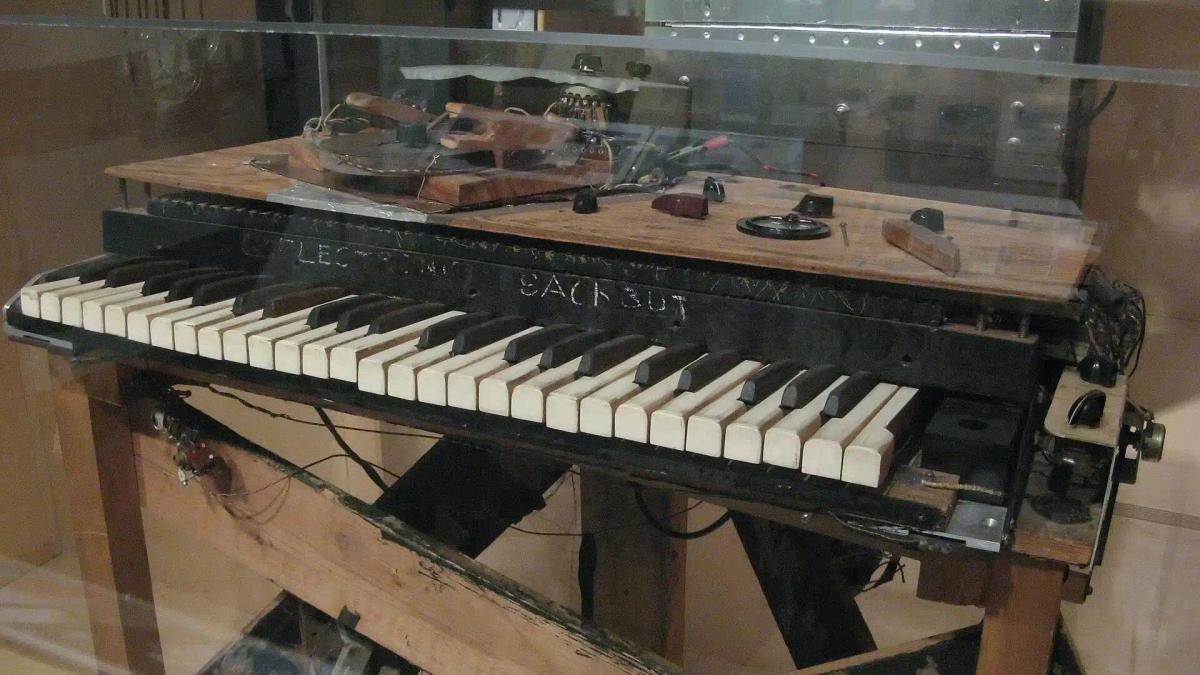
The Sackbut grows up, and stalls
Le Caine was also a builder of studios. He helped set up an electronic music studio at the University of Toronto in 1959, which The Canadian Encyclopedia calls Canada’s first, and another at McGill University in 1964. Sources differ on which Canadian studio deserves the label of first, so it is safest to say he was present at the start.
In the early 1960s he also equipped a studio in Israel, at the Centre for Electronic Music founded by the composer Josef Tal, who had visited Ottawa in 1958 according to Wikipedia. Across about twenty years at the NRC, 120 Years of Electronic Music counts more than twenty-two new instruments.
In 1969 he began redesigning the Sackbut with modern techniques, and the working prototype of the Sackbut Synthesizer was completed in 1971. A 1972 article describes it as a monophonic, touch-sensitive instrument with twenty-four controls, built under license by Dayrand Limited of Montreal. The company planned a cautious first run at about 2,500 dollars each, compared with about 8,000 dollars for large synthesizers.
The article reports that Peter Jermyn played the theme for NBC’s Mr. Wizard on it. It does not say what happened to sales, and the available accounts do not explain why it failed to take off.
How much of a “first” was it?
The Electronic Sackbut is often called the first synthesizer. The Canadian Encyclopedia says it is now recognized to have been exactly that, and the Hugh Le Caine and Sound and Science pages call it the first known voltage-controlled synthesizer. Caution is wise. An abstract from a New Interfaces for Musical Expression paper notes that Hugh Davies and Gayle Young only suggested the early versions might be the first voltage-controlled synthesizer or perhaps the first synthesizer, and that missing technical documentation has obscured clearer claims.
Whatever the label, Le Caine himself did not see his major inventions grow into complete commercial products, a contrast the 120 Years site draws with Robert Moog. Le Caine died on 3 July 1977, at 63, in a motorcycle accident, according to Wikipedia. The 1948 prototype is now in the collection of Ingenium, the national science museum, donated by the NRC in 1975, and Sound and Science says it is inoperable while a conservation project is underway.
Final perspective
The Electronic Sackbut matters less as a first than as an argument. Le Caine proposed that an electronic instrument should respond to the body as an acoustic one does, through pressure, direction and touch, and he supported the argument with working hardware in 1948. The idea of a keyboard that listens to the finger is now so common that it hardly needs explaining.
What his career adds is a reminder of how much synthesis history depends on institutions. The NRC gave him a lab and let him build, while Baldwin and Dayrand showed how thin the bridge to the market could be. Le Caine ended up with a museum piece, a body of compositions and the studios he helped found, which is a modest result for work this early. It is still a strong case for looking beyond the usual names when asking where the synthesizer came from.
That is why the Electronic Sackbut story keeps drawing musicians and historians back to it.
Few chapters of synthesizer history show as clearly as Electronic Sackbut how far a single idea can travel.
What makes the Electronic Sackbut story memorable is how ordinary the people involved were, and how improbable the outcome turned out to be. Anyone retelling the Electronic Sackbut story has to admit that part of it comes down to timing and luck. The Electronic Sackbut story also shows how quickly a promising idea can slip out of public view.
Revisiting the Electronic Sackbut story today, it is striking how many details were lost or rewritten over the years. Each retelling of the Electronic Sackbut story adds a little more context to what the original documents leave out. If there is one lesson in the Electronic Sackbut story, it is that technology rarely follows a straight line.
Related stories
Sources