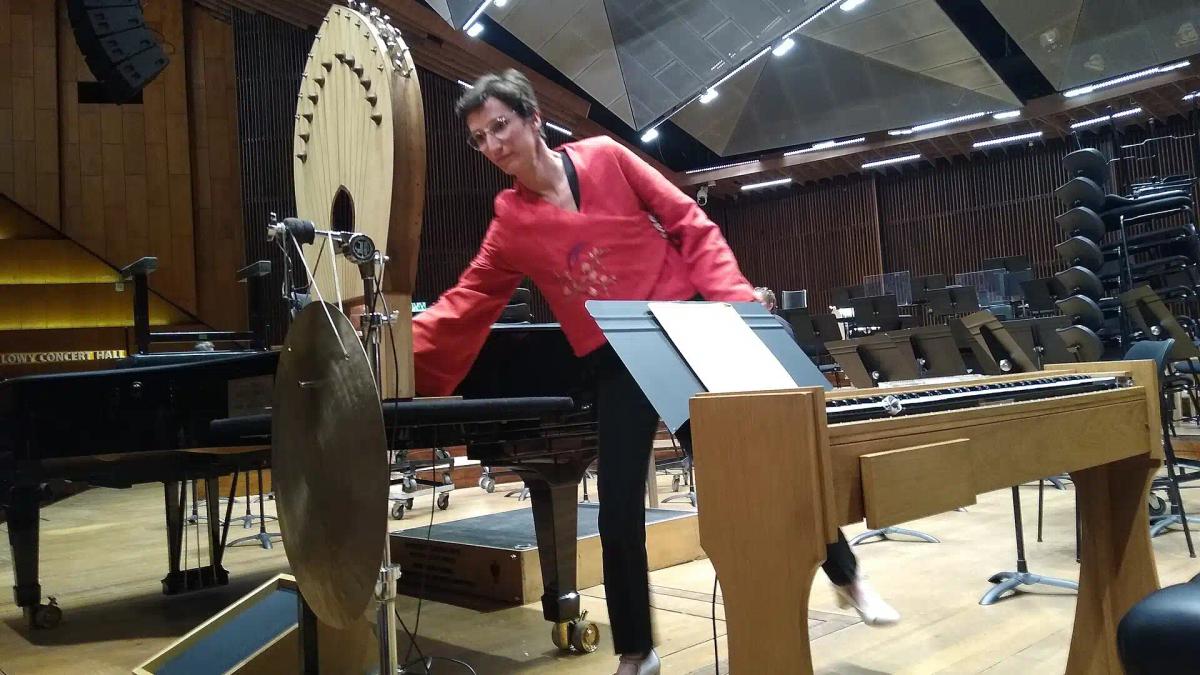
From 1953, Yvonne’s sister Jeanne Loriod played the ondes part in many performances and recordings, according to Wikipedia. Jeanne Loriod became the instrument’s most celebrated performer, having studied with Martenot, and the same article says she premiered 85 works with her sextet. In Turangalîla the ondes is one of two soloists, alongside the piano, in front of a large orchestra, which is a very visible role for an electronic instrument in 1949.
Teaching helped the repertoire grow. Wikipedia says Martenot taught at the Paris Conservatory from 1947 and had unveiled a microtonal model in 1938. Outside the concert hall, the instrument spread into film. The Classical Music magazine article lists Maurice Jarre’s use of it in Lawrence of Arabia, and Red Bull Music Academy adds that Daft Punk’s Touch, on Random Access Memories, used the ondist Thomas Bloch. Those are scattered appearances, but they show the instrument reaching audiences well beyond the concert hall.
Why the Ondes Martenot stayed rare
Wikipedia observes that instruments were built to order and that Martenot was not interested in mass production, a likely factor in the instrument’s decline. The electronics were fragile, and Red Bull Music Academy reports that the powder recipe used in its expression control is unknown, which complicates faithful reconstruction. According to the Guardian in 2009, the last ondes Martenot was manufactured in 1988, though the same article hedges that a new model was apparently being made.
The population of skilled players is small as well. Wikipedia cites Alex Ross, who reported in 2001 that fewer than 100 people had mastered the instrument. At the same time, the repertoire is large. Hugh Davies estimated that more than 1,000 works have been composed for it, and Sound on Sound cites more than a thousand classical works. A tiny instrument population supporting a very large repertoire is one of its stranger statistics.
Replicas have appeared to fill the gap. Wikipedia lists the Ondea by Ambro Oliva in the early 2000s and the Ondomo by Asaden in 2017, a run of 100 units, and the Guardian’s 2009 piece names the Ondea and the French Connection as the two replicas available since 2001.
Jonny Greenwood and the replica problem
Jonny Greenwood of Radiohead is the instrument’s best-known modern champion. Far Out Magazine ties his enthusiasm to his admiration for Messiaen, whose influence on him began at age 15. Wikipedia lists the Ondes Martenot on Radiohead’s Kid A (2000) in songs such as The National Anthem, How to Disappear Completely and Where I End and You Begin.
The Guardian quotes Greenwood describing it as a very accurate theremin that gives far more control, and it reports that a six-player ondes group performed live versions of Arpeggi and How to Disappear Completely.
Touring with a fragile original was a problem. Sound on Sound reports that Greenwood commissioned the French Connection from Analogue Systems in 2000. It is a controller that copies the Martenot’s wire, ring and keyboard but contains no sound generator, so it drives an external analog synthesizer.
A prototype was demonstrated to him in April 2001, the first two units reached Radiohead in May 2001, and the review says it first appeared publicly on Top of the Pops that month, accompanying Pyramid Song. The unit sold for 1,050 pounds, including VAT.
Final perspective
The Ondes Martenot is a rare example of an early electronic instrument that found a stable artistic home without ever becoming a commercial product. It succeeded by being played by dedicated performers, written for by serious composers and taught in a conservatory tradition. Its scarcity is a weakness and also part of the reason it keeps its aura.
Greenwood’s French Connection shows what happens when that tradition meets the logic of the synthesizer. The controller keeps the playing technique but drops the unrepeatable electronics, separating the gesture from the sound. That split between interface and voice is where much of modern synthesis lives. Messiaen needed a new voice and Martenot built one, and Greenwood needed a way to carry that voice on the road.
Related stories
Sources