Home›Articles›Oskar Sala and the Trautonium: The man who played the b…
Articles

Oskar Sala and the Trautonium: The man who played the birds for Hitchcock

Trautonium: When Alfred Hitchcock’s The Birds reached cinemas in 1963, the screams and flutters that made audiences flinch did not come from a flock. At…

Bernardo de Azevedo
Bernardo de Azevedo
· Updated
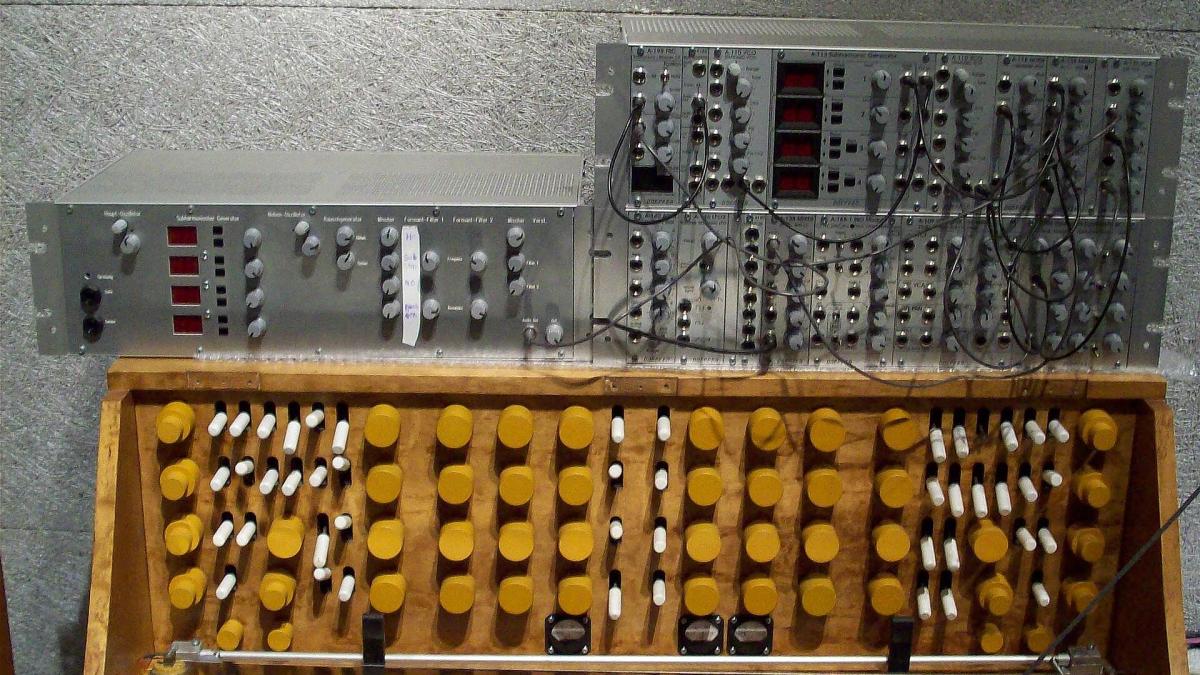
Oskar Sala and the Trautonium - historic photo

When Alfred Hitchcock’s The Birds reached cinemas in 1963, the screams and flutters that made audiences flinch did not come from a flock. At least part of them came from an instrument few people had heard of, played by a German physicist-musician in a studio in Berlin. Oskar Sala had spent more than three decades with the Trautonium, an electronic instrument born in the same era as the theremin, and he had rebuilt it into a machine that could do what no conventional score could.

His story runs against the usual narrative of early electronic music. The Trautonium never became a mass-market product, and Sala was never a household name. Yet he kept one instrument alive and evolving for most of a lifetime, and his work on a film that famously has no musical score shows what a patient specialist can do with an obscure tool. The question is how a strange wire-and-plate instrument ended up making the sound of nature turning hostile.

Table of Contents

  • Oskar Sala: a student of Hindemith meets a stranger’s invention
  • How the Trautonium turned pressure into pitch
  • A people’s instrument that few people bought
  • Rebuilding it as the Mixtur-Trautonium
  • The Birds: sound design without a score
  • What the Trautonium left behind
  • Final perspective

Oskar Sala: a student of Hindemith meets a stranger’s invention

Oskar Sala was born on 18 July 1910 in Greiz, Thuringia. Wikipedia says that he moved to Berlin in 1929 to study piano and composition with Paul Hindemith, and that at the conservatory he followed the experiments of Friedrich Trautwein in the school’s laboratory and learned to play Trautwein’s instrument. The timing mattered. The Trautonium was new, the people who could play it were nearly nonexistent, and Sala was in the right building.

On 20 June 1930, Sala and Hindemith gave a public performance called Neue Musik Berlin 1930 to introduce the instrument. The following year Sala was the soloist in Hindemith’s Concerto for Trautonium with String Quartet. Wikipedia’s article on the instrument adds that Harald Genzmer wrote a concerto for it as well. In the early 1930s the Trautonium had a composer, a performer and a repertoire. It still lacked a market.

How the Trautonium turned pressure into pitch

The Trautonium had no piano keys. According to Wikipedia, its manual was a resistive wire stretched over a metal plate, and pressing the wire down against the plate changed its effective length, which changed the pitch. That meant the player could glide along the wire, produce vibrato and quarter tones, and shape loudness with finger pressure.

The sound source was an oscillator, originally built around neon tubes, later thyratrons and then transistors, producing a sawtooth-like wave. The output passed through two parallel resonant filters, and a foot pedal controlled the balance between them. Sala eventually studied physics at the University of Berlin, from 1932 to 1935, to understand the principles better.

A people’s instrument that few people bought

Telefunken tried to turn the idea into a consumer product. Wikipedia says the company marketed the first Trautoniums from 1933 to 1935 and made about 200 of them, an instrument called the Volkstrautonium. The Google Arts and Culture story on Sala adds that high prices led to poor sales and that it was discontinued. A product named for the people was too expensive for them.

Sala did not stop. Wikipedia lists a Radio-Trautonium built in 1935 and a portable Konzerttrautonium in 1938. Then the war intervened. Wikipedia notes that he served as a soldier on the Eastern Front and was injured, and Al Jazeera reports he returned to his Berlin laboratory in 1946. The point worth noticing is how personal the project had become. The industrial attempt had failed, so the development of the instrument passed into the hands of one player.

Rebuilding it as the Mixtur-Trautonium

In 1948, Sala began developing what became the Mixtur-Trautonium. The original instrument was monophonic. His version, according to Wikipedia, added a tuning-change switch, a noise generator, an envelope generator he called the Schlagwerk, a formant filter made of several bandpass filters, and subharmonic oscillators. Subharmonics are fractions of the fundamental frequency rather than multiples, which gives the instrument low, dense mixtures that ordinary overtone-based synthesis does not produce. Each of its two manuals could mix four predefined waveforms.

Wikipedia states that the instrument was presented publicly in 1952, and the Google Arts and Culture story places the debut at the end of that year at Southwest German Radio in Baden-Baden, with a concert work by Genzmer. The result was an instrument with several voices and percussive attacks, developed over years by the one performer who knew it best.

The Birds: sound design without a score

In 1958, Sala set up his own studio at the film company Mars Film in Berlin, where he produced electronic soundtracks for features including Rosemary and for German commercials, among them the HB-Männchen campaign. That workshop is the setting for his best-known job.

Hitchcock chose not to use a conventional score in The Birds, which premiered in New York on 28 March 1963. Wikipedia says he relied on sound effects, sparse source music and silence, and that the credits list Sala and the American composer Remi Gassmann for electronic sound production and composition, with Bernard Herrmann credited as sound consultant.

How the director reached Sala is a matter of lore. Google Arts and Culture says a former classmate of Sala’s at Universal Studios heard that Hitchcock wanted synthetic bird sounds and passed the lead along, and that Hitchcock flew to Berlin and was impressed by the instrument.

Wikipedia’s film article says Hitchcock had first encountered the instrument on Berlin radio in the late 1920s. Those two accounts are not necessarily in conflict, but neither names a date for the meeting.

Accounts also differ on how much of the soundtrack came from the instrument. Google Arts and Culture says the Trautonium produced all of the film’s sound effects, while Wikipedia says it produced some of the bird sounds. Al Jazeera describes Sala creating bird cries, hammering, and door and window slams. A safe summary is that his electronic work was central to the film’s identity, even if the exact split between his sounds and other sources is not documented in the accounts consulted for this article.

What the Trautonium left behind

Sala collected film-score awards but, as Wikipedia notes, never an Oscar, and his legacy is quieter than his best-known credit suggests. He lent his Mixtur-Trautonium to the Deutsches Museum in 1995, according to the Google Arts and Culture story, and donated his estate to the museum around 2000. He died in Berlin on 26 February 2002.

The Trautonium also found work outside film. Wikipedia says it provided gong and bell parts in the 1942 Dresden premiere of Richard Strauss’s Japanese Festival Music, supplied the Monsalvat bells in Bayreuth’s Parsifal in the 1950s, and, with Gassmann, Sala scored George Balanchine’s ballet Electronics for the New York City Ballet in 1961. Wikipedia also says his Mixtur-Trautonium work soon brought international licenses for its circuits.

The instrument has not disappeared. Wikipedia reports that the player Peter Pichler met Sala in 1996, a meeting credited with preserving much of Sala’s knowledge, and that Pichler later commissioned a new Mixturtrautonium. For Sala’s hundredth birthday in 2010 Pichler staged a performance at the Deutsches Museum in Munich. On 18 July 2022, Google marked what would have been Sala’s 112th birthday with a Doodle.

Final perspective

Sala’s career is a case study in the difference between inventing an instrument and making it musical. Trautwein built the first Trautonium, but Sala added the voices, the filters and the subharmonic mixtures that made it expressive. Industry gave up on the design within a few years of its release. One performer, working with a patient engineer’s mindset, kept developing it until his death in 2002.

The Birds shows why that mattered. A film that dispensed with a score still needed an unearthly sonic world, and the Mixtur-Trautonium could supply sounds that sat somewhere between music and noise. It is an unusual moment in synthesizer history: the most famous use of an early electronic instrument was not a melody at all, but the sound of birds that should not sound like birds.

Related stories

Sources

Bernardo de Azevedo
Written by
Bernardo de AzevedoFounder & Editor

His connection with music began at age 6, in the 1980s, when his father introduced him to Jean-Michel Jarre's Rendez-Vous on vinyl. He works professionally in the legal field, while synthesizers became his space for abstraction and creative exploration. Founder of The Synth Source.