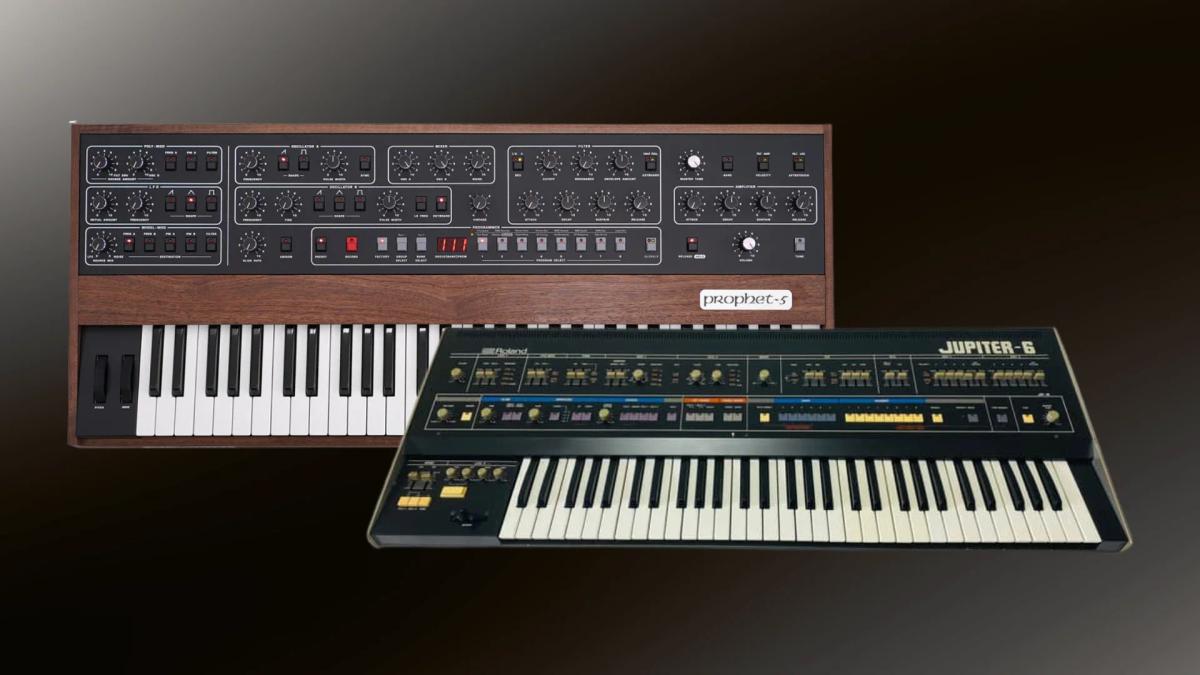
The Jupiter-6 has a software global LFO and software envelopes, and its LFO cannot choose multiple shapes. It does have a second LFO in the performance section. Its strength is performance: dual patches, an expression system and Roland’s bender controls. He calls it more bread and butter for sound design but a more hands-on performance synth.
In the Prophet-5 vs Jupiter-6 comparison, price and playability matter as much as raw sound.
Filters and character
The filters are one of the biggest differences. The Prophet-5 uses a Curtis filter, while the Jupiter-6 uses a unique implementation of the IR3109 chip, a multimode filter with high-pass, low-pass and band-pass, unusual in Roland’s analogue world. His summary is that the magic of the Jupiter-6 lives in the filter while the magic of the Prophet-5 lives in its modulation.
In sound, the Prophet-5 has very broad sweet spots, handling plucks, electric-piano tones, brass and strings well. The Jupiter-6 also does plucks, but brass and strings are harsher. It can make sounds like running water and go to ugly, unhinged harmonic places; he warns it can shred your speakers.
The Prophet-5 vs Jupiter-6 question rarely has a single right answer, because it depends on how you actually work.
Prophet-5 vs Jupiter-6: which one makes more sense?
Both are expensive collector’s pieces, around 6 to 9 thousand dollars used, although the Jupiter-6 is rarer and has recently risen in price. The Prophet-5 rewards careful knob movements and is a little less on-the-fly, and it has reissues and plenty of software versions. The Jupiter-6 gives much more at your fingertips and has no real modern equivalent. If you want a versatile, broad-sounding classic, choose the Prophet-5. If you want a wilder, electronic-leaning, performance-oriented instrument, the Jupiter-6 has no substitute.
That is the Prophet-5 vs Jupiter-6 decision in short: match the instrument to the sound and workflow you actually want, and weigh the price difference before you commit.
Related comparisons
Sources