Home›Reviews›Pro-800 vs Prophet-5: David and Goliath?
Reviews

Pro-800 vs Prophet-5: David and Goliath?

Pro-800 vs Prophet-5: how do they really differ? We break down sound, controls and value from Pete Midi’s hands-on video test to help you choose.

Bernardo de Azevedo
Bernardo de Azevedo
· Updated
Behringer Pro-800 vs Sequential Prophet-5 comparison

Choosing between the Pro-800 and the Prophet-5? This Pro-800 vs Prophet-5 comparison summarizes what Pete Midi found when testing both instruments, so you can see how they differ in sound, controls and value before you buy.

Pete Midi frames his comparison with a provocative question. The Prophet-5, known as the first programmable polyphonic synthesizer ever, wrote music history. Behringer has now released a cheap and extended remake of the Prophet-600. Is there any justification for a Prophet that costs 600 percent of the price but has only 60 percent of the voices?

He owned an original Prophet-600 for a long time and knew it was not a stripped-down Prophet-5 but a different synth. He had never been able to compare it directly with the legend, so this video compares modern versions of the two.

Source video: PRO-800 vs. Prophet-5: David and Goliath? (Pete Midi, YouTube)

Table of Contents

  • What they have in common
  • Where they differ
  • The sound
  • Which one makes more sense?

What they have in common

Both have lots of memory slots, full MIDI implementation and a very similar voice architecture.

However the Pro-800 vs Prophet-5 debate plays out for you, the best test is still playing both instruments side by side.

Where they differ

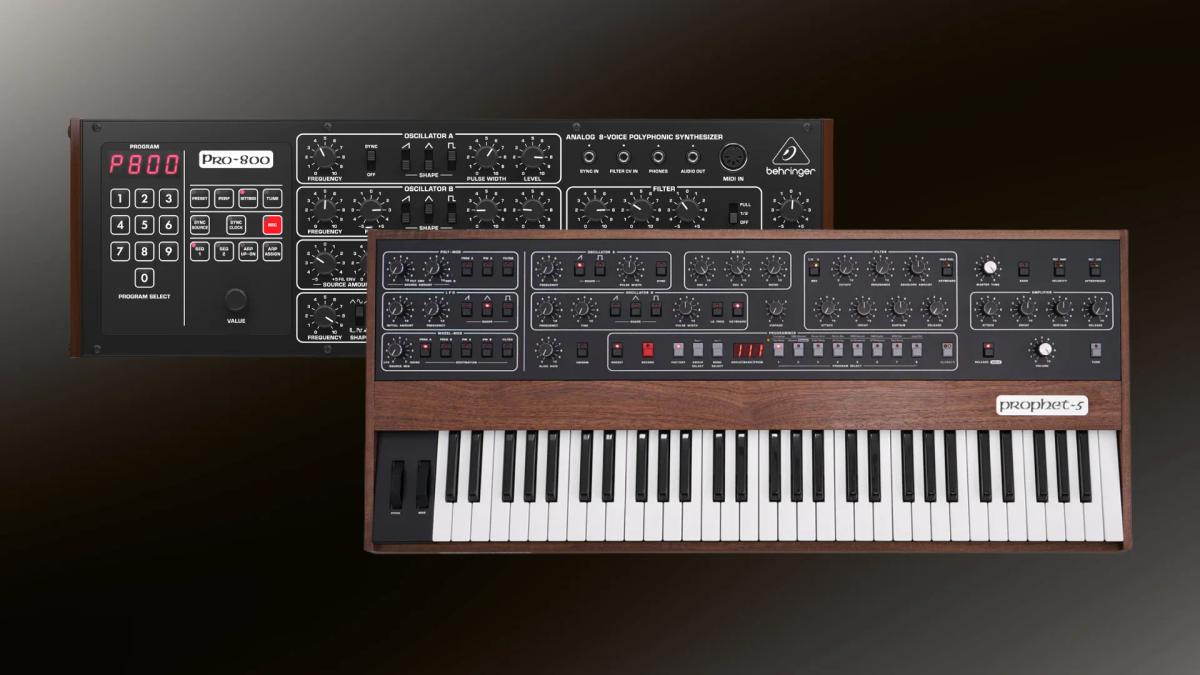
The obvious differences are physical: heavy versus lightweight, illuminated buttons versus dark switches, internal versus external power supply, wood versus plastic, and five voices versus eight. The Pro-800 also has a built-in sequencer and arpeggiator.

The more interesting differences are in the sound engine. The Prophet-5 has one more option in the poly-mod section, lets you switch between different filter revisions, and has a Vintage knob that increases the analog imperfection. The Pro-800 has an additional VBR LFO, which he finds very nice, and lets you choose between different envelope characteristics.

The sound

He was surprised by how small the differences were in most parts of his A/B comparison. He is careful to explain the scope: he focused on sequence sounds with controlled polyphony and deliberately avoided pad sounds with long release phases, because there the eight voices of the Pro-800 would be too obviously an advantage. He also resisted switching the Vintage effect on the Prophet-5, which sounds really great on sequences.

Pro-800 vs Prophet-5: which one makes more sense?

His verdict is that both provide an excellent sound, and in the end it is perhaps a matter of taste which kind of Prophet sound you prefer. What impresses him most is the price: it is a miracle that Behringer can offer an eight-voice poly in a range where other companies sell monophonic synthesizers, and he predicts it will fundamentally change the market. Practically, the Pro-800 gives you more voices, a sequencer and an arpeggiator for far less money. The Prophet-5 gives you the heavier build, the Vintage control, filter revisions and the legend itself.

That is the Pro-800 vs Prophet-5 decision in short: match the instrument to the sound and workflow you actually want, and weigh the price difference before you commit.

If you can, audition the Pro-800 and the Prophet-5 in the same room, through the same speakers or headphones, and with the same patch ideas. Start with a basic sound on each, then move on to the kind of part you actually play: a bass line, a pad, a lead or a layered keyboard sound.

Pay attention to how quickly you can get to a sound you like, how the controls feel under your hands and whether you keep reaching for the same instrument. That kind of hands-on time will tell you more about the Pro-800 vs Prophet-5 question than any list of specifications.

Related comparisons

Sources

Bernardo de Azevedo
Written by
Bernardo de AzevedoFounder & Editor

His connection with music began at age 6, in the 1980s, when his father introduced him to Jean-Michel Jarre's Rendez-Vous on vinyl. He works professionally in the legal field, while synthesizers became his space for abstraction and creative exploration. Founder of The Synth Source.