Home›Reviews›Poly D vs Model D: Is the extra £325 worth four voices …
Reviews

Poly D vs Model D: Is the extra £325 worth four voices and a keyboard?

Poly D vs Model D: how do they differ? Sound, controls and value compared, based on Andertons Synths, Keys and Tech’s hands-on test.

Bernardo de Azevedo
Bernardo de Azevedo
· Updated
Behringer Poly D vs Behringer Model D comparison

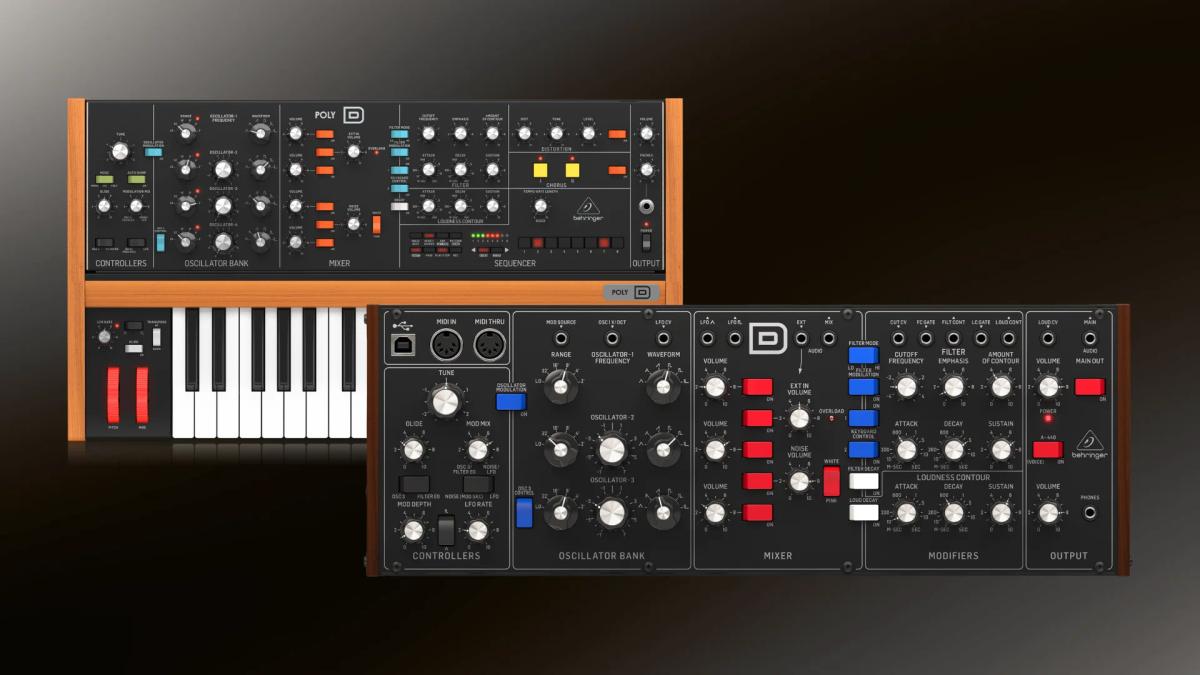
Choosing between the Poly D and the Model D? This Poly D vs Model D comparison summarizes what Andertons Synths, Keys and Tech found when testing both instruments, so you can see how they differ in sound, controls and value before you buy.

Jack Duxbury of Andertons calls this a clash of the low-cost titans, “where intellectual property means nothing but price and features do”. The question is the Behringer Poly D against the Model D, and whether the price gap justifies itself.

At the time of recording, he quotes the Model D at £274 and the Poly D at £599, a difference of £325.

Source video: Behringer Poly D vs. Sintetizador Model D – Choque de Titãs de Baixo Custo! (Andertons Synths, Keys and Tech, YouTube)

Table of Contents

  • Raw sound and filters
  • Four oscillators and polyphony
  • Keys, connectivity and effects
  • Sequencer, arpeggiator and looks
  • Which one makes more sense?

Raw sound and filters

With one sawtooth oscillator on each, they sound essentially the same in their raw state. He stacks three oscillators on each and notes the Poly D has a fourth, which gives it more fatness. With resonance up he hears a small difference in the filter behaviour: with the filter at half-mast, the sound thins out differently on the two. Neither has presets, so, as he says, “this is the world you live in”.

However the Poly D vs Model D debate plays out for you, the best test is still playing both instruments side by side.

Four oscillators and polyphony

The name Poly D, he points out, refers to the number of notes you can play at once. In mono mode the fourth oscillator gives extra fatness. A uni mode spreads oscillators across the notes you play. The magic is in poly mode, where each oscillator becomes a voice for chords. You have to tune the four oscillators, which he does by tuning each in mono mode until the sound thins out the most and then switching back to poly.

An auto-damp feature lets you play a chord and then play over the top, since it damps the notes instead of sharing the same release. It is not true polyphony because there are no separate envelopes, but at this price it is amazing.

In the Poly D vs Model D comparison, price and playability matter as much as raw sound.

Keys, connectivity and effects

The Poly D has a 37-key keyboard, which has no aftertouch but works well as a MIDI controller. He notes a third of the extra money goes into the keyboard, since a comparable controller costs around £90. It also has a MIDI hub with in, out and through, CV in and out, and full quarter-inch outputs. The Model D, on the other hand, can be taken out of its shell and installed in a Eurorack, a point he credits to his colleague.

On effects, the Poly D has a drive circuit with a tone control, though he wishes it had a blend knob, as it is rather dry and lo-fi at high settings. It also has a real analog chorus with two modes that can be combined, giving proper stereo and stereo outputs. The Model D has no effects.

The Poly D vs Model D question rarely has a single right answer, because it depends on how you actually work.

Sequencer, arpeggiator and looks

The Poly D adds a polyphonic sequencer and arpeggiator, another feature worth roughly £90 on its own. He adds a shallow point: with its wooden design it looks like a piece of furniture for the studio.

Poly D vs Model D: which one makes more sense?

If you will use the chords, the keyboard, the effects, the arpeggiator and the I/O, the Poly D justifies its price. If you are not into chords or need a monophonic bass and lead synth to drop into a Eurorack or desktop setup, the Model D is, in his words, an amazing deal. He suggests trying them in a store and notes the price difference can seem smaller when spread out over monthly finance.

That is the Poly D vs Model D decision in short: match the instrument to the sound and workflow you actually want, and weigh the price difference before you commit.

Related comparisons

Sources

Bernardo de Azevedo
Written by
Bernardo de AzevedoFounder & Editor

His connection with music began at age 6, in the 1980s, when his father introduced him to Jean-Michel Jarre's Rendez-Vous on vinyl. He works professionally in the legal field, while synthesizers became his space for abstraction and creative exploration. Founder of The Synth Source.