Home›Reviews›Minimoog vs Poly D: Does the original age like fine win…
Reviews

Minimoog vs Poly D: Does the original age like fine wine?

Minimoog vs Poly D: how do they really differ? We break down sound, controls and value from Alamo Music Sound Lab’s hands-on video test to help you choose.

Bernardo de Azevedo
Bernardo de Azevedo
· Updated
Moog Minimoog vs Behringer Poly D comparison

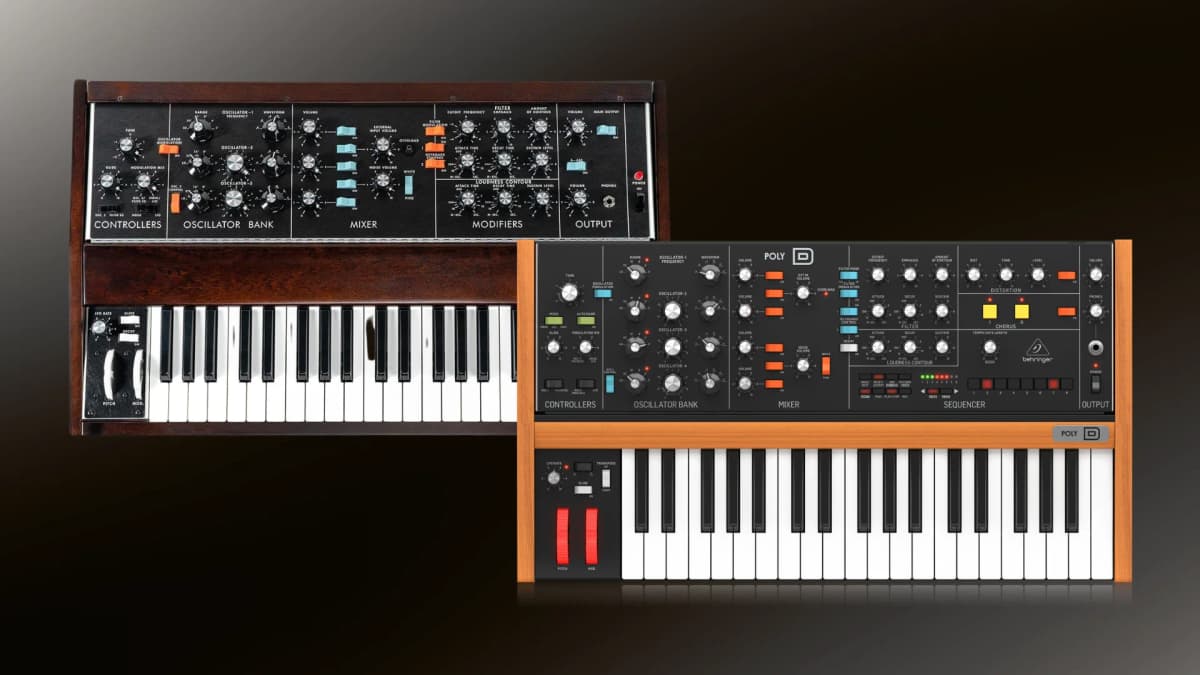
Choosing between the Minimoog and the Poly D? This Minimoog vs Poly D comparison summarizes what Alamo Music Sound Lab found when testing both instruments, so you can see how they differ in sound, controls and value before you buy.

When a vintage Minimoog sells for what the reviewer describes as four to five thousand dollars, the question is no longer only about sound. It is about whether the instrument is a good investment, and what the modern alternatives, from Moog’s revived product line to Behringer’s Model D and Poly D, change about that decision.

Zach Marr of Alamo Music Sound Lab frames the video around a phrase: wine gets better with age. Do synths?

Source video: The Moog Minimoog: Is It Worth It? | The Original vs. the Modern Reproduction, the Behringer Poly D (Alamo Music Sound Lab, YouTube)

Table of Contents

  • Why the Minimoog matters
  • The Poly D as a hot-rodded Minimoog
  • Investment versus music
  • Which one makes more sense?

Why the Minimoog matters

The Minimoog, he explains, was the first major commercial success among analog synthesizers, a miniaturization of the giant modular instruments of the late 1960s and early 1970s. It was produced from the early 1970s into the early 1980s, and he lists artists associated with it that range from Gary Numan to Dr. Dre, Bob Marley and Kraftwerk.

He also notes that, despite its influence, only around 12,000 units were made, compared with the roughly 200,000 DX7s he mentions as a reference point. He recounts that Moog was rarely profitable and eventually went bankrupt in 1987 as digital synthesis took over.

The filter is the heart of the story. He retells the account that an engineer miscalculated the schematic and overdrove the circuit, producing what became the famous Moog sound, and says some argue that no analog filter has ever beaten it.

However the Minimoog vs Poly D debate plays out for you, the best test is still playing both instruments side by side.

The Poly D as a hot-rodded Minimoog

The Behringer Poly D, he explains, follows the company’s Model D, which replicated the Minimoog circuitry closely, including the filters. The Poly D then extends the idea: it adds an oscillator, chorus and distortion, an arpeggiator and a sequencer, none of which exist on the original. The chorus, in his description, is based on a Juno-60 chip.

He is clear about what he hears when he plays it: it is so close that it is difficult for him to say the original is a good investment from a musical point of view.

In the Minimoog vs Poly D comparison, price and playability matter as much as raw sound.

Investment versus music

His position splits the question in two. As a collector’s item, he does not think the Minimoog is a bad investment. Only 10,000 to 12,000 units exist, many are in disrepair, and values appear stable and even growing. He also points to the intangible side: the smell of old circuitry and wood, the bigger scale and the aura of a vintage instrument.

As a musical tool, he comes down on the side of newer instruments. He mentions Roland’s modeling technology with an “age” parameter as a sign that aging changes tone, but wonders whether that change is fine wine or sour wine. For four or five thousand dollars, he argues, you may be better off with a replica or a newer Moog product that adds USB, MIDI, an arpeggiator and a sequencer.

The Minimoog vs Poly D question rarely has a single right answer, because it depends on how you actually work.

Minimoog vs Poly D: which one makes more sense?

For him, the Minimoog is a trophy piece for the studio wall, and the Poly D or another modern Moog is the better musical choice. The decision, as he says himself, is one only you can make. But the framing is valuable: whether you are buying history or sound is the real question.

That is the Minimoog vs Poly D decision in short: match the instrument to the sound and workflow you actually want, and weigh the price difference before you commit.

Related comparisons

Sources

Bernardo de Azevedo
Written by
Bernardo de AzevedoFounder & Editor

His connection with music began at age 6, in the 1980s, when his father introduced him to Jean-Michel Jarre's Rendez-Vous on vinyl. He works professionally in the legal field, while synthesizers became his space for abstraction and creative exploration. Founder of The Synth Source.