Home›Reviews›Hydrasynth vs Minimoog Model D: Can a digital wavetable…
Reviews

Hydrasynth vs Minimoog Model D: Can a digital wavetable monster really do analog bass?

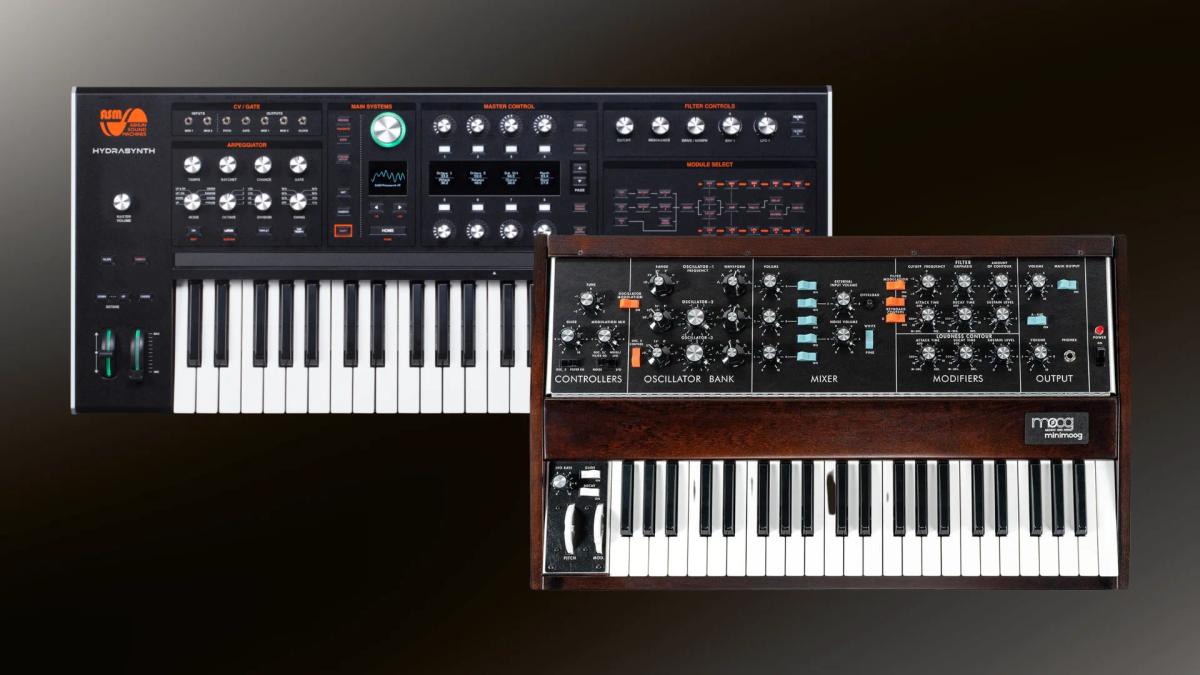
Hydrasynth vs Minimoog Model D: how do they differ? Sound, controls and value compared, based on Peter Kadar Music’s hands-on test.

Bernardo de Azevedo
Bernardo de Azevedo
· Updated
ASM Hydrasynth vs Moog Minimoog Model D comparison

Choosing between the Hydrasynth and the Minimoog Model D? This Hydrasynth vs Minimoog Model D comparison summarizes what Peter Kadar Music found when testing both instruments, so you can see how they differ in sound, controls and value before you buy.

A common complaint about the ASM Hydrasynth is that it is not good at bass. Peter Kadar, who owns a Minimoog Model D reissue, decides to test that on the spot. His video is, by his own description, an impromptu and not-super-scientific comparison made late at night, while he waits for the Hydrasynth Explorer to arrive.

Source video: ASM Hydrasynth vs. Minimoog Model D Reissue – Impromptu Bass Comparison (Peter Kadar Music, YouTube)

Table of Contents

  • The test setup
  • Square, saw and the low end
  • Making the Hydrasynth do more
  • Which one makes more sense?

The test setup

On the Minimoog he builds a very simple bass: a 16-foot square wave, cutoff and resonance down, a filter envelope contoured around 90 percent with minimal attack and a short decay, no sustain, and an amp envelope with maximum sustain. On the Hydrasynth he recreates it with a square wave and the second of its sixteen filters, a 24 dB low-pass ladder without gain compensation, which he feels is closest in concept to the Minimoog.

He sets the envelope amount to maximum, adds a little extra envelope in the mod matrix and adds 2.4 dB of high-frequency gain to match the sizzle he hears from the Moog. Both go through the same mixer settings.

However the Hydrasynth vs Minimoog Model D debate plays out for you, the best test is still playing both instruments side by side.

Square, saw and the low end

On the square wave, the two are really close at the bottom. The Moog gets louder in certain parts of the keyboard, while the Hydrasynth keeps its volume slightly more consistent. Adding a sawtooth an octave up, he needs to turn the Hydrasynth down a little; the bottom end then matches more closely. The Minimoog’s filter and amp seem to attenuate a bit more, and its low end drops off slightly compared with the Hydrasynth.

In the Hydrasynth vs Minimoog Model D comparison, price and playability matter as much as raw sound.

Making the Hydrasynth do more

He emphasises that he is not using many of the Hydrasynth’s facilities. The phase-differential mutator can beef up an oscillator dramatically, and there is no shortage of bass. Fixing differences in attack on repeated notes required setting random phase and softening the envelope. Turning on warm mode makes the sound “just huge”. Overall, the sounds are very close.

Hydrasynth vs Minimoog Model D: which one makes more sense?

His verdict is surprising for a Minimoog owner: if he had to take one of the two to a gig, he would choose the Hydrasynth. He argues that the idea that the Hydrasynth is bad at bass comes from the factory presets, which lean toward digital, PPG-style or DX7-style basses rather than old-school analog. He would use the presets as top-end bass layered over another sound. The practical lesson is that the Hydrasynth can do analog-style bass if you program it that way, while the Minimoog gives the real thing with far less to program.

That is the Hydrasynth vs Minimoog Model D decision in short: match the instrument to the sound and workflow you actually want, and weigh the price difference before you commit.

Related comparisons

Sources

Bernardo de Azevedo
Written by
Bernardo de AzevedoFounder & Editor

His connection with music began at age 6, in the 1980s, when his father introduced him to Jean-Michel Jarre's Rendez-Vous on vinyl. He works professionally in the legal field, while synthesizers became his space for abstraction and creative exploration. Founder of The Synth Source.