

Home›Articles›ORBIT: an OP-1-inspired groovebox firmware built around…
Articles

ORBIT: an OP-1-inspired groovebox firmware built around an Event Tape for the FM-1

ORBIT firmware turns the M-VAVE FM-1 into a four-track groovebox with 17 synth engines and an OP-1-style Event Tape. What it does and how far it is tested.

Bernardo de Azevedo
Bernardo de Azevedo
· Updated
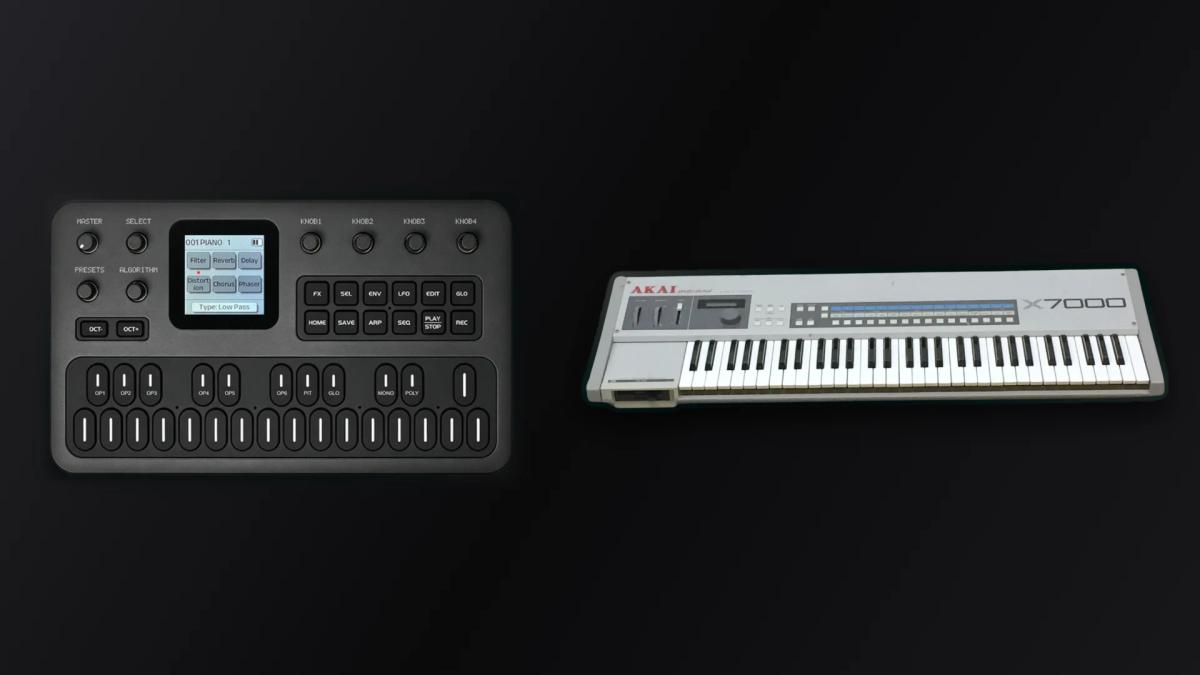
ORBIT firmware: M-VAVE FM-1 pocket synthesizer beside the Akai X7000

ORBIT is a groovebox firmware for the M-VAVE FM-1 published on GitHub by the user dspaudio. It borrows the four-encoder, four-mode logic of the Teenage Engineering OP-1, but applies it to sequencer events instead of recorded audio. The central question is how much of the OP-1 idea survives on a pocket FM synth, and how much of the ORBIT firmware is original work as opposed to inherited from SLOOP and Felucca.

Table of Contents

What the ORBIT firmware is

According to the project README, ORBIT presents the FM-1 as four tracks: three synth parts and one drum machine, navigated through Synth, Drum, Event Tape and Mixer views that are colour-coded to match the four encoders (blue, green, white, orange). It began from a snapshot of the SLOOP firmware at version 2.3 and was not forked with history, so it is an independent repository. SLOOP in turn rests on Felucca, and the README credits Leo Kuroshita and Hügelton Instruments for that foundation.

Since that starting point the author has merged later SLOOP changes selectively and added original engines and graphics. Our article on SLOOP covers the upstream project, so this piece concentrates on what the ORBIT firmware adds.

The project moves quickly. The documentation records hardware installs of version 0.6.0 on 10 October 2026 and of 0.8.2 on 29 October 2026, and by 30 October the README already described 0.9.0 and a separate Bluetooth build. Version numbers in this article should be read as a snapshot.

Seventeen engines and a shared voice budget

The README states that the default build carries 17 synth engines and 189 factory sounds. The first group is inherited: analog with a resonant filter, four-operator FM, phase distortion, a chip-style lo-fi engine, sample playback, formant voices, a three-oscillator part, a tonewheel organ and a granular engine that works on samples. The engine notes treat these nine as the legacy set, with engine IDs 0 to 8.

Around that core sit the additions. FM6 is a six-operator engine based on the msfa code behind Dexed, with DX7 SysEx import and a 27-patch bank. PHYS models strings, resonators and percussion, and NOISE offers filtered noise sources. The engines written for ORBIT are SWARM, PULSE, FM4 and CLOUD, joined by CLUSTER, which has a different origin.

SWARM stacks up to six detuned harmonic oscillators. PULSE is a dual pulse oscillator with pulse-width modulation. FM4 uses four sine operators with three routing choices. CLOUD is a granular engine whose grains come from oscillators rather than samples, which separates it from the sample-based GRAIN engine.

CLUSTER is the most unusual entry. Per the project’s documentation, it is a C translation of the cluster oscillator core of the original OP-1, with sixteen raw presets. The same documents are explicit that the extracted OP-1 tables and factory data retain Teenage Engineering’s original rights, that extraction alone does not establish permission to distribute them, and that the project is not affiliated with Teenage Engineering. That caveat matters for anyone planning to redistribute builds.

The three synth tracks share eight sounding voices globally, not eight each. CLUSTER is capped at four voices per part and CLOUD at three, and the documentation describes these as allocation limits rather than guaranteed polyphony, since CPU load can thin voices out.

Shaping the sound

Sound pages in the ORBIT firmware map to the four colour-coded encoders. The envelope page offers attack, decay, sustain and release, with destination depths for filter, pitch and shape. The LFO has rate, waveform, phase and fade, with tempo sync, free or note-triggered phase, and bipolar or unipolar modes. Fast encoder turns accelerate through wide numeric ranges, while slow turns move one value at a time.

A separate track filter sits in the effects section and applies to every track, drums included. It offers a bypassable low-pass/high-pass or a band-pass mode, with a resonance control. Each track also has an insert slot with eight effect types, and the README counts 27 punch-in performance effects, a stereo delay with mono, wide and ping-pong types, and a background texture bed (vinyl, tape, rain, wind, radio, room tone or a user sample).

Four user macros per synth sound are assigned on a MACROS page and played on a PERFORM page, and they are saved with a user sound or a project. The sequencer allows up to 64 steps per track, four-note steps, ratchets, nudging, fill conditions and 24 parameter locks per track. While recording, moving a supported parameter writes the value into the playing step, which the guide describes as discrete step automation, not continuous motion recording.

The author’s own engine notes are candid about limits. The tone control on the new engines is a simple one-pole filter, FM and pulse-width modulation can alias on high notes with aggressive settings, and the notes make no claim that the sound matches the OP-1.

Event Tape: editing performance, not audio

The feature that defines the ORBIT firmware is Event Tape, reached with the HOME key. Two reels and four lanes represent notes and drum hits, not audio. The guide says plainly that it is not PCM recording, overdubbing or tape-speed playback.

The workflow runs in three moves. One knob sets the destination head, two knobs set the start and end of an inclusive region, and a fourth chooses between COPY and LIFT. A key combination captures the region, and another drops it at the head. LIFT removes the events from the source, while DROP overwrites whatever lies at the destination.

What travels with the clip is the useful part. Chords, ties, hit levels, ratchets, nudges, fill conditions and parameter locks all move together. Synth clips can pass between the three synth tracks, but drum clips can only land on the drum track. A drop is clipped at the end of the destination pattern and is refused if it would exceed the 24-lock limit. The clipboard and selection are temporary, and undo and redo cover drops and synth lifts.

Because a drop overwrites, the README advises saving a section before experimenting. Sections A to D can be stored and recalled on the next bar, chained, and arranged into a song, which turns the Tape into a way of building variations from a recorded loop.

Recording itself follows a loop-first approach. In free mode the player records without a click and presses record on the next downbeat to close the loop and set the tempo, then overdubs further parts. The drum track has a sixteen-lane grid view and a separate live pad view.

How the ORBIT firmware compares with the OP-1 idea

The OP-1 reference is deliberate but selective. Teenage Engineering’s guide describes tape mode as four audio tracks with roughly six minutes of recording time, where lift moves a recorded take into memory and drop places the last stored take back on the tape. ORBIT keeps the vocabulary and the lift and drop gesture but moves it to MIDI-like events. That gives up the OP-1’s central trick of capturing audio and splitting takes, and gains precise editing of notes and locks, plus the ability to move a phrase between instruments.

The synth side shows the same pattern. The OP-1 lists ten engines, including FM, Cluster, Pulse, Phase and String. ORBIT’s SWARM, PULSE and FM4 are independent implementations of the same families, according to the feasibility notes, with a different parameter model. PHYS and the FM-style engines cover territory the OP-1 also covers, while FM6 with DX7 import and the granular CLOUD engine have no counterpart among the ten engines in Teenage Engineering’s list.

The graphics are original, and the README says no OP-1 logo or artwork is included. The interface is a tribute in layout and colour rather than a clone.

Among other FM-1 groovebox firmwares

SLOOP, which ORBIT descends from, describes itself as a live groovebox with three synth tracks plus drums and, in its repository page at the time of writing, lists 12 engines and 153 factory sounds, with version 2.8.1 labelled beta, although ORBIT’s own release notes cite SLOOP 2.8.4 fixes, so the SLOOP figures may already be dated. The larger engine count and Event Tape editing of the ORBIT firmware are the clearest differences. Other FM-1 firmwares, such as Skiff, are listed on the Firmware Hub but are outside the scope of this comparison.

The same author publishes a separate firmware called MC-1, a four-part groovebox with a different identity. Its README describes 128 melodic presets, made up of 112 LA-style sounds and 16 Acid sounds, plus eight synthesized drum kits, with the code under GPL-3.0-only. It is a distinct project and not a variant of ORBIT.

The Firmware Hub, a site that lists open firmwares for the FM-1, includes an ORBIT entry that describes it as a four-track groovebox with OP-1-style screens. The hub’s text gives no version or install status for it.

Installing, testing status and licence

The ORBIT firmware has a browser installer at dspaudio.github.io/orbit, which requires Chrome or Edge, a USB data cable and a direct connection, and checks the release package before enabling the install step. The page itself notes that recovery of an FM-1 that fails to start needs separate tooling and cannot cover every failure. Readers should follow our install and recovery guide and the project’s own backup warnings, because newer ORBIT builds write project and preset formats that older ORBIT versions cannot read.

A browser version runs the actual firmware sound engine and display as WebAssembly and requires no hardware. It cannot show device timing, and sample upload, USB audio and installation are not available there.

On testing, the documentation for the ORBIT firmware is detailed but self-reported. The README says 0.8.2 was installed on an FM-1 and that the device owner confirmed normal operation and the delay types. For 0.9.0 and 0.9.B it says both packages were installed and their versions read back, and that the owner confirmed Bluetooth pairing and synchronization on 0.9.B. The same documents state that measured audio timing, worst-case radio load and some rescue paths remain unverified.

The project’s documents do not fully agree on the status of the 0.9 builds. The validation record heads its 0.9 entry as local candidates, “not published or hardware-qualified releases”, records an installation of 0.9.B only, and says no physical radio pairing measurement has been made. The README, by contrast, speaks of both packages as installed and of pairing as confirmed. The status of the 0.9 builds is therefore unsettled, and the 0.8.2 release is the one the README presents as an official release.

The code is licensed GPL-3.0-only. Assets such as fonts and samples have separate notices in the repository’s licensing files, and the OP-1-derived data is not covered by the GPL, since the project says it keeps Teenage Engineering’s original rights.

Final perspective

The ORBIT firmware is more substantial than a tribute to the OP-1. It combines an unusually deep engine list, careful sound-shaping controls and a distinctive event-based Tape editor on a pocket device, and its documentation is frank about limits.

The weaknesses are equally visible. Voice allocation is limited to eight shared voices, the OP-1 comparison stops at layout and gesture, the OP-1-derived CLUSTER data stays under Teenage Engineering’s rights with distribution permission not established, and hardware validation rests on one owner’s reports. Rapid version changes also mean any specific claim here may already be dated. As a design for turning sequencer events into something closer to a tape workflow, it is one of the more distinctive ideas among FM-1 groovebox firmwares, and its long-term standing will depend on testing across more than one unit.

Sources

  1. dspaudio/orbit: ORBIT README, GitHub
  2. ORBIT user guide, GitHub
  3. Original OP-1 synthesis feasibility and ORBIT engines, GitHub
  4. ORBIT 0.9.0 and 0.9.B release notes, GitHub
  5. ORBIT web emulator, dspaudio
  6. ORBIT installer, dspaudio
  7. dspaudio/MC-1, GitHub
  8. isod89/sloop-fm1, GitHub
  9. The Firmware Hub, thefirmwarehub.com
  10. OP-1 original: tape mode, teenage engineering
  11. OP-1 original: synthesizer mode, teenage engineering
Bernardo de Azevedo
Written by
Bernardo de AzevedoFounder & Editor

His connection with music began at age 6, in the 1980s, when his father introduced him to Jean-Michel Jarre's Rendez-Vous on vinyl. He works professionally in the legal field, while synthesizers became his space for abstraction and creative exploration. Founder of The Synth Source.