Home›Articles›Oberheim OB-Xa: The synthesizer Eddie Van Halen bought …
Articles

Oberheim OB-Xa: The synthesizer Eddie Van Halen bought when his Prophet kept blowing fuses

Oberheim OB-Xa: The most famous synthesizer riff in hard rock was written by a guitarist whose own band told him to keep his hands off keyboards. Eddie Van…

Bernardo de Azevedo
Bernardo de Azevedo
· Updated
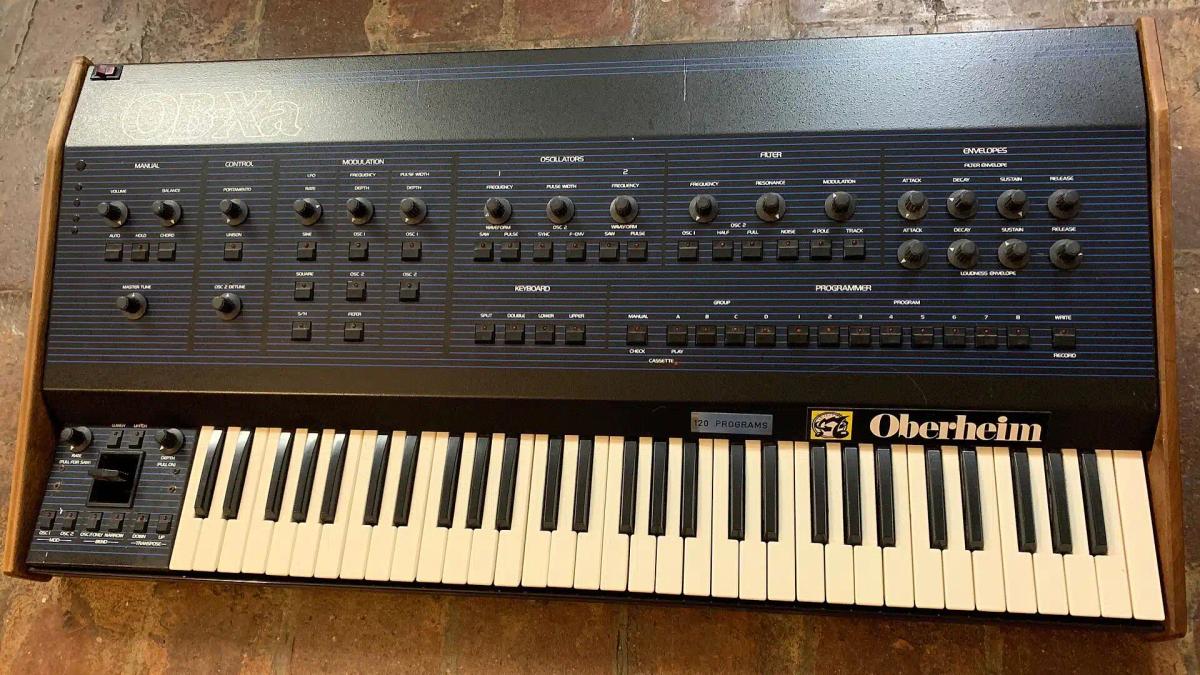
Oberheim OB-Xa - historic photo

The most famous synthesizer riff in hard rock was written by a guitarist whose own band told him to keep his hands off keyboards. Eddie Van Halen wrote the part that became “Jump” years before it was released, argued for it against producer and singer, and finally recorded it on an Oberheim OB-Xa in a studio he had built himself.

The popular version of this story is a clean one: guitar hero discovers synths, scores a number one. The documented version is messier, and more interesting. It involves a smoking Sequential Prophet, a producer who thought the band should stay a guitar band, and a hit that arrived only when the person who wanted it controlled the room.

Table of Contents

  • Oberheim OB-Xa: the polysynth of a short window
  • A pianist who became a guitar hero
  • The riff nobody wanted
  • The synthesizer that smoked
  • 5150 and the rules nobody could enforce
  • One take, then a guitar solo
  • The album that split the band
  • Final perspective

Oberheim OB-Xa: the polysynth of a short window

The OB-Xa was the second synthesizer in Oberheim’s OB series. Wikipedia dates it to 1980 to 1983, with a release in December 1980, and says it replaced the OB-X after only a year on the market. It was an analog polyphonic instrument with four, six or eight voices, and original prices ran from $4,595 for the smallest version to $6,195 for eight voices.

Each voice had two oscillators and a resonant low-pass filter that could be switched between 12 and 24 decibels per octave. The OB-Xa added keyboard splitting and layering to the OB-X design, and it moved much of the circuitry from discrete parts to Curtis integrated circuits, which made servicing easier and manufacturing cheaper. It had 32 or 120 patch memories depending on the model, but no velocity sensitivity or aftertouch and no built-in effects.

Those chips later became a headache, because they grew scarce and complicated repairs. The sound survived anyway. Behringer’s UB-Xa clone began shipping in December 2023, and in May 2022 Oberheim and Sequential announced the OB-X8, which combines elements of the OB-X, OB-SX, OB-Xa and OB-8.

A pianist who became a guitar hero

Eddie Van Halen had a long keyboard history before any of this. According to Ultimate Classic Rock, he and his brother Alex started piano around the age of five with their father Jan, a jazz musician, and lessons continued after the family emigrated from the Netherlands to the United States in 1962. Eddie won piano competitions around Los Angeles before switching to guitar in the mid-1960s.

Inside Van Halen, however, keyboards were treated as a distraction. On “And the Cradle Will Rock…” from Women and Children First in 1980, Eddie played a Wurlitzer electric piano through a Marshall stack, and onstage bassist Michael Anthony played the part because the band did not want their guitarist at a keyboard.

On Diver Down in 1982, a riff Eddie wrote on a Minimoog was used by Ted Templeman and David Lee Roth for a cover of “Dancing in the Streets,” which Eddie did not like. The band’s logic was simple: he was a guitar hero, and that was the product.

The riff nobody wanted

When exactly Eddie wrote the “Jump” part is not settled. Wikipedia’s article on the song says he wrote the synth line around 1981 and the rest of the band rejected it. Ultimate Classic Rock says 1982, adding that Roth and Templeman turned it down while Anthony and Alex were lukewarm. The Wikipedia article on the album says only that he wrote it several years before the recording.

What the sources agree on is the resistance. In a December 2023 piece, MusicRadar presented what it called the earliest known recording of the part: a scratchy home cassette made with a rhythm box, which Eddie introduced as something he had done the night before. The piece puts it about two years before the single was released.

Eddie said he first demoed the idea with a Linn drum machine and that the band told him not to spread himself too thin. Roth, he said, reportedly told him he should not play keyboards, and he answered that he would play whatever he liked, even a tuba.

Producer Ted Templeman eventually asked Roth to listen to the idea in 1983. According to Wikipedia, Roth played it repeatedly in the back of his 1951 Mercury while roadie Larry Hostler drove, and wrote the lyrics that afternoon in the backseat. Eddie later said Roth had rejected the riff for at least two years before agreeing to write words for it.

The synthesizer that smoked

The part of the story that survives only in MusicRadar’s account is the best detail. Eddie wrote “Jump” on a Sequential Circuits Prophet-10 in his bedroom while his studio was being built. The sound he wanted for the right-hand section of the split keyboard repeatedly made the Prophet smoke and blow a fuse, and so did a replacement unit. Someone suggested an Oberheim OB-Xa. Eddie bought one and got the sound he was looking for.

The article gives no patch settings, and neither do any of the other sources used here. That is worth saying plainly, because the internet is full of patch recipes for “Jump” and none of them can be tied to a primary account. What the sources do say is that the work was done by ear. Templeman remembered that the synthesizers in the 5150 sessions had no presets, and that Eddie would simply twist the controls until it sounded right.

5150 and the rules nobody could enforce

The OB-Xa arrived just as Eddie gained the means to ignore objections. According to Wikipedia, 1984 was recorded from June to October 1983 at 5150 Studios in Studio City, California, which Eddie built with longtime engineer Donn Landee. The sessions lasted about three months, where earlier albums were typically finished in under two weeks.

The context matters here. Eddie had been unhappy with earlier concessions to Roth and Templeman, who had discouraged him from making keyboards prominent. In his own studio, he composed without that perceived interference. He used the OB-Xa for most of the album, and for “I’ll Wait” he turned to a newer Oberheim OB-8 while his OB-Xa was in repair. Eddie told Guitar World that he and Landee almost took control of the record, because they knew what they wanted.

One take, then a guitar solo

The recording of the song itself was brisk. In Guitar World, Eddie said the band tracked “Jump” live in the studio with him playing the keyboards on the Oberheim OB-Xa, adding the guitar afterward. He believed they captured only one take. The tape nearly ran out at the end, so Landee had to execute the fade precisely during the mix.

Templeman’s account, as Wikipedia relays it, is that Landee and Eddie put the track down alone in the middle of the night, and that it was recut once in one take for sonic reasons. The vocals were finished the following afternoon and the song was mixed that evening. Eddie also admitted that the guitar solo was punched in and that two separate sections can be heard in it. He no longer remembered what he had originally played.

One footnote from Wikipedia shows how loosely the hook was assembled in public memory. Daryl Hall has said that Eddie told him he copied the synthesizer part from Hall and Oates’ “Kiss on My List,” and that Hall had no problem with it. That is a single secondhand remark, so it is best taken as an anecdote, not a finding.

The album that split the band

“Jump” was released in December 1983, and it became Van Halen’s only number one on the Billboard Hot 100. The album 1984 followed on January 9, 1984, and spent five weeks at number two on the Billboard 200, held off the top by Michael Jackson’s Thriller. The RIAA certified it Diamond in 1999 for ten million copies shipped in the United States.

Templeman later credited the synthesizer with winning the band a broader audience. The record was a compromise between the band’s factions: keyboard-heavy songs next to hard rock. Critics noticed the shift. Julian Cope wrote of a change from Guitar Eddie to Synth Eddie. Roth left in 1985 over creative differences, and 1984 was his last studio album with the band until 2012.

Final perspective

The Oberheim OB-Xa did not invent the synth hook, and the riff it carried did not need an Oberheim to be good. What the story shows is how often a musical identity is policed from the inside. Eddie Van Halen was told, by people who were not wrong about the audience, that his job was to play guitar. The hit came from ignoring that advice, and from being in a position to do so.

It also shows how practical the decisive moment can be. A Prophet that smoked, a friend with a suggestion, a studio with no one to veto the plan. The Oberheim OB-Xa was a competent, ordinary polysynth for its day. It entered rock history because it could do one specific thing, on one specific night, in a room that belonged to the player.

That is why the Oberheim OB-Xa story keeps drawing musicians and historians back to it.

Few chapters of synthesizer history show as clearly as Oberheim OB-Xa how far a single idea can travel.

Looking back, the Oberheim OB-Xa episode suggests that the most unusual stories are often the most instructive ones.

For anyone tracing the history of electronic instruments, Oberheim OB-Xa is a name worth remembering.

Related stories

Sources

Bernardo de Azevedo
Written by
Bernardo de AzevedoFounder & Editor

His connection with music began at age 6, in the 1980s, when his father introduced him to Jean-Michel Jarre's Rendez-Vous on vinyl. He works professionally in the legal field, while synthesizers became his space for abstraction and creative exploration. Founder of The Synth Source.