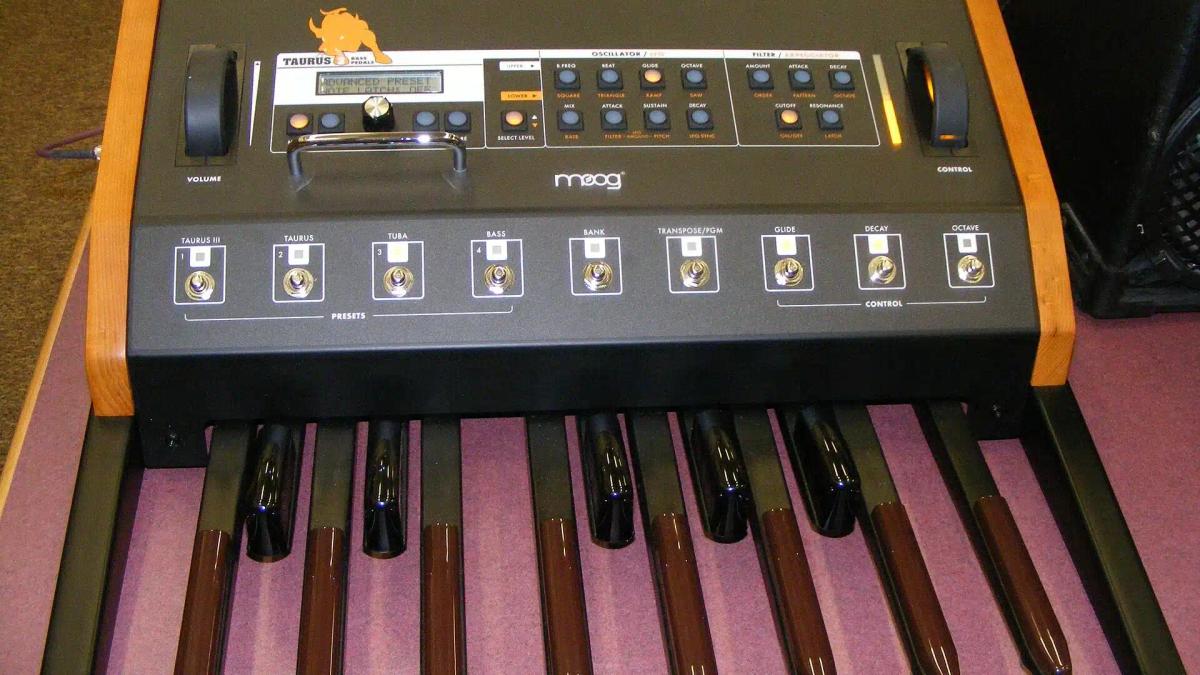
A 1978 Beat Instrumental profile reports that Lee ran the pedals alongside his Rickenbacker basses, which let him play bass lines and high synthesizer lines at the same time. He told the magazine it was like having another person in the band. The article describes four preset bass sounds and one variable high-end sound, and it makes clear the aim: Rush was a three-piece, and the band wanted to pull it off themselves rather than add a fourth member.
The role grew. Lee later said the pedals were used to slip melodic parts into the arrangements, and that the work became so experimental that the band was basically trying to invent MIDI before it existed. Guitar Player adds that Lee also used the Taurus for synth lines, citing “Xanadu,” and that it fell out of favor in the band’s studio experiments after 1982’s Signals.
Online forums argue at length about which songs used which sounds, and since none of those threads cite a primary source, this article leaves those arguments alone.
The Mark II and the price of forgetting what worked
Moog replaced the original in 1981 with the Taurus II, which Wikipedia says used the same synthesis engine as the Moog Rogue. It had eighteen pedals, pitch and modulation wheels and a control voltage interface, but no patch memory. Making Music, in 1987, notes that the control section moved to a separate module connected by a long cable, and that it could talk to MIDI through a connection box.
Many players disliked it. Hollow Sun calls it essentially a budget Moog Rogue, and says the Mark II lost the depth and character of the original. Wikipedia cites Mark Vail’s 2000 assessment that it was worth about half as much as the Taurus I and is generally considered inferior. The ecosystem moved on as well, as FM synthesis and MIDI took attention away from analog pedal synths.
The market for the original did not collapse. In 1987, the Making Music writer reported secondhand Taurus pedals in demand with asking prices starting at £3,500. Cheaper MIDI pedalboards from Korg and Viscount cost around £300, though the Korg had no sound of its own and only triggered other instruments.
Rented back from the past
The most revealing episode comes from the end of Rush’s career. According to Guitar Player, producer Nick Raskulinecz wanted the band’s 1970s sound on Clockwork Angels, released in 2012, and suggested bringing back the Taurus pedals. The band no longer owned any, so it rented a set from a Toronto company.
When they arrived at the studio, Lee recognized them as his own old pedals because of a mute switch he had added to his unit. The band then rented the other pedals used on the old albums and tours, and later moved from the original T-1 to the newer T-3 model.
That T-3 was Moog’s own return to the idea. The Taurus III ran from 2010 to 2012 as a limited edition of 1,000 units, closely emulating the circuitry of the Taurus I, with 13 pedals, 52 patches, MIDI and USB, according to Wikipedia. Work began in 2007 after 250 units had been pre-ordered, and Moog announced the end of production on June 14, 2012.
Final perspective
The Moog Taurus is a case of an instrument finding its purpose after its plan failed. The system it was designed for never shipped, its successor was widely disliked, and its price made at least one reviewer grumble. Yet the core idea, a single clean voice of weight and sustain under a player’s feet, answered a real problem for bands that wanted more sound than they had hands.
What the Taurus shows is how much of an instrument’s legacy comes from the relationship it creates, not its feature list. Rutherford and Lee each used the Moog Taurus to change who in the band could play what. Decades later, a producer asked for the sound of those records, and the answer was to track down the pedals themselves.
That is why the Moog Taurus story keeps drawing musicians and historians back to it.
Few chapters of synthesizer history show as clearly as Moog Taurus how far a single idea can travel.
Looking back, the Moog Taurus episode suggests that the most unusual stories are often the most instructive ones.
Related stories
Sources